

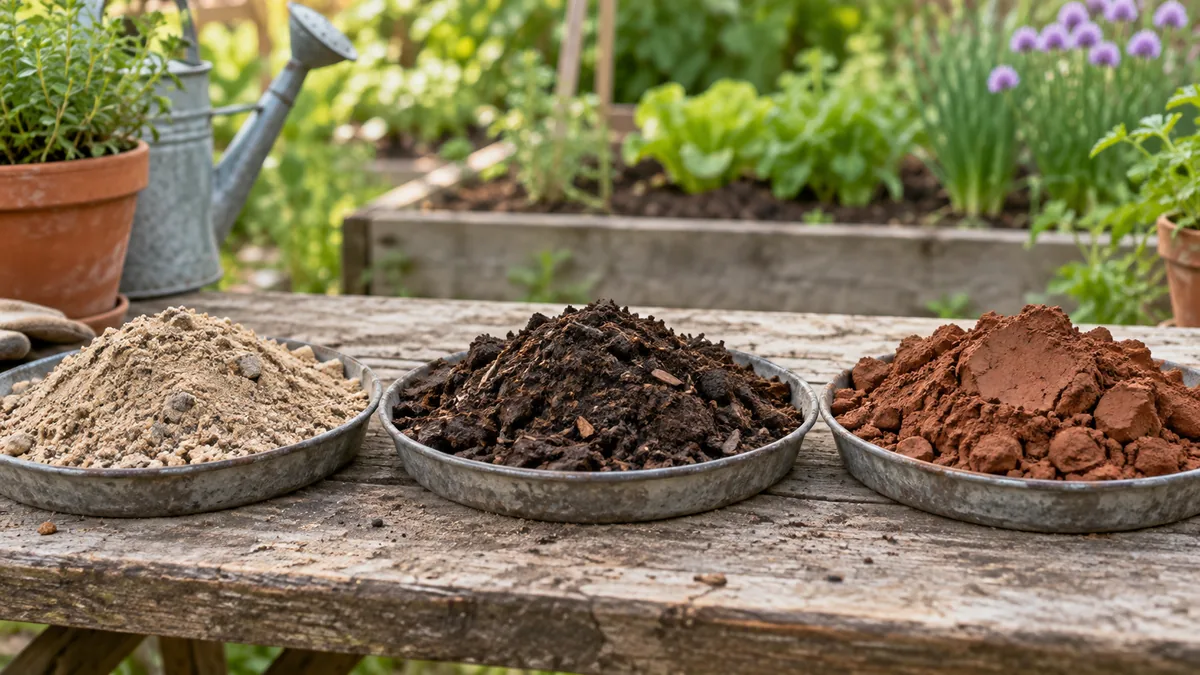
Start with soil texture and site condition
Soil texture describes the relative proportions of sand, silt and clay; organic matter, structure, compaction, drainage and pH are separate properties. A label such as “loam” does not guarantee fertility or good drainage at every site.
Observe how the soil behaves when wet and dry, and use a laboratory test for pH and nutrients before applying amendments. The soil’s structure and the crop’s needs matter as much as its texture.
Sand, silt and clay describe particle-size groups. Their relative proportions place a mineral soil into a textural class, such as sandy loam or clay loam. Many popular garden lists also include “chalky” or “peaty” soil; those words describe carbonate or organic-matter characteristics rather than the same texture categories. A garden can be clayey and calcareous, sandy with little organic matter, or a loam with poor structure.
| Common description | What the term mainly describes | What still needs checking |
|---|---|---|
| Sand or sandy soil | Coarse mineral particles and often rapid drainage. | Water retention, organic matter, compaction layers and nutrient recommendations. |
| Silt or silty soil | Medium-sized mineral particles that can feel smooth. | Surface crusting, erosion, structure, drainage and pH. |
| Clay or clay loam | More fine particles; often slower drainage and greater water retention. | Compaction, structure, workability, water movement and crop suitability. |
| Loam | A balanced mixture of sand, silt and clay in a recognized texture class. | Structure, organic matter, pH, nutrients and site drainage. |
| Calcareous or chalky | Carbonate material and often alkaline soil chemistry. | Measured pH, salts and crop-specific nutrient availability. |
| Organic-rich or peat-like | High organic matter or accumulated organic material. | Drainage, decomposition, nutrient behavior and whether the site is a protected wetland or organic soil. |
These descriptions help organize observations; they do not tell you which amendment to buy. The USDA soil texture triangle uses sand, silt and clay proportions to assign a mineral-soil class, while pH and nutrient testing answer different questions.
Clay texture: protect structure and drainage
Clay particles are small and can hold water and nutrients, but actual drainage depends on aggregation, compaction, slope and organic matter. Avoid walking or working the soil when it is wet. Choose plants or raised beds appropriate to the site rather than adding sand by guesswork.
Wet clay can be sticky and form a ribbon when squeezed, but the texture test is only an estimate. A compacted clay soil can shed water across the surface even though its particles hold moisture; roots may then sit in an oxygen-poor zone. Look at the site after rainfall and inspect below the top layer before deciding that all clay is the problem.
Do not try to turn clay into sandy soil by adding a small quantity of sand. Soil texture changes require very large amounts of mineral material and are difficult to mix through a root zone; poorly proportioned sand and clay can create a dense mass. Organic matter and protection from repeated compaction can improve structure over time, but drainage problems caused by grading or a dense subsurface layer may require a different solution. USU Extension’s clay-soil guide discusses site management and why adding sand is not a simple fix.
Sandy texture: monitor moisture and nutrients
Coarse sandy soils often drain quickly, but performance varies with organic matter and site structure. Add mature organic material only when it suits the crop and local guidance; a fixed amendment rate may not be appropriate. Mulch can protect the surface, while watering frequency should be based on root-zone checks.
Fast drainage can make nutrients and water move beyond shallow roots sooner, especially during hot or windy weather. Check moisture at more than one depth and consider shorter, measured irrigation events if runoff or deep percolation occurs. This is not a rule to water every day: plant roots, slope, soil layers and local restrictions all affect the interval.
For sandy beds, maintain surface cover where it fits the crop and add organic material based on local soil-test guidance. Compost and manure have their own nutrient content, and repeated use can build phosphorus or salts. Choose plants suited to the site if a large-scale soil change is impractical. A raised bed or a different planting location may be more realistic than trying to replace the soil across an entire yard.
Silty soil: protect a smooth, erosion-prone surface
Silty soil often feels smooth or floury when dry and slippery when wet, but a hand-feel test cannot identify the exact texture class. Silt particles can erode or crust after heavy rain or overhead irrigation, especially when the surface is bare. Preserve soil cover, avoid working wet beds and use gentle irrigation that does not wash soil from seed rows.
If seedlings struggle to emerge, inspect for a surface crust and compaction rather than adding fertilizer. Organic matter can support aggregation over time, but choose the amount and source according to the crop and local guidance. On slopes, use beds or planting rows that limit runoff, and retain ground cover where practical. If a site has both silt and clay, drainage can differ by depth; a simple label will not explain the full soil profile.
Loam is a texture description, not a guarantee
Loam contains a mix of particle sizes, but a soil can still be compacted, poorly drained, too acidic or nutrient-deficient. Use a soil test and site observation before deciding what to plant or amend.
“Loam” is often used as shorthand for workable garden soil, but the term refers to a particle mixture, not a guarantee of fertility. Loams can vary in organic matter, pH, structure and depth to a restrictive layer. A loam over compacted construction fill may drain poorly; a loam on a slope may dry faster than a level bed. Observe how the root zone behaves and match crops to actual conditions.
Calcareous and alkaline soils
White carbonate material or alkaline pH can influence nutrient availability, but visual appearance alone cannot establish pH or a deficiency. Test first, then choose plants suited to the site or apply a lab-recommended amendment. Avoid repeated acidifying treatments without measurements.
Calcareous soil can be naturally rich in calcium carbonate. Some plants tolerate higher pH better than others, while iron and other nutrients may become less available to sensitive species. Adding sulfur, acidifying fertilizer or chelated iron without identifying the issue can waste money or injure plants. Use the lab result and an Extension source for the crop, and consider selecting a plant that tolerates the existing soil when correction is impractical.
Organic-rich soils and drainage
Soils with high organic matter can hold water and may have unique nutrient or pH conditions. Do not assume “peaty” describes every dark, moist soil. Use a laboratory test and local guidance before changing drainage or fertility.
Organic matter is not a particle-size class. A dark color can reflect organic material, mineral parent material or both, and does not prove that a soil is fertile. Organic-rich soil may remain wet, settle as it decomposes or contain different nutrient levels from mineral garden soil. If the site is a natural wetland or peatland, do not drain or excavate it without checking environmental rules and local guidance.
Separate soil texture from structure and drainage
Texture changes little over ordinary gardening time, but structure can improve or deteriorate as aggregates form, organic matter changes and soil is compacted. Structure describes how particles bind into clumps and pores. Those pores hold air and water and give roots space. Treading, tilling or driving over wet soil can collapse pores, while roots, fungal growth and organic inputs can help build aggregation under suitable conditions.
Drainage is also influenced by slope, buried layers, hardpan, construction fill, raised beds and the water table. If one area remains saturated while a nearby bed drains, compare the soil profile and irrigation rather than assuming the texture is identical. Dig a narrow observation hole only where it is safe, and avoid damaging utilities or tree roots. If water stands persistently or flows toward a foundation, seek local drainage advice before installing a drain.
Plant selection can be more effective than trying to make every area resemble loam. Match the root depth, moisture preference and pH needs of a plant to the conditions you can maintain. Use raised beds only where the site, materials and watering plan support them; a raised bed does not fix a contaminated or chronically waterlogged location automatically.
Use a field check as a clue, not a laboratory result
To get a rough feel for texture, take a small sample from the root zone away from mulch, moisten it gradually and rub it between your fingers. Grit suggests more sand; smoothness may suggest silt; stickiness and the ability to form a ribbon can suggest clay. Compare a few spots because soil can change across a yard. Do not perform the test when the sample is saturated, frozen or mixed with compost.
A jar-settling test can offer a rough visual comparison of settling particles, but it depends on how the sample is prepared and does not supply the laboratory’s textural class or a fertilizer recommendation. It does not measure pH, salinity, contaminants, nutrient availability, drainage or structure. Use it as an educational clue only. For planting or amendment decisions, follow a regional soil-testing laboratory’s sample instructions.
UMN Extension’s soil testing guide explains what a test can and cannot tell a home gardener. The reported texture is a baseline; repeat testing is more useful when a management change or specific problem warrants it than as an annual texture check.
Use a laboratory soil test for actionable results
- Choose the right test for the site and intended crop.
- Collect a representative sample using the lab’s depth and sampling instructions.
- Keep lawn, vegetable bed and landscape samples separate when their conditions differ.
- Use the lab report’s crop-specific recommendations rather than a generic home jar test.
- Retest when the crop, management or soil conditions justify it.
UMN Extension’s soil-testing guide explains sample collection and interpretation.
Improve soil only after identifying the constraint
Start with the issue you can verify: compaction, poor drainage, low organic matter, pH or a tested nutrient need. Avoid adding coarse sand to clay or applying a fixed volume of compost as a cure-all. Protect soil structure, avoid tilling when wet and choose plants suited to the site.
Utah State Extension’s soil preparation guide covers soil testing and site preparation.
Use the smallest intervention that addresses the constraint. For compaction, reduce foot traffic when wet and protect the surface with suitable cover. For low organic matter, add mature plant-based material only when local guidance recommends it and monitor nutrient tests over time. For high pH, choose plants that tolerate it or follow a measured, crop-specific amendment plan. For poor drainage, determine whether the cause is texture, compaction, grade, a restrictive layer or irrigation before changing the bed.
Raised beds can help create a more controllable root zone when the ground is unsuitable, but they dry faster and need a safe, appropriate fill. Keep bed mixes consistent and avoid using potting mix as a bulk outdoor soil replacement unless the product is designed for that purpose. For containers, use a container-specific medium; the potting mix guide explains why growing media behave differently from garden soil.
After making a change, record its material, amount, area and date. Recheck plant performance and soil-test results at an interval recommended by the lab. Avoid stacking several amendments at once: if growth improves or worsens, you will not know which change caused it. The aim is not a perfect soil label; it is a stable root environment suited to the plants you want to grow.
Frequently Asked Questions
Separate texture from chemistry. A squeeze or jar test can give a rough feel for sand, silt and clay, but it does not reveal nutrient levels or establish pH. For fertilizer or lime decisions, send a representative sample to a lab and follow the lab’s crop-specific interpretation; test methods and recommendations vary by region. See UMN’s home-garden soil testing guide and USU’s soil preparation guidance.