

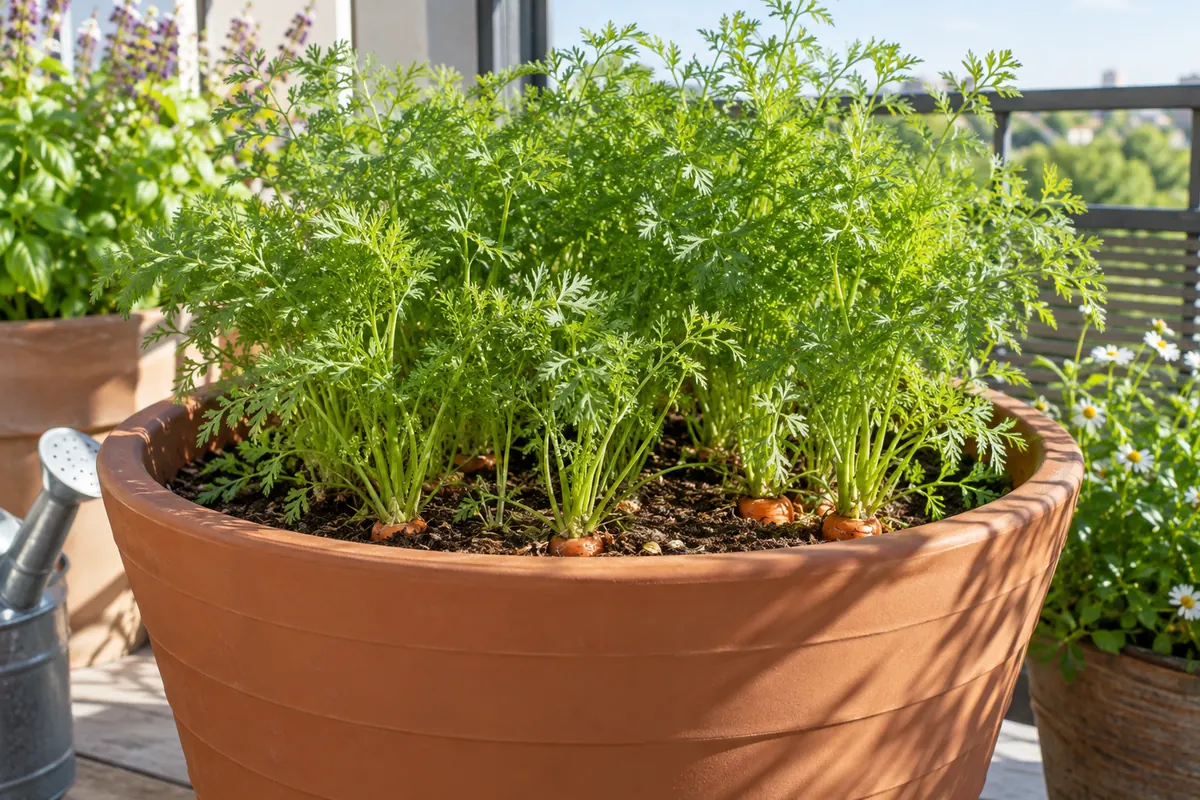
Carrots in pots need enough usable root depth, a well-drained medium and timely thinning. Choose a cultivar whose mature root length fits the container. Compare the packet’s maturity and spacing guidance with the usable medium depth.
Illinois Extension lists examples of container-friendly carrots and a two-gallon container as a starting point. Treat its table as guidance, then account for the exact variety, drainage and local growing conditions.
Choose carrot cultivars by root length
Root shape sets the container plan. Round or short-rooted carrots can be more forgiving where depth is limited, while longer types need a deeper, unobstructed column of medium. “Baby carrot” may describe an immature harvest size rather than a genetically short root, so verify the named cultivar. Check whether the variety is recommended for heavier or shallow soils, and use an Extension or supplier description that identifies the cultivar. Utah State University Extension’s carrot guide covers root development; its cultivar and timing details are regional examples.
Choose a crop you can harvest before roots become cramped. If you want small roots for fresh eating, sowing and thinning schedule may matter as much as cultivar. For storage, use local recommendations about variety and harvest maturity. The packet’s mature root length and spacing are more useful than a short “baby” label on the front.
Short-rooted or half-long cultivars are more practical than long types when container depth is limited. Illinois Extension lists Little Finger, Danvers Half Long and Nantes Half Long as examples suitable for containers. These are examples, not a guarantee that each seed lot will perform identically.
Read the seed packet for expected root length, days to maturity, sowing depth and spacing. If the packet does not state container guidance, compare the mature root length with the usable medium depth and provide a margin below the root for drainage.
Match usable depth and volume to the cultivar
A practical way to compare pots is to fill the proposed container with the medium you plan to use and measure the actual column above the drainage area. Root depth should be continuous: a deep but narrow cavity can make thinning and watering difficult, while a wide but shallow tray restricts long cultivars. Match the container to the named variety rather than buying a generic “vegetable planter.” If you want several harvests, it may be easier to use separate containers for short and long-rooted cultivars so their depth and spacing do not conflict.
Measure internal usable depth, subtracting a built-in reservoir, false bottom or unfilled rim. Leave a little headspace for watering. Match the depth to the root length stated by the seed supplier and keep a continuous loose root zone above the drainage holes. A wide planter can hold more plants but does not compensate for inadequate depth. If the container is elevated, consider the weight of wet medium and water and check the surface’s permitted load before filling.
Before sowing, fill and water the container to see how the medium settles and drains. Blocked holes, standing water or a hard compacted layer can cause poor root development. Gravel at the base does not replace open drainage; use suitable medium through the root zone and confirm that excess water can leave safely.
The container must have drainage and enough medium for the chosen root type. Illinois Extension lists a 12-inch diameter minimum and a two-gallon container reference for carrots; diameter alone does not confirm usable depth. Check the variety’s mature root length and choose a container deeper than that root.
Use the largest practical container for steadier moisture, and place it where it can receive the light and water required by the crop. Do not use a shallow decorative pot because it has a wide opening.
Compare the seed packet with a regional guide
Compare named cultivars using root length and shape, packet spacing, sowing depth, harvest estimate, color and local sowing window. Flavor descriptions are subjective; prioritize fit, availability and regional performance. “Days to maturity” is an estimate that may start at sowing, so do not compare figures unless suppliers use the same starting point. Keep the packet and record actual emergence and harvest dates.
If roots fork or split, note whether the medium contained stones, dried hard or was disturbed, and whether the plants were crowded. One container rarely proves a cultivar is unsuitable. The USU vegetable irrigation guide explains why even moisture matters across crops, but it does not prescribe one schedule for every pot.
A cultivar comparison should use exact seed-packet information rather than universalized days or flavor ratings. Illinois Extension lists Little Finger, Danvers Half Long and Nantes Half Long as examples for container carrots; seed sellers may use different selections or names. Compare:
- stated root length and shape;
- recommended sowing depth and spacing;
- days-to-maturity estimate and what the estimate measures;
- regional sowing window and heat tolerance;
- container depth and volume available to the roots.
Use the packet for the selected seed lot and the Illinois Extension container guide for a regional starting reference.
Sow directly and follow the packet
After a heavy rain or an accidental dry-out, check the medium gently rather than digging down beside every seedling. A crust on the surface can make emergence difficult; loosen only the surface carefully and avoid disturbing developing roots. If the container is exposed to birds or cats, a breathable temporary mesh can protect the seedbed, but remove it or raise it as foliage emerges and make sure it does not overheat the pot.
Use fresh seed and sow directly: moving a young carrot can damage the developing taproot. Sow when the medium and local season suit the crop, not simply because a calendar date has arrived. If tiny seed is hard to distribute, sow shallowly and thin later; do not bury it deeply to compensate for a surface that dries too quickly. A temporary cover can slow drying, but remove it when shoots emerge and do not trap excessive moisture.
Label cultivar and sowing date. Water gently so seed stays in place and check the seed zone until emergence. Germination timing varies with seed lot and temperature, so use the packet’s range before deciding sowing failed. Do not transplant surplus seedlings after roots have formed. Thin at the base of unwanted plants to avoid pulling through neighboring roots and follow packet spacing.
- Choose a container with unobstructed drainage and enough depth for the named cultivar.
- Fill with a container medium intended for vegetables; remove large clods or debris without adding a fixed sand or perlite percentage.
- Sow at the depth and spacing shown on the packet. Carrots are normally direct-sown because their roots do not transplant well.
- Keep the seed zone evenly moist while seedlings emerge. Use a gentle stream or cover the surface lightly if weather dries it rapidly.
- Thin seedlings to the packet’s spacing so roots have room to develop. Cut extras at the medium surface if pulling would disturb neighboring seedlings.
- Water as needed by checking moisture in the root zone and allow excess to drain.
Use a loose, well-drained container medium
Container media vary in how they hold water and air. Select a fresh product intended for vegetable containers, inspect it for debris or compacted clumps, and avoid replacing it with heavy garden soil. Moisten dry mix gradually and evenly before sowing. Some products initially resist water; adding it little by little and mixing can prevent a dry core surrounded by wet material. The surface should hold moisture without becoming muddy or crusted.
If water pools on the surface or runs through a channel without wetting the root zone, re-wet and settle the medium before sowing. Do not add a fixed percentage of sand, compost or perlite unless the medium maker or local guide recommends it. Amendments can change drainage and nutrient levels. Gravel at the bottom is not a drainage solution.
Choose a medium labeled for vegetable containers that holds moisture but drains freely. Avoid dense garden soil in a pot and remove large stones or woody pieces. Do not assume a fixed percentage of sand, perlite or compost is needed; use the medium maker’s guidance and avoid overfertilizing a root crop.
If a mix settles heavily or remains waterlogged, investigate drainage and composition before adding amendments.
Monitor moisture and thin to the named variety
Thinning is a crop-quality step. Crowded roots compete for space and may become small or irregular. Thin in stages if seedlings are too close to handle safely at once; snipping extras at soil level reduces disturbance. Use clean scissors and keep cut foliage away from wet seedlings. Packet spacing is a better guide than the appearance of young leaves because roots need room before they become visible.
Check moisture below the surface. A light pot in wind may dry faster than a sheltered deep container. Water enough to moisten the profile, then let excess drain; repeated sprinkles can wet only the top. Empty a saucer after drainage. Feed only when the medium and crop guidance call for it. Excess nitrogen cannot fix insufficient depth, poor light or crowded seedlings.
Thin according to the seed packet so roots have room. Keep moisture reasonably even during root development; severe drying followed by heavy watering can affect root quality. Containers in sun or wind need more frequent checks than sheltered pots, but no fixed daily schedule suits every site.
Use a small amount of fertilizer only if the product label and crop guidance support it. Excess nutrients are not a substitute for appropriate light, root space or drainage.
Troubleshoot by checking the root zone
Do not assume foliage size predicts the root size beneath it. Gently loosen medium at the container edge to inspect one root if the crop seems ready, then use that sample to decide whether the rest needs more time. Pulling every carrot early can reduce the harvest, while leaving roots past the packet’s suggested stage may change texture. Harvest carefully from moist but not saturated medium to reduce breakage. Clean and store the roots according to food-safety guidance; remove damaged roots rather than storing them with sound produce.
Cracking can follow uneven moisture, rapid growth or cultivar traits; record dry and wet periods before changing the mix. Forking may be associated with stones, compaction, root injury, pests or other conditions, and the exact cause is not always identifiable. Green shoulders are exposed roots receiving light; gently cover them with medium if local guidance advises it, without burying foliage.
Thin roots can reflect crowding, early harvest, insufficient root zone or low light. If seedlings disappear, inspect for slugs, birds or disturbance rather than assuming germination failed. For persistent pest or disease signs, ask Extension for identification. A useful diagnosis includes cultivar, sowing date, container depth, medium, watering observations and photos of roots and foliage.
Uneven emergence: check seed age, sowing depth and whether the surface dried before seedlings emerged. Forked roots: possible contributors include stones, clods, compaction, root injury or the cultivar; do not assume one cause. Small roots: check seedling spacing, available depth, light and crop timing. Green shoulders: follow seed or Extension guidance on covering exposed shoulders if this occurs. Ask local Extension for help when pest or disease damage is suspected.