

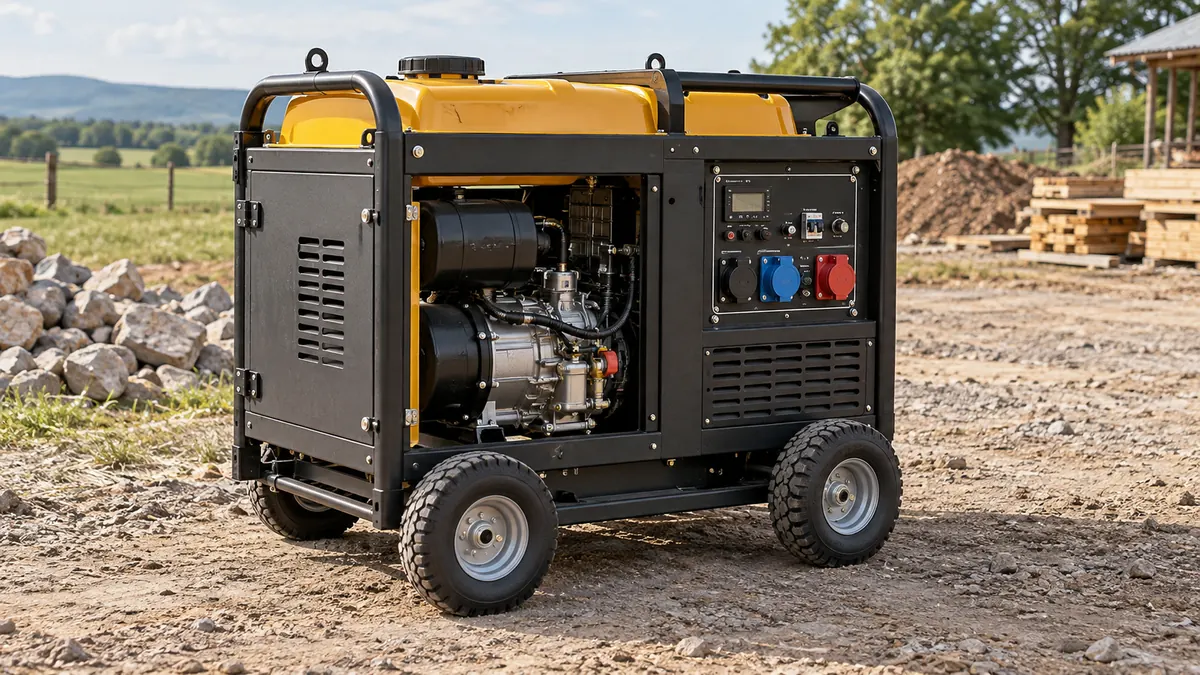
When to consider a diesel generator
Do not assume that diesel is always more economical or lasts longer. The right choice depends on the engine and generator set, its operating hours, load pattern, purchase and installation cost, maintenance, fuel storage, noise and local emissions rules. A small backup set used for a few short outages has different needs from a unit specified for regular commercial service. There is no universal annual-hour threshold that proves diesel is the best option.
Write down the intended duty first: occasional emergency backup, temporary site power, continuous operation, or a defined standby installation. Identify the critical loads, how long they must run, and whether professional service and parts are available nearby. For a fixed or frequently used installation, ask the manufacturer, installer or a power-system engineer to confirm the engine duty rating, cooling, exhaust, fuel arrangement and maintenance plan.
In this guide, “diesel generator” means a set whose nameplate and model manual specify a compression-ignition diesel engine. The word “generator” in a seller's title does not confirm fuel type. Verify the complete model code, engine model, manual and fuel instructions before comparing a listing.
For a documented example, the Pramac PMD 5050S guide separates the manufacturer’s three-phase rating from its lower single-phase output and explains what to confirm on the exact unit. It is a technical reference, not a verified current retail offer.
Rated, prime and standby power
Generator specifications may describe different power ratings for different duty patterns. Standby, prime and continuous ratings are not interchangeable marketing labels; their definitions and permitted operating conditions depend on the applicable standard and the manufacturer's declaration. Compare the rating that matches the hours, load profile and conditions in which the set will actually operate. Do not compare one product's short-term maximum with another product's continuous rating.
Look for a complete technical sheet that states voltage, frequency, phase, power factor, ambient conditions and whether the number is kW or kVA. Check the power available per phase and per receptacle, not only the largest number in the headline. If the rating is not clear in the manual, ask the manufacturer or distributor for the official datasheet before sizing a system.
Size the load and plan the installation
Start with the devices that must operate at the same time. Record their voltage, phase, running input and motor-start demand from the equipment plate or manual. Pumps, compressors, refrigeration and workshop motors can draw a brief surge when they start. Use manufacturer data rather than applying one fixed multiplier to every motor. Separate loads that can be scheduled or switched off from critical equipment that needs uninterrupted power.
- List the essential circuits and calculate their simultaneous operating demand.
- Identify the largest starting load and determine whether it can start alongside the other loads.
- Match the calculated load to the correct prime, continuous or standby rating and the generator's voltage and phase.
- Check the limits of each outlet, breaker, cable and distribution panel separately.
- Ask a qualified electrician to design the connection and transfer equipment for a building or fixed installation.
A simple sum of appliance watts may not be enough for loads with a poor power factor, non-linear electronics or large inrush current. For critical systems, review the generator's voltage and frequency regulation, transient response and compatibility requirements with the equipment manufacturer. Cummins' application manual discusses generator sizing and load characteristics, but the correct calculation still depends on the specific installation.
Check phase, voltage and frequency
Confirm whether the generator is single-phase or three-phase and compare the required voltage phase-to-neutral and phase-to-phase. A three-phase rating cannot automatically supply a single-phase load at the same total capacity, and a single-phase machine cannot serve a three-phase appliance. Check the connection diagram, neutral arrangement, earthing, outlet types and protection specified by the manufacturer.
Voltage and frequency must match both the generator and each load. Do not use plug adapters or improvised wiring to make an incompatible system appear to fit. A building connection, grid connection or transfer arrangement requires correctly rated equipment and a qualified professional who can confirm local electrical rules. If the generator is imported, verify written approval, certification, service and spare-parts support in the country where it will operate.
Compare fuel use, service and total cost
Fuel consumption should be compared at the same percentage load and under stated test conditions. A litres-per-hour figure at full load does not predict consumption while powering a small fraction of the generator's capacity. Estimate the expected load curve and operating hours, then compare the manufacturer's fuel table at representative points. Include tank capacity, refill interval, safe storage and fuel availability in the plan.
Build a total-cost view that includes delivery, foundations or enclosure, cabling, transfer equipment, commissioning, scheduled servicing, filters, oil, coolant or starting batteries, and eventual repair. Compare warranty terms and the availability of authorized service technicians. Maintenance schedules differ by model and may depend on engine hours, calendar time, dust, temperature and load. Record operating hours and follow the manual rather than using a generic diesel service interval.
Prepare a comparable diesel generator specification
When requesting a quotation, send suppliers the same load and duty brief. A headline wattage is not enough to compare two diesel generator sets if one rating is for standby service and the other is intended for a different operating profile. Use the manufacturer datasheet and ask the supplier to identify the document revision that supports each answer.
| Ask for | Record in the comparison | Check against |
|---|---|---|
| Duty rating | Standby, prime or continuous rating and operating conditions | Hours, load profile and application stated in the brief |
| Electrical output | kW/kVA, power factor, voltage, frequency, phase and per-phase limits | Appliance nameplates and site supply |
| Fuel data | Tank arrangement and consumption at named load points | Expected operating hours and refill plan |
| Installation | Starting system, transfer equipment, exhaust, intake and sound data | Site layout and applicable local requirements |
| Ownership support | Service intervals, warranty, parts and authorized technician access | Expected service location and operating environment |
Ask suppliers to state any exclusions, such as a reduced single-phase output from a three-phase set, an optional transfer panel, or a fuel table that applies only to a stated test load. Do not fill gaps with a generic percentage or transfer a figure from a different engine. The Pramac PMD 5050S guide illustrates why the phase-specific output matters: confirm the rating for the connection you will actually use.
Before signing off on a fixed installation, have the responsible designer or qualified electrician confirm the load calculation, protection, neutral and earthing arrangement, transfer method, ventilation and exhaust route. Ask who will commission the unit, document the initial test and train operators. A quotation should make clear which work and equipment are included; this guide cannot certify a proposed system or replace the model-specific installation manual.
Keep a decision record with the site address, intended duty, essential loads, planned operating hours and local service contact. For a mobile or temporary set, include delivery access, safe positioning, refuelling arrangements, cable route and who will secure the equipment after use. For a permanent standby installation, ask the designer to document the transfer method and which circuits are included. These notes make later comparisons clearer and help prevent a seller's generic “whole-site power” description from being mistaken for an engineered load plan.
Before accepting a proposed model, trace each important figure back to a matching manufacturer sheet or manual: the engine and alternator identity, rated output, phase configuration, outlet or terminal arrangement, fuel-consumption condition and service schedule. If a product page and manual conflict, ask the manufacturer to resolve the exact revision rather than averaging the figures or choosing the more attractive one. The Cummins application manual already cited above can inform load planning, but the selected set's own documentation and a qualified site's design govern the final decision.
Emissions, exhaust and noise
Diesel engines produce exhaust and require safe exhaust routing and adequate ventilation. A portable generator must never operate indoors, in a garage or in another enclosed space. For a permanent set, an installer must account for exhaust discharge, air intake, heat, noise, vibration, fuel storage and access for service. Check local planning and environmental conditions before installation.
For equipment placed on the European market, verify the engine and machine documentation against applicable non-road mobile machinery emissions requirements. Do not infer compliance from a brand name or a generic product photo. Compare sound pressure and sound power only when the measurement method, load and distance are stated; different figures are not directly comparable.
Why the previous examples were removed
The former examples were DuroMax XP10000EH (gasoline/propane), Generac GP8000E (gasoline) and Westinghouse WGen12000DF (gasoline/propane). Their specifications do not answer a diesel-generator query, and there is no verified diesel product comparison on this URL.
Generator and carbon-monoxide safety
CDC guidance: operate portable generators outdoors, more than 20 feet from windows, doors and vents; never run one in a home or garage, even with doors open. Use a battery-powered or backup CO detector. Follow generator and transfer-equipment manuals and use a qualified electrician for building connections.