

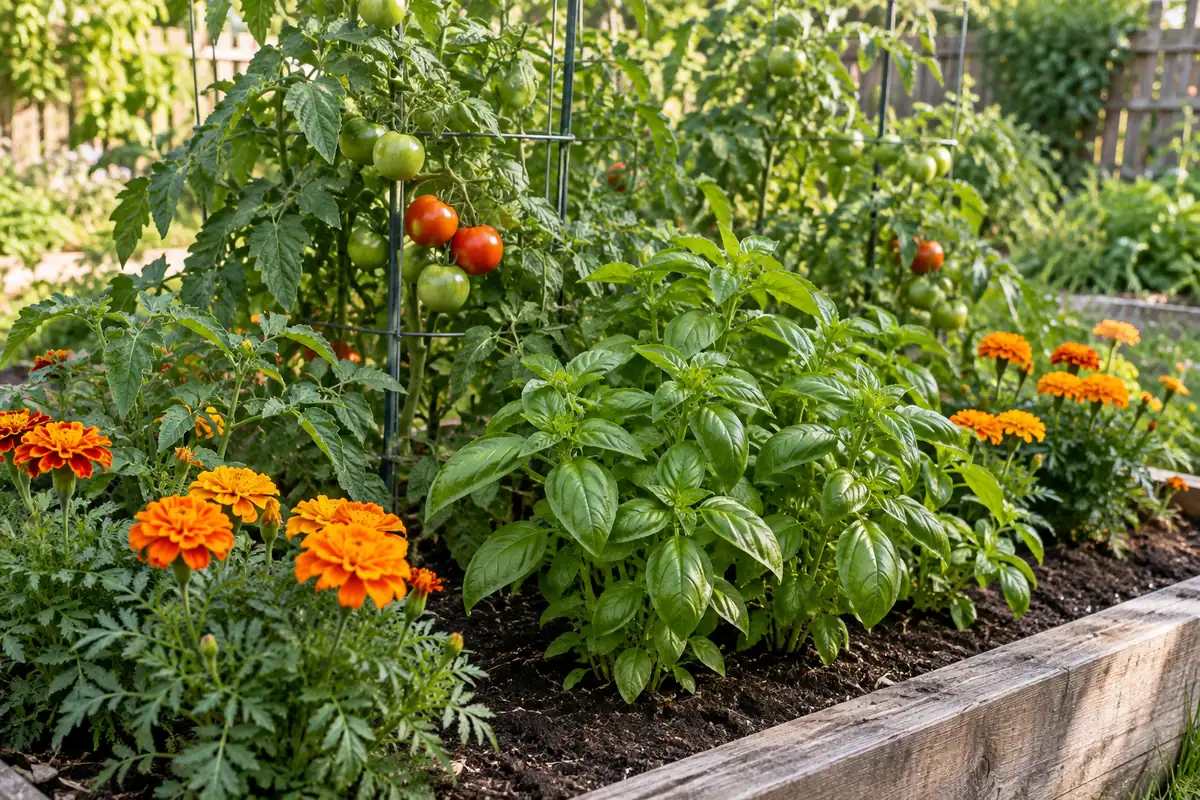
Companion planting examples supported by Extension research
| Goal or crop | Example | Evidence limit |
|---|---|---|
| Use bed space across the season | Harvest early lettuce, spinach or basil as later tomatoes or peppers begin to fill the bed. | Plan harvest timing and mature spacing; do not leave the early crop shading or crowding the later one. |
| Use different crop timing and root space | UMN Extension describes planting radishes with carrots as a space-saving combination. | Follow seed-packet spacing and thin both crops as they grow. |
| Support beneficial insects | Let suitable herbs or flowering plants such as sweet alyssum provide flowers near vegetable crops. | Flowers may support predators and parasitoids, but extra beneficial insects do not always reduce pests on a crop. |
| Reduce a crop-specific pest in studies | UMN reports research in which basil or marigolds reduced thrips in tomatoes, and nasturtium or marigolds reduced damage from some cucurbit pests. | Results are crop-, pest- and setting-specific. Keep monitoring and do not treat the combination as a replacement for pest identification. |
| Trap-crop a pest | UMN notes mustard, arugula, rapeseed or napa cabbage can attract flea beetles away from some brassicas. | A trap crop needs a management plan; it can host the pest and does not suit every garden. |
Before filling a bed, sketch each crop at mature size and mark the direction of strongest sun. Tall crops or supports can shade low crops, while a dense canopy can make it difficult to water or inspect the center. Use the packet for final spacing and leave a route to reach fruit and leaves. If the companion is a flower or herb, decide where it can bloom without competing for the root zone during the vegetable’s peak growth. A small trial in one corner is easier to adjust than an entire bed planted from a chart.
These examples come from the UMN Extension research review. The guidance is regional and not a guarantee for another climate or pest population.
What companion planting can change
Distinguish four goals before choosing a pair. Succession planting separates crops by time; intercropping uses space while crops share a bed; insectary planting offers flowers or shelter to beneficial organisms; trap cropping attempts to draw a specific pest toward a plant that can be monitored or removed. These are different methods and require different spacing and follow-up.
Added diversity can also increase competition, shade or difficulty accessing crops. A flower that attracts pollinators may not reduce a pest. A trap crop can become a reservoir if left unchecked. The useful question is whether a named combination advances a defined goal under conditions similar to your garden. UMN and Delaware Extension sources cited here provide examples and evidence limits.
Plant diversity can change how insects find host plants and can provide nectar, pollen or shelter for natural enemies. Intercropping can also use bed space across different harvest times or plant structures. These mechanisms are not interchangeable: an insectary plant supports habitat, while a trap crop attracts a target insect and must be monitored.
University of Delaware Extension cautions that more natural enemies do not always mean fewer pests on a crop; added plants also compete for light, water and nutrients. See its companion planting guidance.
Choose a combination by purpose
Tomatoes: plan space first, then test a companion
Basil or marigold may be worth testing where local research supports a specific pest-management goal, but do not assume the pairing repels aphids, hornworms or every tomato pest. Leave room for airflow and mature plant size. For container care, see our tomatoes in pots guide.
Carrots: pair by timing and root space
Radishes and carrots can share space as crops with different timing, according to UMN Extension. Sow and thin each crop by its own packet and avoid overcrowding the developing roots. Do not claim alliums reliably repel carrot fly without local evidence.
Brassicas: distinguish a trap crop from a repellent
Some brassicas can be used as trap crops for flea beetles, but planting one without a monitoring and removal plan can move the problem rather than solve it. UMN Extension notes that popular marigold-and-green-onion claims for flea beetles are not well supported and some findings conflict.
Cucurbits: flowers and trap crops need monitoring
Some studies cited by UMN found lower damage from squash bugs or cucumber beetles in plots with nasturtium or marigolds. This does not establish a universal cucumber pairing. Give vines adequate light and space, inspect for pests and use the crop’s own growing guidance.
The Three Sisters: a specific interplanting tradition
The Three Sisters combines corn, climbing beans and squash in a system developed by Indigenous peoples of North America. The crops can provide structure and cover, but success depends on variety, planting sequence, climate and space. Seek guidance from Indigenous sources and regional educators; do not reduce the tradition to a guaranteed “hack.”
Choose flowers for habitat, not a pest-free promise
Flowering plants can provide nectar and pollen to beneficial insects and pollinators. Select species suited to the local climate and the available space, stagger bloom where practical and avoid pesticide use that could harm visitors. Sweet alyssum and flowering herbs are examples discussed in Extension sources; they do not guarantee biological control.
Avoid unsupported compatibility charts
To test a pairing, choose a small plot and one outcome you can observe, such as pest counts, marketable harvest or time spent managing the crop. Keep one comparable area without the companion if space allows, and otherwise record the limitation. Use the same crop variety, sowing dates, irrigation and care in both areas. Repeat in another season before treating an apparent difference as a reliable result; weather and pest pressure can overwhelm a single observation.
Do not use a companion crop as the only response to a serious pest or disease. Identify the problem, monitor its level and use integrated pest-management recommendations. Remove a trap crop before the target pest spreads if the local plan calls for it. Avoid planting combinations that block access, reduce airflow or make watering inconsistent.
Before rejecting or planting a pair, look for evidence tied to the crop, pest, plant variety and growing conditions. Some reputed pairings are based on folklore; others work only as a cover crop, trap crop or timed succession rather than when planted directly beside another crop. UF/IFAS explains that marigold effects on nematodes depend on species, variety and nematode, and that interplanting may not work. See its marigold and nematode management guide.
Try one combination in a small area, keep an untreated comparison if practical, record pest counts and crop growth, and repeat before drawing conclusions. Continue standard monitoring and crop-specific care.
Keep a record that can separate results from assumptions
For each trial, write down the crop variety, companion species, planting distance, sowing date, bed position and the outcome you are trying to influence. Note when flowers open, which insects you actually see, and whether pest damage appears on both the companion and vegetable. A photograph from the same angle each week can make changes easier to compare than memory. If you harvest, record the usable crop rather than only counting flowers or leaves.
Keep normal watering and crop care as consistent as practical. If a companion shades the vegetable or makes it harder to inspect, that is a real cost even if beneficial insects visit. Repeat the observation in another part of the garden or another season before changing a whole planting plan. The purpose is to find a pairing that works in your site and climate, not to prove a broad chart right.
Frequently asked questions
For more crop-specific guidance, see our vegetable garden hub and the guides to tomatoes, cucumbers and carrots in containers.