

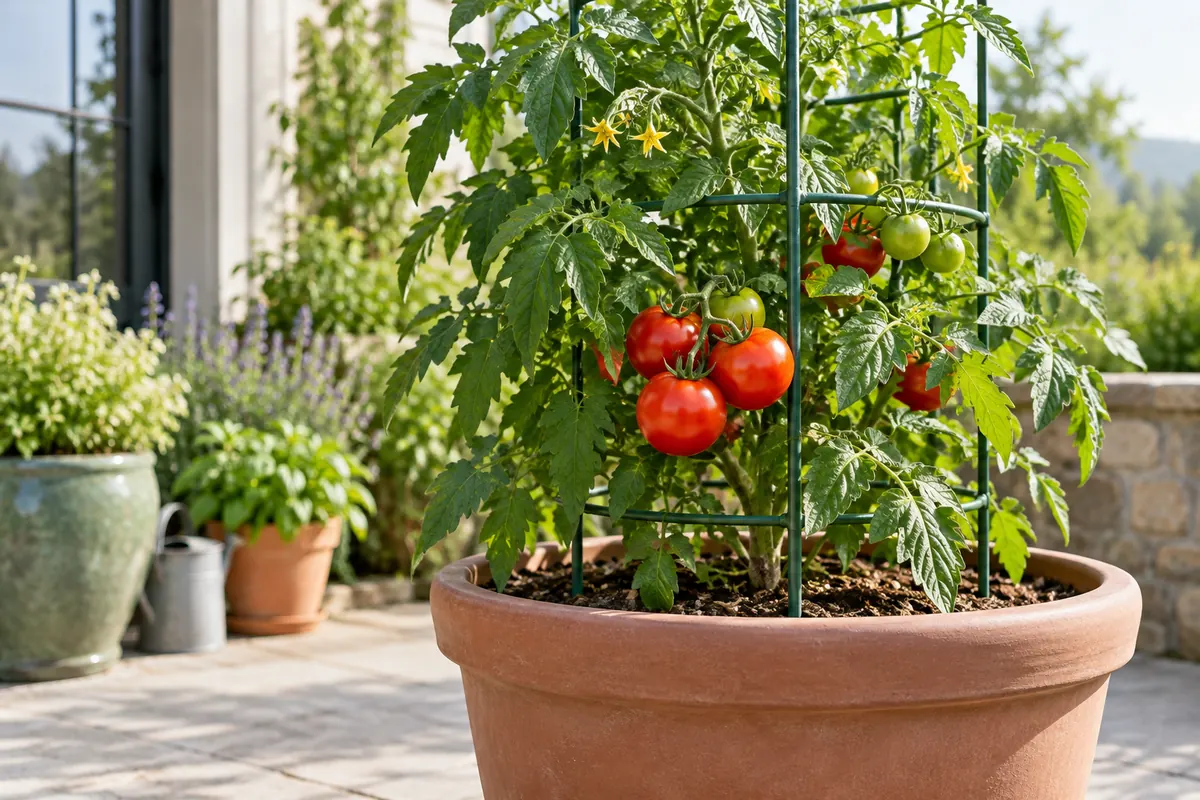
Growing tomatoes in pots depends on choosing a cultivar that fits the available root volume, support, light and frost-free season. “Patio” or “container” on a seed label is a useful clue, but follow the exact cultivar’s instructions and check local Extension guidance.
Keep notes on container size, watering observations, support and harvest so the next planting is based on your own conditions rather than a universal schedule.
Choose a tomato growth habit for the container
Choose growth habit before choosing a pot. Determinate plants have a more bounded pattern, while indeterminate vines keep growing and need ongoing support. Dwarf and compact cultivars may fit constrained spaces but can still need meaningful root volume. “Patio” on a label is not a measurement: check mature height, spread, fruit type, support and disease-resistance codes. If your season is short, compare regional recommendations rather than treating “early” as a guarantee.
Cherry tomatoes may be convenient to pick often, while large-fruited cultivars can need stronger support and more time to mature. Suppliers may count “days to maturity” from sowing or transplanting. Illinois Extension’s tomato guide explains growth habits and care; its container table is a regional example, not a universal ranking.
Compare determinate, indeterminate and compact cultivars by mature plant size, fruit type, support needs, days to maturity and local disease guidance. A dwarf or patio cultivar may be easier to manage in a small container; an indeterminate plant generally needs substantial support and space. Seed packets and regional Extension guides are the source for the named variety.
Plan a stable container with drainage
A tomato pot must support roots, water and a plant that becomes top-heavy. Compare usable volume, depth, base footprint, drainage openings and material for outdoor exposure. A narrow lightweight pot can tip when the vine and fruit develop. Larger containers may buffer moisture changes but become heavy when wet, so choose the permanent location before filling. Keep the pot away from roof runoff that can saturate the mix during heavy rain.
On a balcony or deck, include wet medium, plant, support, reservoir and people in any load assessment. Ask the property owner or a qualified professional if the permitted load is unclear. Plan where drainage water will go so it cannot damage the surface or another property. Use medium made for container vegetables, and do not assume outside dimensions equal usable root volume.
Choose a container large and stable enough for the named cultivar and its support. Container size recommendations differ across varieties and sources; use the seed or nursery label and a regional Extension container table. Provide drainage and a growing medium intended for vegetables rather than compacted garden soil.
Check that the filled container can be safely placed on its surface, especially on balconies or decks.
Supplies to match to a tomato plant
Keep the supply list proportional to the cultivar. A suitable pot, container medium, stable support and a watering method are the core items. Labels help when several cultivars share a patio. A cage should match mature size and be installed while the plant is small; a stake needs a secure position that will not damage major roots. Ties should support stems without constricting them and should be checked as growth thickens.
For any listing, verify exact dimensions, material, attachment method, included accessories and manual. Product photos may show extras sold separately. A reservoir planter changes how water reaches roots, so inspect the mix while learning it. This is a matching checklist, not a product test or a claim that an accessory increases harvest.
- A container with drainage and root volume appropriate for the cultivar.
- A cage, stake or trellis sized for the plant’s mature growth habit.
- Vegetable container medium and a way to check moisture.
- Twine or clips that support stems without constricting them.
Verify dimensions, materials and weight limits for the exact item. This is a planning checklist, not a product test or ranking.
Compare packet details instead of generic ratings
Make a comparison table with growth habit, mature height and width, fruit type and size, maturity estimate, support method, disease-resistance codes and regional planting guidance. Look up resistance codes in the seed company’s glossary: a cultivar may resist selected strains while remaining susceptible to others. “Heirloom” and “hybrid” labels do not replace the traits you need.
Keep the packet or plant label so you can identify the cultivar if a disease appears. If comparing two varieties, choose the one that fits your available light and support before prioritizing generic ratings. Use a local Extension service for disease pressure and crop timing; recommendations from a distant climate can help explain concepts but should not be treated as a calendar for your garden.
Record cultivar, growth habit, expected size, fruit type, maturity range, disease-resistance codes and support needs. “Days to maturity” is an estimate defined by the seed seller and may begin at transplanting; do not compare varieties without checking what the figure means. Illinois Extension’s container vegetable guide lists examples by container size, while its tomato guide discusses types, support and care. Use a local Extension service for regional disease pressure and growing season.
Plant and support according to the cultivar
Prepare the container, support and watering access before transplanting. Install a cage or trellis early so it does not have to be pushed through established roots. If you start from seed, follow packet timing and harden seedlings gradually before placing them outdoors. Choose a healthy, correctly labeled transplant and wait until local conditions suit its cultivar, rather than relying on a universal date.
Set the plant at the depth recommended by the supplier and regional guide. Tomato stems can form roots under suitable conditions, but burying a transplant is not a universal instruction for every pot or grafted plant; keep a graft union above the medium when the nursery label directs it. Water to settle roots without saturating the pot and check stability after the medium settles. Leave access around foliage for inspection and harvest.
- Wait until local frost danger has passed and conditions suit the named cultivar.
- Fill the container with vegetable medium and install the support before the plant becomes large.
- Transplant and space according to the seed or nursery label; avoid burying or pruning based on a generic rule.
- Water the root zone and check drainage. Adjust after observing the pot in its actual sun and wind.
- Inspect leaves and stems regularly for pests, disease and support needs; seek local Extension diagnosis for uncertain problems.
Manage water and nutrients from observations
After watering, observe how long the container takes to drain and how quickly the plant returns to normal growth. If water exits immediately from one channel, the medium may be hydrophobic or settled unevenly; re-wet gradually and check whether roots are receiving moisture. If it drains slowly and smells sour, inspect blocked outlets and root health. These observations are more useful than increasing fertilizer when the plant wilts.
For systems with multiple pots, do not assume every container needs the same amount. Differences in volume, sun exposure, canopy size and material change water use. Group plants only when their needs are similar, and check each pot after changing a timer setting.
Watering is an observation, not a fixed calendar. Check below the surface and consider pot size, wind, temperature, leaf area and fruit load. Water toward the root zone and let excess drain. A plant may wilt briefly in midday heat even when its mix is moist; check again in cooler conditions before saturating it. A dry surface can also hide wet roots lower down.
Record heavy rain, missed watering and changes in pot position. A reservoir changes water delivery but does not remove the need to inspect the root zone. Fertilize according to the medium, product label and regional guidance. Before treating yellow leaves as a nutrient problem, check for waterlogging, restricted roots, pests and disease. Irrigating the medium can ease inspection, but does not guarantee disease-free plants.
Check moisture in the root zone; container size, weather, plant growth and medium change how quickly it dries. Avoid both waterlogging and a fixed daily schedule. Use fertilizer only according to the product label and crop guidance; excessive nitrogen can favor foliage over fruiting, but symptoms alone do not diagnose a nutrient problem.
For fertilizer questions, use a soil or medium test where available and follow local Extension recommendations.
Support growth without assuming every plant needs pruning
Check that a support does not block the path to the faucet, drain or balcony door. A tidy-looking vine is less useful if routine watering requires reaching across a heavy container. If a support loosens, secure it without pulling on the main stem. At the end of the season, inspect the frame for corrosion, cracks or sharp edges before storing it, and clean reusable ties if disease was suspected.
Match support to mature growth habit and fruit load. A compact determinate plant may need a different cage from an indeterminate vine. Check ties during rapid growth and loosen them before they constrict stems. Add support before branches sag and anchor tall structures against wind. Avoid tying around a flower cluster or forcing a bent stem upright at once.
Pruning is not automatically beneficial. Removing suckers changes the number of fruiting stems, shade and airflow; the right method depends on cultivar and growing system. Use Extension guidance for the chosen type, especially if disease management is the reason. Clean tools between plants when disease is suspected and avoid removing large amounts of foliage at once. A trellis cannot fix low light, poor drainage or a small root zone.
Use a cage, stake or trellis that can carry the mature plant and fruit load. Pruning practices depend on cultivar and growing system; determinate and compact tomatoes are not managed the same as indeterminate vines. Follow Extension guidance for your region and sanitize tools when disease is a concern.
Check growing conditions before treating symptoms
Inspect fruit and foliage often enough to notice change early. Remove damaged fruit and keep it from contacting healthy fruit. If you suspect a bacterial or fungal disease, avoid handling healthy plants immediately after the affected one and clean reusable tools according to Extension advice. Do not compost diseased material unless local guidance confirms that your composting method controls the pathogen. Keep a photo log with date and recent weather to help an Extension diagnostician distinguish disease from nutrient or water stress.
Record weather, watering, fertilizer, pot position, pruning and fruit stage before changing several things. Inspect both sides of leaves, stems and the base for pests, spots, lesions or water stress. Similar symptoms can have different causes; extra fertilizer can worsen a problem when roots are wet or damaged.
Blossom-end rot is associated with disrupted calcium movement in developing fruit and water stress, but one affected fruit does not prove that the medium lacks calcium. Check moisture management and soil or medium guidance before adding amendments. Flower drop can relate to heat, cold, maturity, pollination or stress. Cracking may follow changing water uptake and weather. Seek regional Extension diagnosis for persistent disease and use only treatments labeled for edible tomatoes.
Flower drop or poor fruit set: review temperature, plant stage and water stress. Yellow leaves: check moisture, drainage, light, pests and disease before adding fertilizer. Cracked fruit: changes in water availability can contribute, but cultivar and weather also matter. Fungal symptoms: identify the disease and ask Extension about local management before applying a fungicide.