

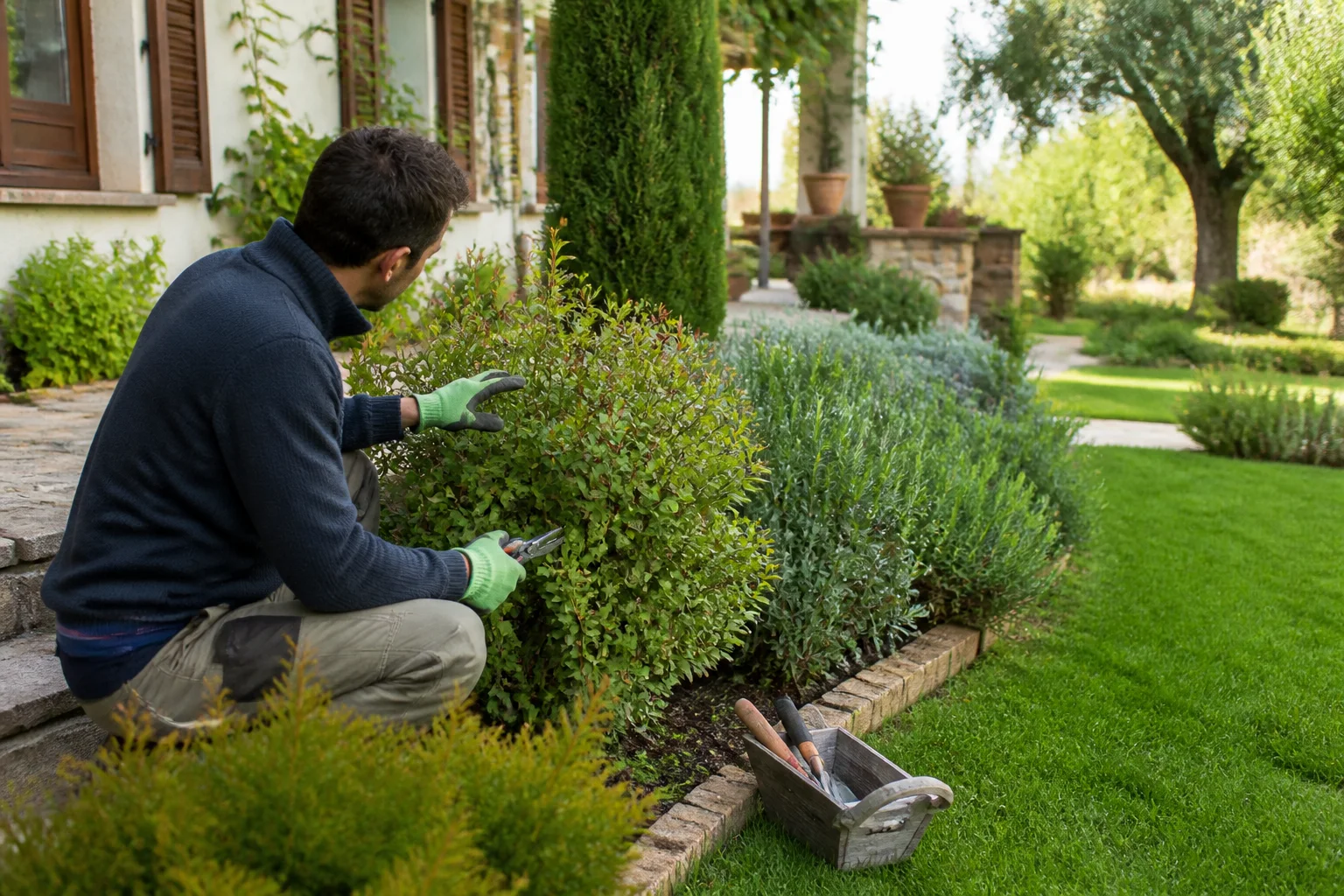
Garden maintenance calendar by season
Garden maintenance is an annual cycle where each season has its own priorities. Understanding the logic behind each task — why it is done at that particular moment and not another — allows you to work much more efficiently and achieve better results.
Spring maintenance: the peak activity season
Spring is the most intense gardening season of the year, and for good reason: it is when plants begin their active growth cycle, and all the effort we invest at this moment multiplies throughout the year. Spring tasks are not optional if you want a beautiful garden in summer.
Lawn: If the lawn has a thatch layer exceeding 1 cm, spring scarification is a priority. Without this step, water and nutrients do not reach the roots effectively. After scarifying, aerate with a fork or spike roller and apply the first feed of the year with a slow-release fertiliser (high-nitrogen NPK formula to stimulate growth). If there are bare patches, overseed now: the rising temperatures and spring moisture are ideal for germination.
Shrub pruning: Shrubs that flower in summer and autumn (roses, buddlejas, lavenders) are pruned in early spring to stimulate new growth. Those that flower in spring (forsythias, lilacs, deutzias) are pruned immediately after their flowers drop: pruning them before they flower removes that year's buds. Evergreen hedges receive their first trim in late spring once the new growth has hardened.
General fertilising: All garden plants appreciate a base feed in spring. For container plants, use liquid or slow-release granular fertiliser. For plants in the ground, organic amendment in the form of compost or well-rotted manure also improves soil structure. Established trees and shrubs generally need less fertiliser than recently planted ones.
Irrigation system: Before hot weather arrives, check all connections and sprinkler heads if you have an automatic irrigation system installed. A badly calibrated controller can both drown plants and leave them without water in July. Replace blocked emitters and adjust irrigation zones if you have added new plants.
MOSFiATA Garden Tool Kit — 12-Piece Stainless Steel Set
- ✓ 12-piece stainless steel garden tool set
- ✓ Ergonomic non-slip handles for reduced fatigue
- ✓ Covers all garden maintenance tasks
- ✓ Carry storage bag included
No verified direct Amazon.com listing is linked for this exact model.
Summer maintenance: watering and heat protection
Summer is the season requiring the least intervention in terms of pruning and soil work, but the most demanding in terms of irrigation and pest control. The heat concentrates work on two fronts: maintaining sufficient water so plants do not suffer drought stress, and preventing pests from taking advantage of weakened plants.
Watering: In summer, watering frequency increases considerably. Lawns in warm climates can need watering three times a week in August. Container plants, especially on balconies, may need daily watering. Always water early in the morning (6:00–9:00): evaporation is reduced and plants have water available before the heat of the day. Avoid watering at midday (up to 40% losses through evaporation) or at night (risk of fungal disease).
Lawn mowing: In summer, the lawn can be mown once a week in cooler climates or every 5–7 days in warm climates. Importantly: during periods of drought and extreme heat, raise the cutting height to 5–6 cm. Longer grass shades the soil, reduces evaporation and better withstands drought stress. Never cut more than 1/3 of the height in a single session.
Deadheading: Regularly removing spent flowers from roses, petunias, geraniums and other flowering plants extends the blooming period by weeks. When the dead flower is removed, the plant does not direct energy into producing seeds and continues producing new flowers. This is a 10–15 minute weekly task that makes a huge visual difference.
Pest control: Heat favours the spread of aphids, red spider mite and scale insects. Check the undersides of leaves regularly. In case of an early infestation, treat with potassium soap or neem oil before resorting to synthetic insecticides. Early intervention is far more effective and less harmful to the environment.
Autumn maintenance: preparing for winter
Autumn is the second busiest season in the garden, almost as intense as spring. All the work you do now determines how the garden starts next spring.
Leaf collection: This is the most visible autumn task and one of the most important for garden health. Leaves that accumulate on the lawn smother it if not removed: they block light, create a damp environment favourable to fungal disease and can kill the grass beneath them in a matter of weeks. Collect leaves every 1–2 weeks with a fan rake or blower. Collected leaves are excellent raw material for the compost heap: after 6–12 months they produce a highly valued leaf mould.
Second hedge trim: Evergreen hedges (privet, yew, box, laurel) receive their autumn clip before low temperatures halt growth. This trim gives them the definitive shape they will carry into winter. Do not prune in late autumn in cold climates: the new growth stimulated by pruning is vulnerable to frost.
Bulb planting: Autumn is the time to plant the bulbs that will flower in spring: tulips, daffodils, hyacinths, muscari. Plant between October and November depending on your region. The standard depth is 2–3 times the bulb's diameter. In areas with mild winters, tulips need 4–6 weeks in a fridge before planting to simulate the cold they require in order to flower.
Winter maintenance: dormancy and planning
Winter is the season of least visible activity but a great deal of planning and quiet work that sets up the following season. In areas with cold winters, the garden is in vegetative dormancy: this is the ideal time to work the soil and prune without damaging active growth.
Pruning deciduous trees: Deciduous trees and shrubs are pruned when they are completely bare, between December and February. Without leaves it is easy to see the structure, identify crossing, diseased or inward-pointing branches and make informed decisions. Pruning wounds heal before spring budding, minimising the risk of disease.
Protecting tender plants: Tropical or Mediterranean plants in gardens with cold winters need protection: tie palm leaves to protect the growing point, cover sensitive plants with horticultural fleece and bring more delicate containers indoors or wrap them in bubble wrap.
Tool cleaning and maintenance: Winter is the perfect time to inspect, clean and sharpen all tools. Sand rust from metal parts, apply linseed oil or WD-40 to protect against corrosion, sharpen spade and hoe blades with a metal file and check handles for cracks or splinters.
FLORA GUARD Garden Kit — 6 Tools with Gloves
- ✓ 6 essential garden tools plus gloves included
- ✓ Durable steel with non-slip rubber handles
- ✓ Perfect for general domestic garden upkeep
- ✓ Gloves included at no extra cost
No verified direct Amazon.com listing is linked for this exact model.
Essential tools for garden maintenance
You do not need an arsenal of tools to keep a garden in perfect condition. With 8–10 well-chosen tools you can tackle virtually any maintenance task in domestic gardens up to 400 m².
Cutting and pruning tools
Cutting tools are the core of the maintenance kit. The essentials are: bypass pruning shears (for branches up to 20 mm, cleaner cut than anvil type), an electric or battery hedge trimmer (for medium and large hedges, incomparably faster than manual), and a lawnmower suited to your garden size. For height pruning, add a telescopic pruner or long-reach pruning shears. For thicker tree branches, a manual pruning saw or a lightweight chainsaw.
Cleaning and collection tools
The fan rake is indispensable for autumn leaf collection: models with a wide plastic or bamboo head cover more surface area with less effort. A leaf blower dramatically speeds up cleaning in gardens with deciduous trees: in 20 minutes you do what would take 2 hours with a rake. For transporting debris, a 100-litre or larger polyethylene wheelbarrow is the most practical and durable option.
Tools for soil work
The spade and hoe are the workhorses of soil work: planting, trench digging, and spring and autumn cultivation. The garden fork is irreplaceable for turning compost, aerating compacted soil and lifting bulbs without damaging them. For more intensive work such as preparing new beds or tilling large vegetable garden areas, an electric or battery tiller considerably reduces physical effort.
Lawn care: the most demanding element
If you have a lawn in your garden, it will account for the majority of your maintenance workload. A well-maintained lawn can completely transform the look of a garden, but it also requires regular attention that cannot be neglected during the growing season.
Mowing frequency and ideal height
The one-third rule is the basic principle of lawn mowing: never cut more than 1/3 of the total height in a single cut. If the grass has grown to 9 cm, do not drop it to 3 cm in one go: make the first cut at 7 cm, wait 2–3 days and then lower to the desired level. As for the ideal height, 3–5 cm suits most domestic lawns: lower is more aesthetically precise but more vulnerable to drought stress; higher is more resilient but can encourage fungal disease. In summer, keep the lawn at the upper end of the range (4–5 cm).
Fertilising and overseeding the lawn
The lawn benefits from at least three feeds per year: spring (nitrogen-rich fertiliser to kickstart growth), summer (balanced fertiliser with micronutrients to maintain the green) and autumn (potassium-rich fertiliser to toughen roots before the cold). Slow-release products are more convenient: applied just once, they release nutrients over 3–6 months. If there are bare or damaged patches, overseeding in spring or early autumn gives excellent results: scarify the area, aerate, sow by hand mixed with a little compost and water until germination.
Hedge and shrub pruning: when and how to do it right
Pruning is perhaps the maintenance task that causes the most uncertainty. The fear of "cutting too much" leads many gardeners to under-prune, resulting in unstructured shrubs that become increasingly difficult to manage. The basic rule: vigorous shrubs tolerate harder pruning than delicate ones; when in doubt, pruning less is safer than overdoing it.
For privet, yew or laurel hedges, cut with the hedge trimmer leaving the base slightly wider than the top: the trapezoidal shape allows light to reach all parts of the hedge and keeps foliage dense from the base down. Hedges trimmed into a vertical wall shape tend to thin out at the bottom over time. For ornamental shrubs, renovation pruning (drastic cut removing the oldest stems from the base) every 3–4 years keeps the plant young and vigorous.
Irrigation: the cornerstone of summer maintenance
Inadequate irrigation is the most common cause of problems in domestic gardens: both overwatering and underwatering create plant stress, making them more vulnerable to pests and diseases and, in extreme cases, killing them. Automating irrigation is the investment that delivers the greatest return in terms of time saved and quality of results.
A drip irrigation system for borders and planted areas, combined with pop-up sprinklers for the lawn and a smart controller with rain sensor, can manage watering for a complex garden autonomously and efficiently throughout the season. The installation cost of a basic system for a domestic garden ranges from £150 to £400 in materials, and installation time is one day for gardens up to 200 m².
Pest and disease control in the garden
Prevention is always more effective than treatment. A well-maintained garden — with properly fed, well-watered plants in the right location — is far more resistant to pests and diseases than a stressed one. Plants in inappropriate conditions (too much shade, poor drainage, unsuitable soil) are the first victims of any infestation.
The most common garden pests include: aphids (spring), red spider mite (dry summer), scale insects (year-round on indoor and outdoor plants), caterpillars (spring–summer) and slugs and snails (autumn–spring in wet periods). Treatments with potassium soap, neem oil or Bordeaux mixture are effective against most of these pests when applied at the right moment and at the correct concentration.
Garden cleaning: leaf collection and plant debris
Cleaning is the least glamorous maintenance task but one of the most important for garden health. Accumulated plant debris — leaves, fallen branches, spent plants — creates the damp, airless environment that favours fungal disease and harbours pests reproducing unseen.
In autumn, leaf collection is urgent if you have a lawn: leaves left on it for more than 2–3 weeks can smother it. A battery-powered leaf blower, which can move leaves to a collection point in minutes, is the greatest time-saver for this task. For the compost heap, leaves are a valuable material: mixed with green matter (cut grass, kitchen scraps) they produce excellent compost in 6–12 months.
SnapFresh Leaf Blower — 20V Cordless with Battery
- ✓ Weight: 1.2 kg — easy to handle for long sessions
- ✓ 20V battery and charger included
- ✓ Air speed up to 90 mph for dry leaves
- ✓ Covers gardens up to 500 m²
No verified direct Amazon.com listing is linked for this exact model.