

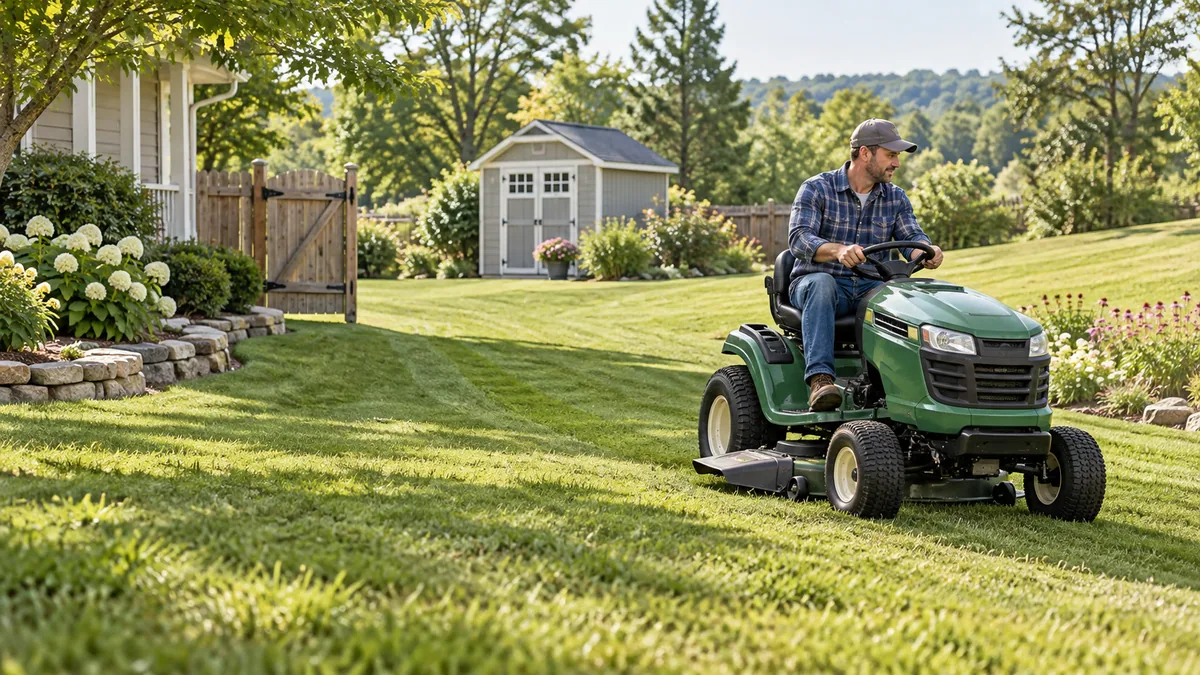
Check whether a riding mower fits the property
Measure the parts of the property that are actually grass and note obstacles, slopes, narrow gates, trees, beds and separate lawn areas. Then measure the tightest access point from the driveway or shed to the mowing area. A machine that fits the open lawn may still be too wide to pass through a gate or too large to store safely.
Think about how often you mow and who will operate the machine. A riding mower can reduce time on a large, open area, but may be difficult to maneuver in a small garden with many turns. If the job takes little time with a walk-behind mower, include the cost and upkeep of the ride-on machine before deciding.
Lawn tractor, garden tractor or zero-turn?
A lawn tractor steers with a wheel and front wheels. It is familiar to many operators and some models support approved rear attachments. A garden tractor may have a heavier chassis or broader attachment capability, but the name alone does not establish its capacity. Check the specific model’s hitch, towing and attachment limits.
A zero-turn mower controls each drive wheel separately, usually with lap bars or a steering wheel on certain models. This can help the operator turn around obstacles, but it requires learning the controls and maintaining good traction. Do not assume that every zero-turn is faster or safer on every yard. Compare actual maneuverability, deck design, slope instructions and warranty support.
Measure access, deck width and storage
Deck width affects the number of passes, but also the machine’s overall width and turning clearance. Measure gates, bridges, shed doors, trailer ramps and the space around stored equipment. Check turning radius and total length as well as the advertised cutting width.
Plan the route to the lawn and account for ramps, steps or soft ground. Verify the mower’s weight and the capacity of any trailer or lift. Store fuel-powered machines in a suitable ventilated storage area, follow the manual’s fuel procedure, and protect the mower from weather. Include the space needed to access blades, belts and cleaning points for service.
Match the machine to the terrain
Read the operator manual for the exact mower’s maximum slope, tire and traction guidance, and directions for operating on inclines. The deck and engine specifications do not indicate whether a mower is suitable for a particular hill. Wet grass, holes, ruts, drop-offs and abrupt turns can change traction and stability.
The CPSC riding-mower guidance says to mow up and down slopes rather than across, avoid wet grass, and not operate on a slope if you cannot back up it or feel uneasy. Those are general precautions, not a replacement for a model’s instructions. If the terrain is outside the machine’s limits, choose another method such as a suitable walk-behind mower or a maintained no-mow planting.
Inspect a used riding mower before purchase
A used mower needs a model-specific inspection, not just a short engine start. Ask for the model and serial number, the operator manual, service records and the number of operating hours if the machine has an hour meter. Use those details to check parts availability and the maker’s maintenance schedule. A missing manual or unclear identity makes it difficult to confirm safe operating limits and attachment compatibility.
With the engine off and the machine secured, look for cracked guards, missing discharge parts, damaged wiring, leaks, bent deck components, uneven tire wear and loose steering or controls. Ask the seller to explain recent repairs and show the safety switches, parking brake and blade engagement controls. Do not place hands near a blade or belt. A qualified technician should inspect internal or safety-critical components when condition is uncertain.
If you test the mower, do so only with the owner’s permission, on a flat, open area and in accordance with the operator manual. Confirm that the seat, brake, steering and blade controls respond predictably and that the deck cuts evenly over a small patch. Stop immediately for unusual vibration, smoke, fuel smell, unstable steering or a safety switch that does not work. A brief demonstration cannot replace a service inspection or prove long-term reliability.
Record the exact included equipment: bagger, hitch, deck, mulching parts, keys, charger and spare blades. Ask whether any attachment is original or approved for that model and year. Similar-looking tractors may use different hitch dimensions, electrical connections or deck hardware. Never assume an attachment will fit based on brand alone.
Plan for service, transport and ownership cost
Before purchase, locate the operator manual, warranty terms and service network for the exact model. Ask about routine engine, battery, belt, tire, blade and deck maintenance, and check the availability and price of common replacement parts. If buying used, verify the serial number and ask for service records instead of relying on the seller’s description.
Estimate total cost across the mower, attachments, fuel or batteries, blades, service, storage and transport. If you need to tow, use only approved attachments and remain within the stated load limits. A cart or aerator can change steering and braking behavior, especially on slopes.
Before adding an attachment, read both manuals: the mower manual sets the approved hitch and load, while the attachment manual describes its own limits and setup. Check whether ballast, tire chains or a particular operating speed are required. Test the combined setup on level ground first and leave more stopping distance. If an attachment obscures the operator’s view or makes the route too narrow, do not use it in that area.
Also check whether the machine can be transported and serviced without unsafe lifting. Measure a trailer’s loading width, ramp angle and rated capacity, then compare those figures with the mower’s weight and overall dimensions. Secure the mower as its transport instructions specify; do not assume the parking brake alone will restrain it. If a dealer will deliver the machine, confirm what assembly and safety checks are included.
For a property with multiple operators, make sure each person can reach the controls, understand the safety interlocks and stop the blades promptly. Seat position, visibility and control layout can matter more than engine output. Arrange instruction for anyone unfamiliar with a zero-turn’s steering behavior, and keep inexperienced operators away from slopes or towing until they have learned the machine in an open, level area.
If the machine will be used near neighbors, check the product’s sound information and any local restrictions before scheduling work. A larger deck can shorten some mowing sessions but does not remove the need for safe clearance, bystander separation and routine maintenance.
Plan a secure, level place to park the mower before the first use. Keep the ignition key under control, lower or disengage equipment as the manual directs, and make sure children cannot access the controls or attachments. If the machine is left outdoors, follow the manufacturer’s instructions for weather protection and battery care.
Compare formats against the property
Use the machine’s working conditions, not a single acreage threshold, to narrow the format. A lawn tractor’s wheel steering may suit a user who wants a familiar driving layout or an approved rear attachment. A zero-turn may reduce repeated wide turns around trees, but it still needs room to change direction and traction that matches the surface. A garden tractor should be considered only when its exact manual supports the attachment and towing work you plan to do.
| Property condition | What to compare | What could rule it out |
|---|---|---|
| Open lawn with long straight runs | Deck width, service access, storage and transport. | A machine too wide for the shed, trailer or access gate. |
| Many trees and curved beds | Turning space, visibility and control practice. | A tight layout where the deck repeatedly contacts beds or trunks. |
| Steep, wet or uneven sections | Exact slope instructions, traction and surface condition. | A grade or drop-off outside the operator manual’s safe method. |
| Several operators | Seat adjustment, visibility, controls and safety interlocks. | An operator who cannot comfortably reach and use the controls. |
Walk the intended mowing path with a tape measure before shopping. Record the narrowest gate, the tightest turning area, low branches and the place where the mower will be parked. Compare those measurements with the machine’s total width, length, deck overhang and turning guidance. If the lawn includes a hill, evaluate the exact slope and surface separately from flat-yard coverage; the same mower can be manageable on dry turf and unsafe on wet or loose ground.
For used machines, ask for the model and serial numbers before travelling to see one. Confirm the manual, service interval, hours if available, parts support and whether attachments are original or approved. Inspect the guards, discharge chute, brake, steering, tires, wiring, deck, belts and safety switches with the engine off. Do not reach under the deck. If the seller cannot demonstrate that the controls stop the machine and blades as intended, or if the mower has unstable steering, vibration or leaks, leave the evaluation to a qualified technician.
Request a cold start only when the seller agrees and follow the operator manual for any demonstration. Test on a level, open patch with no bystanders. A short demonstration can reveal rough starting, unusual smoke or vibration, but cannot prove the condition of the engine, transmission or deck. Budget for a professional inspection when service records are incomplete, and include any missing safety guards or attachments in the cost before comparing the purchase price.
For a used or new machine, plan how it will reach the property. Riding mowers can be heavy and wide; measure the trailer, ramp, storage door and tightest turn, and confirm the tow vehicle and trailer are rated for the loaded machine. Do not assume a garden tractor is road-legal or that a mower can be driven between properties. Follow local transport rules and the operator manual for securing, loading and unloading.
Evaluate the controls before you commit. Lawn tractors typically use a steering wheel and foot or hand controls, while zero-turn machines use independent steering controls. The learning curve, visibility, turning behavior and safe slope direction differ. If several people will operate the mower, have each person read the manual and practise on an open, level area with the blades disengaged before using it around trees, slopes or obstacles.
Attachments can change both the machine’s suitability and its maintenance. Check the exact model’s approved deck, bagger, mulching kit, cart or snow attachment and the required hitch or ballast. Confirm whether an attachment affects the warranty or slope instructions. A mower should be selected for the mowing task first; avoid adding attachments that encourage operation outside the manufacturer’s limits.
Riding mower safety and slope limits
Read the safety section of the owner’s manual before operating. Keep guards and discharge shields in place, clear people and pets from the work area, remove debris that could become projectiles and wear eye protection and sturdy footwear. Stop the blades before crossing gravel or leaving the operator’s position, as instructed by the manufacturer.
Never carry passengers. Avoid mowing near drop-offs and water unless the manual explicitly describes a safe method. Penn State Extension stresses stopping the machine when someone enters the operating area and keeping clear of the discharge zone. For children and pets, use a separate safe area rather than relying on warning sounds or sensors.
Frequently asked questions
Frequently Asked Questions
Safety and selection sources
Selection features vary by manufacturer and market. Slope limits and control procedures must come from the operator manual for the exact machine; the general safety guidance below does not set a universal safe gradient.
- 588 Riding Lawnmower Fact Sheet — U.S. Consumer Product Safety Commission
- Riding lawn mower safety practices — Penn State Extension
- How to choose the best lawn mower for your yard — Husqvarna Australia