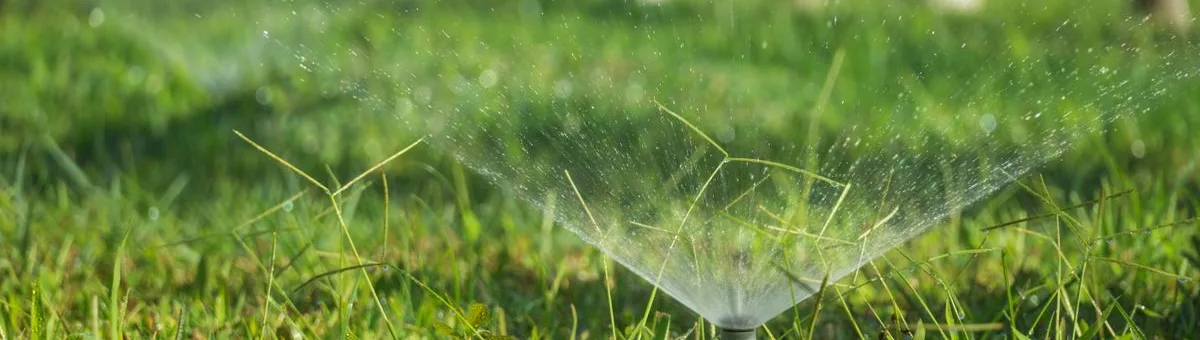
The right garden sprinkler can water a 4,500 sq ft lawn while you sleep — connected to a $20 timer and using 30% less water than irregular hand-watering. The wrong one leaves dry patches in corners, oversoaks narrow strips, or falls apart after one season. This comparison covers the three best garden sprinklers of 2026 for different lawn shapes and sizes, with a guide to choosing based on your specific yard.
▷ Best garden sprinklers of 2026
Gardena ZoomMaxx Oscillating Sprinkler — Up to 2,700 sq ft
- ✓ Coverage: 540–2,700 sq ft (adjustable width & range)
- ✓ 20 precision nozzles — clog-resistant
- ✓ ZoomMaxx: width & length control without tools
- ✓ Metal distribution arm — long-lasting
- ✓ Standard 3/4" hose connection
- ✓ Flow control valve included
Price from Amazon.com · ships within US
Rain Bird 25PJDAC Brass Impact Sprinkler on Spike
- ✓ Coverage: up to 5,800 sq ft (full circle)
- ✓ Adjustable arc: part-circle to full 360°
- ✓ Brass construction — professional durability
- ✓ Distance: 20–41 ft adjustable radius
- ✓ Ground spike included for easy positioning
- ✓ Works at 25–50 PSI
Price from Amazon.com · ships within US
Melnor XT Turbo Oscillating Sprinkler — 4,200 sq ft
- ✓ Coverage: up to 4,200 sq ft
- ✓ 20 precision nozzles with clog-resistant design
- ✓ Turbo Drive: patented precision coverage
- ✓ Range control: adjustable for any size lawn
- ✓ Flow control knob
- ✓ Durable construction with metal base
Price from Amazon.com · ships within US
Best garden sprinkler by budget: under $50, $100, $500
Most "best sprinkler" lists ignore budget — but most yards don't need a $500 in-ground system. Here's the practical breakdown:
| Budget | Best pick | Coverage | Use case |
|---|---|---|---|
| Under $30 | Melnor 65078-AMZ Multi-Adjusting | 3,600 sq ft | Small to medium lawn, occasional use |
| Under $50 | Gardena ZoomMaxx Oscillating | 4,500 sq ft | Rectangular lawns, precise coverage |
| Under $100 | Rain Bird 32SA Pop-Up Rotor (3-pack) | 2,500-5,000 sq ft each | In-ground installation, large lawns |
| Under $500 | Hunter Pro-Spray + Pro-C Controller kit | 10,000+ sq ft | Full-system upgrade with smart controller |
Comparison: coverage, type & best use
| Model | Coverage | Type | Best For |
|---|---|---|---|
| Gardena ZoomMaxx | 540–2,700 sq ft | Oscillating | Small–medium rectangular lawns |
| Rain Bird 25PJDAC | Up to 5,800 sq ft | Impact | Large / wind-exposed areas |
| Melnor XT Turbo | Up to 4,200 sq ft | Oscillating | Medium–large rectangular lawns |
Oscillating vs impact vs pop-up sprinklers
Oscillating sprinklers — best for rectangular lawns
Oscillating sprinklers use a curved metal or plastic arm with multiple holes (typically 16–20 nozzles) that sweeps back and forth in an arc, spraying a fan of fine mist. They cover rectangular areas precisely and can be positioned right at the edge of a bed without overspraying on paths. The horizontal sweep allows you to adjust both the width of coverage (narrow strip or full width) and the distance (range) the water travels. Modern oscillating sprinklers like the Melnor XT and Gardena ZoomMaxx have adjustable width and range controls that let you dial in the coverage pattern to match your specific lawn shape.
Modern oscillating designs deliver water in a pattern that's very even across the width — the multiple nozzles and the sweeping motion create minimal dry spots or overwatered areas if the sprinkler is positioned correctly. Coverage ranges from 540 sq ft for small lawns to 4,200+ sq ft on larger models. You can also reduce the arc (sweep angle) so the sprinkler doesn't water beyond your property line. Best for: small to medium rectangular or square lawns, garden beds, properties where precision matters.
Impact sprinklers — best for large and windy areas
Impact sprinklers deliver water through a single rotating jet deflected by a spring-loaded arm that makes the characteristic "sproing-sproing-sproing" sound as it fires water in pulses. The arm strikes the incoming water jet, deflecting it outward, then resets and strikes again. This creates a single rotating arc of water that's heavier and larger in droplet size than oscillating sprinklers. The adjustable arc (part-circle to full 360°) lets you cover everything from a quarter of a circle to a complete circle.
Impact sprinklers are more wind-resistant because of their larger droplet size — fine mist from oscillating sprinklers can be blown off-target on windy days, but impact sprinklers punch through wind better. Coverage is much larger per position: a Rain Bird 25PJDAC can cover up to 5,800 sq ft in a single setting, meaning one sprinkler might water your entire large lawn. The brass models are nearly indestructible and can last decades with zero maintenance beyond occasional nozzle cleaning. The main limitation: they're less precise for rectangular areas and the single-jet pattern can leave some irregular coverage. Best for: large lawns, irregular shapes, windy areas, or situations where durability and coverage distance are the priority.
Pop-up in-ground sprinklers — best for permanent installation
Pop-up in-ground sprinklers are permanently installed below grade and retract when not in use. The sprinkler head sits level with the soil and pops up 4–8 inches when water pressure activates the internal spring mechanism. They provide the cleanest look and most even coverage for large turf areas. Because multiple pop-ups work together in a planned grid pattern, they deliver very uniform water distribution across the entire lawn. Pop-up systems eliminate the need to move sprinklers between zones — your entire lawn is watered simultaneously in one cycle.
The tradeoff is significant upfront investment and installation complexity. A professional in-ground irrigation system costs $500–$3,000+ depending on lawn size and terrain. However, for a homeowner committed to long-term lawn care, pop-ups are the most convenient and water-efficient option. You set the schedule once and forget it. Modern smart controllers can automate adjustments based on weather and season. Best for: permanent lawn installations, large properties, homeowners planning to stay in the home long-term.
Which sprinkler is right for your lawn?
Small rectangular lawn (under 2,500 sq ft): The Gardena ZoomMaxx with its adjustable width control covers the area precisely without overspraying paths or flower beds. The metal distribution arm and quality nozzles mean it'll last many seasons. Position it so it covers parallel to the longest edge of the lawn, and adjust the width to just barely miss your driveway or sidewalk. You'll get crisp edge coverage and no water waste.
Large or irregularly shaped lawn (over 3,000 sq ft): The Rain Bird 25PJDAC impact sprinkler on its spike covers up to 5,800 sq ft in a single position and can be adjusted from part-circle to full 360°. Position it in the center of the area for full coverage, or on the edge set to half-circle for rectangular areas. Move and reposition between zones as needed. The brass construction means you won't replace this sprinkler in your lifetime — it's a one-time purchase.
Medium lawn where you want set-and-forget coverage: The Melnor XT Turbo's 4,200 sq ft coverage with flow control valve and consistent pattern makes it the easiest to set up and walk away from. Works best connected to a programmable timer so you never need to think about it. The turbo drive mechanism ensures even coverage from edge to edge with minimal fine-tuning.
Narrow strip lawns and parkways: Oscillating sprinklers are the only choice for long, narrow areas (like a front yard strip between sidewalk and house). Reduce the arc width to match your strip width, set the distance to your lot line, and position it perpendicular to the length of the strip. Two or three passes along the strip with the sprinkler repositioned will ensure complete coverage. Impact sprinklers will water areas you don't want watered (street, neighbor's yard) when set to narrow arc.
Sloped lawns: Water pressure and gravity interact on slopes. On a downhill slope, water delivered to the upper part of the slope often runs down rather than soaking in, wasting water and sometimes eroding soil. Position your sprinkler at the highest point of the slope and set it to deliver water toward the lower area, allowing the water time to soak in as it flows downward. Impact sprinklers with their larger, heavier droplets perform better on slopes than fine-mist oscillating sprinklers. Consider running your sprinkler in shorter cycles (20–30 minutes) with breaks between cycles to allow water to penetrate rather than run off.
How long to run your sprinkler to apply 1 inch of water
The tuna-can test: place 3–4 straight-sided cans throughout the coverage area and run the sprinkler for exactly 30 minutes. Measure the depth in the cans — if you collected 0.5 inches, you need 60 minutes total for 1 inch of water. Most lawns need 1–1.5 inches per week in summer. Run in the early morning and avoid evening watering to reduce disease risk.
Watering needs by season
Spring (March–May): Your lawn is greening up and root development is active. Cool temperatures mean lower evaporation. Most spring lawns need 0.5–1 inch per week depending on rainfall and temperature. Weekly testing with the tuna-can method is important because spring rainfall is unpredictable — you may need to skip scheduled waterings after rain.
Summer (June–August): Peak heat and evaporation. Cool-season grasses (fescue, bluegrass, ryegrass in northern climates) typically need 1.5–2 inches per week. Warm-season grasses (bermuda, zoysia, st. augustine in southern climates) need 1–1.5 inches per week. High heat stresses all grass types, so consistent watering is critical. Many homeowners increase to 2 cycles per week (or lengthen their single cycle) during peak summer heat.
Fall (September–November): Cooling temperatures reduce evaporation demand. Your lawn is storing energy for winter. Reduce watering to 0.5–1 inch per week, and taper off entirely in late fall when natural rainfall increases and grass goes dormant. Early-fall watering promotes fall root growth; late-fall watering invites fungal disease and is unnecessary.
Winter: No watering needed for dormant cool-season grass. In mild climates, occasional deep watering during extended dry periods (more than 2 weeks without rain) can help evergreen plants, but turf grass itself is dormant and requires no moisture.
Signs of overwatering vs underwatering
Overwatering symptoms: Soft, squishy turf; active fungal disease (brown patch, dollar spot, rust); shallow roots because the grass doesn't need to dig deep for water; persistent standing water or muddy patches; rapid moss and weed invasion (weeds and moss thrive in soggy soil while grass roots weaken). If these appear, reduce your watering frequency — perhaps water every 4–5 days instead of every 3 days, and always run the tuna-can test to verify you're not applying excess water.
Underwatering symptoms: Visible wilting, thin or pale turf; bare or thin patches where weeds invade because grass roots are stressed; slower growth. Soil that's hard and compacted near the surface indicates the grass roots can't penetrate deep. If you're seeing underwatering signs, increase your watering time or frequency incrementally (add 10 minutes to your runtime, then observe for a week before adjusting again). It's much easier to add water than remove it — start conservative and increase as needed.
Setting up your sprinkler for best coverage
Positioning for rectangular lawns
For oscillating sprinklers, placement is critical. The best position is at the bottom of the rectangle looking upward (or to the side of a long rectangle looking across its width). This ensures the full sweep covers the lawn edge-to-edge without overshooting into neighbors' yards or onto the driveway. If your lawn is 40 feet wide and 60 feet deep, position the sprinkler 20 feet from one long edge, angled to sweep parallel to that edge — this way you're maximizing the along-the-length coverage and centering your side-to-side width.
For impact sprinklers on large rectangular lawns, position them slightly off-center so they can be adjusted to full circle or 180° arc to cover the maximum area. A 5,800 sq ft coverage circle from one position beats trying to use multiple oscillating sprinklers. If your lawn is L-shaped or has irregular boundaries, you'll likely need 2–3 impact sprinkler positions or repositioning of a single sprinkler between zones.
Adjusting pressure and flow
Most outdoor faucets deliver 40–80 PSI (pounds per square inch). Sprinklers are rated to work best in specific pressure ranges — typically 40–60 PSI for oscillating and 25–50 PSI for impact. If your water pressure is too high (over 80 PSI), the sprinkler misses its intended pattern, the stream is too forceful, and you get uneven coverage with dry patches. Too low pressure (under 30 PSI) and the sprinkler may not reach its full distance or may not sweep properly.
You can adjust pressure using a pressure regulator installed on the faucet or at the sprinkler base. Most quality sprinklers include an adjustment valve on the body — the Rain Bird and Melnor both have inline flow control dials. Start with the valve fully open, run the sprinkler and measure coverage with the tuna-can test. If pressure is excessive (heavy, uneven droplets), slightly reduce the flow until you get a fine, even mist.
Setting a watering timer
A simple mechanical or battery-powered timer screws onto your outdoor faucet and lets you set start time and duration. Connect your sprinkler hose to the timer outlet. Set the start time to early morning (5–7 AM before the sun heats up) and duration based on your tuna-can test (typically 45–90 minutes). A 7-day programmable timer costs $20–50 and allows different schedules for weekdays vs weekends, or different zones if you have multiple sprinklers rotating through faucet positions.
For set-and-forget watering, a timer is the single best investment. It ensures you water consistently every few days regardless of how busy life gets, and it removes the guesswork of remembering to water manually. Most lawns perform best on every-other-day or every-three-day schedules in summer.
Common coverage mistakes
Not testing coverage: Assumption that a sprinkler covers evenly across its arc is the #1 reason lawns have dry patches and overwatered soggy areas. Run the tuna-can test before you rely on any new sprinkler placement — it takes 30 minutes and saves months of guessing.
Overlapping zones too much: If you position two oscillating sprinklers to cover the same area with 50% overlap, you'll overwater the overlap zone while potentially missing edges. Aim for 10–20% overlap — enough to avoid dry lines, but not so much that you waste water.
Ignoring wind: Even light wind deflects fine mist. A 15 mph wind can reduce oscillating coverage by 30%. Water on calm mornings or use impact sprinklers if your property is consistently windy.
Wrong sprinkler type for lawn shape: Trying to cover a long narrow parkway with an impact sprinkler, or a 5,000+ sq ft lawn with a small oscillating sprinkler, leads to frustration and waste. Match the sprinkler type to your space.
Sprinkler maintenance and troubleshooting
Cleaning clogged nozzles
Over time, mineral deposits (especially in hard water areas) and debris build up in sprinkler nozzles, reducing flow and creating uneven coverage. If you notice reduced distance or a weak spray from some holes, the nozzles are partially clogged. Remove the sprinkler from the faucet, hold it under running water, and use a small straightened paperclip or dedicated nozzle-cleaning tool to gently clear each hole. Don't use a toothpick (it can break and lodge inside) or force the wire — gentle pressure is enough to dislodge mineral deposits. Soak the sprinkler in white vinegar for an hour if deposits are heavy, then flush with clean water.
Fixing uneven coverage
The tuna-can test revealed one area gets too much water and another too little. Causes and fixes: (1) Clogged nozzles — clean as described above. (2) Low pressure — verify your faucet is fully open and no other water is running elsewhere in your house. (3) Sprinkler body damage — if the arm is bent or plastic is cracked, water escapes unpredictably. (4) Incorrect positioning — sometimes simply rotating the sprinkler 90° and re-testing fixes the problem. (5) Grass or debris blocking the sweep arc — clear vegetation before running the sprinkler.
Winterizing your sprinkler
In climates with freezing winters, leave your hose and sprinkler disconnected, drained, and stored indoors. Water left in the hose expands when frozen, bursting the hose walls. Sprinklers left outside accumulate rust and internal corrosion. Before winter storage, flush the hose with running water to remove any sediment, hang it in large coils (not kinked) to dry fully, and store in a garage or shed. Coil your sprinkler lightly and store it alongside the hose. In spring, inspect the nozzles and arm for corrosion or cracks before reconnecting.
When to replace vs repair
Repair: Clogged nozzles, bent spike or base (if impact sprinkler), cracked hose connection threads, or weak sweep arm can often be fixed. Impact sprinkler nozzles can be individually replaced ($5–15). Oscillating sprinklers with bent distribution arms can sometimes be carefully straightened. The cost of parts is usually $5–20.
Replace: If the plastic body is cracked and water leaks from the main body, the internal mechanism is broken (sweep arm doesn't move), or the brass components show heavy corrosion or broken parts, replacement is more economical than repair. Quality sprinklers (Gardena, Melnor, Rain Bird) cost $20–60, which is cheaper than troubleshooting a failing unit for the next season. Plan to replace plastic oscillating sprinklers every 5–7 years; brass impact sprinklers can last 20+ years.