

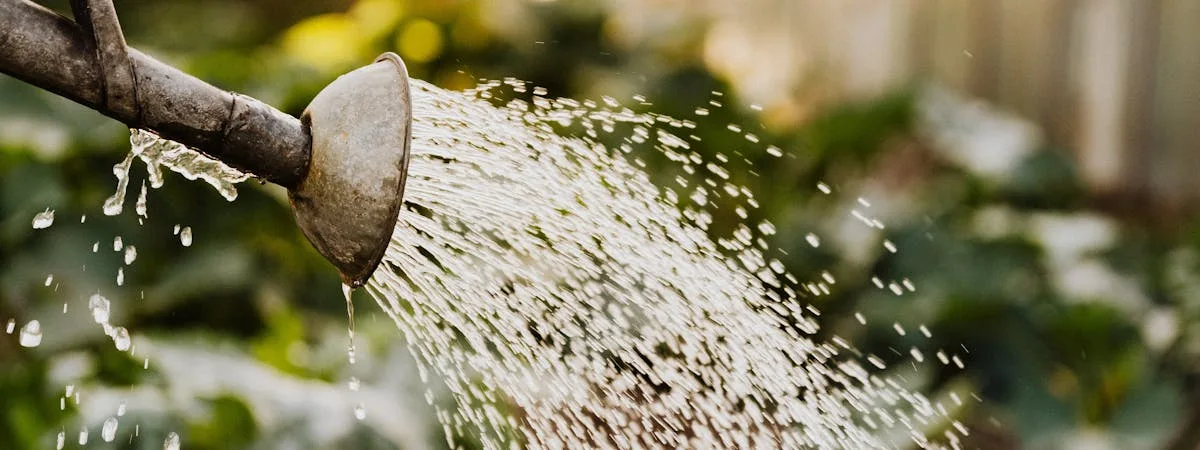
Types of garden irrigation systems
There are five main approaches to garden irrigation, each suited to different garden types and budgets:
- Drip irrigation: Delivers water directly to plant roots through emitters. Most water-efficient; ideal for vegetable gardens, flower beds, raised beds, and containers. Costs $25–$200 for a DIY system.
- Sprinkler systems: Oscillating, impact, or pop-up sprinklers distribute water over a wide area like rainfall. Best for lawns and large uniform areas. Costs $15–$200 for portable units; much more for in-ground systems.
- Soaker hoses: Porous hoses that weep water along their entire length. Simple, inexpensive, and effective for rows of vegetables or hedges. Costs $15–$40.
- Automatic timer systems: WiFi-connected smart controllers or basic mechanical timers that automate any hose-connected irrigation. Costs $20 (mechanical timer) to $250 (multi-zone smart controller).
- Hand watering: Hose, watering can, or wand. The most flexible but most time-consuming option. Best for containers, individual plants that need monitoring, or supplementing an automated system.
Drip irrigation: the most water-efficient system
Drip irrigation consistently saves 30–70% more water compared to overhead sprinklers or hand-watering. By delivering water directly to the root zone, it eliminates evaporation from foliage and the soil surface, keeps paths and mulch dry, and prevents the wet-leaf conditions that cause fungal diseases. For vegetable gardens, the results are visible in faster growth and higher yields.
A basic drip system consists of: a backflow preventer (to protect your home's water supply), a filter (to prevent clogged emitters), a pressure reducer (drip systems run at 15–25 PSI, much lower than your home's 40–80 PSI), mainline tubing (usually 1/2" poly tubing), and emitters (1/2 gallon/hour or 1 gallon/hour depending on plant needs). Complete kits sold on Amazon bundle all these components for $30–$80 and cover a typical vegetable garden or 10–15 shrubs.
Rain Bird 32ETI Easy to Install In-Ground Automatic Sprinkler System
- ✓ Complete in-ground system: heads, pipe, fittings
- ✓ Covers up to 1,750 sq ft in multiple configurations
- ✓ Connects to standard garden hose or outdoor faucet
- ✓ Built-in timer with 3 cycle settings
- ✓ Rain Bird — the industry standard brand
- ✓ Includes pop-up spray heads + rotary heads
No verified direct Amazon.com listing is linked for this exact model.
Sprinkler systems: best for lawns and large areas
For uniform coverage of grass and large ground-cover plantings, sprinklers are the right choice. Oscillating sprinklers cover rectangular areas of 3,000–4,500 sq ft and are the most common choice for home lawns. Impact (impulse) sprinklers are more durable, better in wind, and cover circular areas up to 5,800 sq ft — the classic "sproing" sprinkler seen on farms and athletic fields. Pop-up in-ground sprinklers provide the cleanest appearance and most even coverage but require professional installation in most cases.
For an average suburban lawn (3,000–6,000 sq ft), a quality oscillating sprinkler connected to a programmable timer is the most cost-effective solution — under $50 total and working in 15 minutes. Key specs to compare: coverage area (sq ft), water distribution uniformity, and the pattern adjustment range.
Gardena ZoomMaxx Oscillating Sprinkler — Covers up to 2,700 sq ft
- ✓ Coverage: 540–2,700 sq ft (adjustable width & length)
- ✓ 20 precision nozzles with metal head
- ✓ ZoomMaxx range adjustment: no tools needed
- ✓ Connects to standard 3/4" hose fitting
- ✓ Built-in flow control valve
- ✓ Gardena — European quality garden brand
No verified direct Amazon.com listing is linked for this exact model.
Automatic irrigation: timers, WiFi controllers & rain sensors
Automatic irrigation timers are the single upgrade that most transforms a garden's health. A basic mechanical timer ($20) simply turns water on and off on a schedule. A smart WiFi timer ($80–$250) adjusts schedules based on real-time weather data, skips watering when rain is detected, and lets you control everything from a smartphone — even when you're on vacation. For a garden that waters itself precisely and intelligently, a smart controller pays for itself in water savings and healthier plants within one season.
Smart watering systems like the Rachio 3 or Orbit B-hyve use your local weather forecast and soil type data to calculate exactly how much water your specific lawn and beds need. They skip scheduled watering cycles before and after rain, and some can even communicate with rain sensors for real-time cutoff. Apartment balcony and container garden systems from Gardena and Claber automate individual pots — life-changing for anyone who travels regularly.
When and how often to water your garden
The best time to water is early morning (6–10 AM): the soil is cool, sun hasn't raised evaporation rates yet, and foliage has time to dry before nightfall — reducing fungal disease risk. Evening is second best (after 6 PM). Midday watering loses 20–50% of water to evaporation before it can soak into the soil.
Frequency depends on soil type, climate, and plant type. Clay soils hold water longer (water less frequently but more deeply). Sandy soils drain quickly (water more frequently but with less per session). A useful test: push a finger 2 inches into the soil. If it's still moist, don't water. If it's dry at that depth, it's time. For established lawns and plants, watering deeply 2–3 times per week is almost always better than shallow daily watering — it encourages deep root growth and drought resilience.
How much water does each type of garden need?
| Garden Type | Water per Week (summer) | Frequency | Best Method |
|---|---|---|---|
| Lawn (cool-season grass) | 1–1.5" | 2–3× / week | Oscillating sprinkler |
| Vegetable garden | 1–2" | Daily (heat) / 3× | Drip irrigation |
| Flower beds | 1" | 2× / week | Drip or soaker hose |
| Container plants (outdoor) | Daily in heat | Daily (90°F+) | Drip kit or self-watering |
| Shrubs & hedges (established) | 0.5–1" | 1× / week | Drip emitters |
| Trees (established) | Occasional deep soak | 1–2× / month | Slow trickle at base |
How to choose the right irrigation system
Vegetable garden or raised beds: Drip irrigation is the clear choice. It delivers water exactly where needed, keeps paths dry, prevents leaf diseases, and combined with a timer makes watering fully automatic. A complete kit for a 4×8 raised bed costs under $30 and installs in an afternoon.
Lawn (up to 6,000 sq ft): An oscillating sprinkler on a programmable timer covers most suburban lawns perfectly. No installation required. For larger or irregularly shaped lawns, consider a multi-zone timer with 2–3 sprinklers covering different zones.
Containers and balcony: The Gardena Micro-Drip Balcony Set or Claber Oasis automatic watering systems are purpose-built for potted plants and handle 20–40 containers from a single outdoor faucet. Game-changing for travel.
Smart whole-garden automation: Rachio 3 or Orbit B-hyve WiFi controller for weather-responsive irrigation that adjusts to forecast data. Connect up to 8 zones (different sprinklers or drip lines in different garden areas) and manage everything from your phone.
How to install a drip irrigation system
Step 1 — Connect to the faucet: Attach the backflow preventer, filter, and pressure reducer to your outdoor faucet in sequence. These three components are often sold as a unit and take under a minute to install. The filter prevents debris from clogging emitters; the pressure reducer brings your home water pressure (40–80 PSI) down to 15–25 PSI which drip systems require.
Step 2 — Lay the mainline: Run 1/2" poly tubing from the faucet assembly to your garden beds, staking it to the ground as you go. The mainline is the "backbone" of the system; individual plant emitters or micro-tubing branches off it.
Step 3 — Add emitters: Punch holes in the mainline at each plant location using the included punch tool, insert barb connectors, and run 1/4" micro-tubing with an emitter to the base of each plant. Use 0.5 GPH emitters for small plants, 1 GPH for medium, and 2 GPH for large shrubs or trees.
Step 4 — Add a timer: A basic $20 mechanical timer turns the system on and off on a schedule. Upgrade to a WiFi smart timer for weather-based adjustment and smartphone control. Test the system with the timer on for 30 minutes and check that each emitter drips evenly.
Water saving techniques for the garden
Mulch is the single most impactful water-saving technique after switching to drip irrigation. A 2–3 inch layer of wood chip or straw mulch around plants reduces soil evaporation by 70% and keeps roots cooler in summer heat. Combine mulching with drip irrigation and you can often cut water use by 50–60% compared to overhead watering without mulch.
Group plants with similar water needs together — this prevents overwatering drought-tolerant species while ensuring thirsty plants get enough. Add rain sensors to automatic irrigation systems to prevent watering after rainfall. Consider upgrading to a smart controller that uses local evapotranspiration (ET) data to calculate exact water needs based on temperature, humidity, wind, and solar radiation.
Common watering mistakes that damage plants
Shallow, frequent watering: Daily light watering keeps soil surface moist but roots stay shallow and close to the surface. When heat or drought stress comes, shallow-rooted plants suffer immediately. Water deeply and less frequently to drive roots downward.
Watering the leaves, not the roots: Plants absorb water through roots, not leaves. Wet foliage is a pathway for fungal diseases (powdery mildew, black spot, botrytis). Always water at soil level when possible, especially late in the day.
Ignoring soil type: Clay soil holds water and should be watered less frequently than sandy soil. Apply water slowly (drip irrigation or gentle sprinkler) to clay to prevent runoff before it soaks in.
Watering on a rigid schedule regardless of weather: A lawn doesn't need 1.5" of water per week if it just rained an inch. A WiFi smart controller or simple rain sensor prevents this automatic waste and protects your lawn from overwatering-caused root rot.
Watering guide by plant type and space
Newly planted trees and shrubs need significantly more water in their first 1–2 years than established plants — during this establishment phase, water 2–3 times per week regardless of rainfall. Once established, most trees and shrubs in temperate climates are largely drought-tolerant and rarely need supplemental irrigation. Container-grown plants are the exact opposite: in summer heat, they may need daily or even twice-daily watering because the limited soil volume dries quickly.
Vegetable gardens have some of the highest and most consistent water needs. Tomatoes are particularly sensitive to uneven watering — inconsistent soil moisture causes blossom-end rot and cracking. Drip irrigation solves this completely by maintaining consistent soil moisture. Leafy greens prefer consistent moisture and suffer quickly from heat stress combined with drought; plan 1" per week minimum.
Best irrigation products of 2026
Rachio 3 Smart Sprinkler Controller — 8-Zone WiFi
- ✓ 8-zone smart WiFi controller
- ✓ Weather intelligence: skips watering based on rain forecasts
- ✓ Works with Amazon Alexa, Google Assistant, Apple HomeKit
- ✓ WaterSense labeled — saves up to 50% water
- ✓ Compatible with most in-ground and above-ground systems
- ✓ Free app for iOS and Android
Check current price and availability on Amazon.com.
Orbit 94546 B-Hyve WiFi Hose Timer — 6-Zone with Cover
- ✓ 6-zone WiFi irrigation timer
- ✓ Weather-smart skip: automatically adjusts for rainfall
- ✓ Works with Amazon Alexa
- ✓ Easy DIY installation — attaches directly to hose bibb
- ✓ B-Hyve app: schedule from anywhere
- ✓ Weatherproof cover included
No verified direct Amazon.com listing is linked for this exact model.