

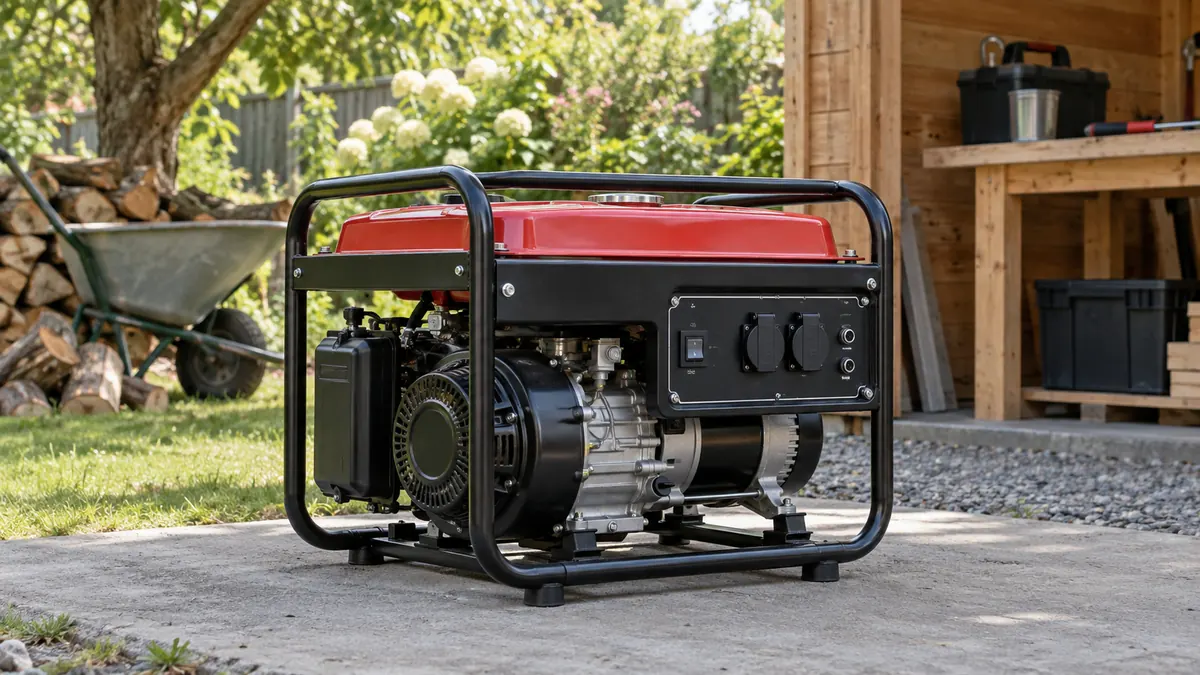
A documented Generac GP8000E example
Generac's specification sheet for model 7676 identifies a gasoline portable generator rated at 8,000 running watts and 10,000 starting watts, with 120/240 V output. It lists a 7.9-gallon tank and a 420 cc engine. These figures describe that named North American model only; they are not a benchmark for every gasoline generator or an active-offer claim.
| Model document | Published data | How to use it |
|---|---|---|
| Generac GP8000E, model 7676 | 8,000 W running / 10,000 W starting; 120/240 V; 420 cc; 7.9-gallon tank | Use running watts for sustained load, starting watts for brief motor demand, and confirm outlet-specific ratings in the manual |
The manufacturer offers other GP8000E revisions and packages, so match the exact model code and data plate before relying on the example. It is a documented reference point, not a hands-on test, a current retailer offer, or a claim that this size is suitable for a particular home.
- Use rated/running output for sustained loads and starting/peak output for motor startup; do not treat those numbers as interchangeable.
- Add only loads that must run simultaneously, then compare their startup requirements with the generator's published capability.
- For each model, verify outlet type, voltage, fuel capacity, stated runtime load and noise measurement distance in the manual.
Choose a model by market and generator type
The current model pages in this silo document examples from different electrical regions. Read them as separate model references, not as a head-to-head ranking. A generator from one region may have a different receptacle panel, voltage, frequency, emissions label, warranty or service network from a similar model sold elsewhere.
| Model guide | Documented scope | Why check it |
|---|---|---|
| Generac GP8000E | North American 120/240 V conventional generator; model suffix matters | Compare rated/starting output and outlet limits on the exact revision |
| Hyundai HY4500SEi | European-market 230 V inverter variant | Check continuous output, frequency and the UK/European model identity |
| maXpeedingrods MXR3500-EU | 230 V/50 Hz European variant | Do not transfer specifications from similarly named regional models |
| GENERGY Aneto 5500W | European 230 V range; the product page labels its outlets 220 V | Confirm rated output, frequency and exact package from the data plate |
Each linked page is a source-based model guide. None implies that the unit has been physically tested or that a retailer has a current matching offer. For a specific purchase, compare the model code in the manufacturer document with the seller's data plate photo and package details.
Size running and starting loads
For a refrigerator, pump or air conditioner, the startup draw may be more important than the appliance's steady load. Make a load list, check nameplates and ask an electrician about the transfer method before buying. Inverter status alone does not establish power quality for a specific device; consult the generator and device documentation.
Plan output, fuel and installation
- Match the full model suffix and fuel, then compare running and starting output for that fuel and voltage.
- Check receptacles, circuit protection, transfer-switch requirements, frequency and regional electrical standards.
- Confirm package contents, regulator or hose, maintenance schedule, weight and current local service support.
- Plan outdoor placement more than 20 feet from doors, windows and vents before operating.
Make a practical appliance load sheet
Write down what must operate at the same time rather than adding every appliance in the building. For each item, note the voltage, normal watts or amps, and whether the load contains a motor, compressor or heating element. Give priority to essential circuits, then decide which lower-priority loads can be switched off while a pump, refrigerator or other high-startup device starts. The goal is a safe, workable sequence rather than a theoretical maximum.
Compare the total continuous load with the generator's rated watts. Check each motor's starting demand separately against the starting rating, and consider whether two motors could start together after a power interruption. If labels list only amperes, use the appliance manufacturer's electrical information to convert or clarify the load; voltage multiplied by current is not always enough for motors because of power factor and startup behavior. Do not size a generator from the peak number alone.
Then inspect the outlet panel. A model's total wattage does not mean one receptacle can supply all of it, and an adapter does not increase the circuit rating. Match the current and voltage of the appliance plug to a generator receptacle with suitable protection. For fixed wiring, a qualified electrician must select and install approved transfer equipment so utility power and generator power cannot feed the same circuit unsafely.
A simple first-pass worksheet is: (1) list the essential loads, (2) add the running watts of items used together, (3) identify the largest motor start and any overlapping starts, (4) compare both totals with the exact model's rated and starting figures, and (5) check each outlet's current limit. If the manual or appliance maker does not publish a critical figure, leave it unresolved and ask before buying instead of estimating from a product family name.
Estimate fuel needs without guessing runtime
Gasoline use depends on engine design, load, operating mode, temperature and maintenance condition. Prefer a manufacturer runtime table that shows the fuel volume and load used for each claim. A single “hours per tank” figure without a stated load is not a reliable emergency plan. If the manual provides no comparable data, treat fuel consumption as unknown and run a supervised test with the intended loads before relying on the machine.
Plan where gasoline will be stored and how it will be transported under local fire and safety rules. Use approved containers, keep fuel away from ignition sources, and follow the manual on cool-down and refuelling. Never refill a hot or running generator. For long storage, follow the engine maker's instructions for fuel stabilization or draining; do not substitute a generic maintenance interval for the model manual.
Also account for service items such as oil, air filters, spark plugs and battery condition on electric-start models. A generator that starts after months in storage is not proven to carry the intended load, so check its maintenance status and test it outdoors before an outage.
Set a reminder for the maintenance interval in the model manual and keep a dated record of test runs, oil changes and fuel-system preparation. If the generator is used only seasonally, inspect it before storage and again before the next period of use; do not rely on a successful start as proof that its outlets and load capacity are ready.
To estimate operating cost, use the maker's fuel-consumption data at a load close to yours and multiply by the local price per litre. If only a tank runtime is given, preserve its stated load and tank size; do not assume the machine uses fuel at a constant rate as load changes. The Aneto guide, for example, separates its 28 L tank and 17.5-hour claim at 25% load from unknown runtime at other loads.
Plan outlets and circuits before purchase
Generator wattage is a total-output figure, not a promise that every receptacle can deliver that total. Read the outlet table and circuit-breaker limits in the exact manual. If a generator has several sockets, add the loads that will be connected at the same time and keep each branch within its own rating. A plug adapter can change shape but cannot create a higher-current circuit, split phases correctly or make a 120 V supply suitable for 230 V equipment.
For a portable appliance, compare its plug, rated voltage, frequency and current with the generator outlet. For household backup, decide which circuits are essential, whether any load is 240 V, and whether the generator provides the phase and connection type the electrician needs. A generator's headline running watts may be split across legs or outlets in a way that matters to the intended load. Ask an electrician to check the exact panel and generator diagram instead of assuming the total is available at any one socket.
Record each uncertainty before buying: outlet current, GFCI or residual-current protection, neutral bonding, earthing arrangement, transfer equipment and compatible cable gauge. Do not modify the generator plug, remove a protective earth, or connect it through a wall outlet. An approved transfer switch or interlock isolates the building from utility power; this is a design and installation decision for a qualified professional under the local rules.
After the electrical plan is clear, compare the practical package. Check whether the machine includes the battery for electric start, wheels and handles for its weight, the correct regional plug, and the maintenance items called for in the manual. A lower advertised price may exclude pieces needed to move or safely connect it. Save the seller's full model code and package list so a similar-name revision cannot silently replace the model you researched.
Read the model plate and compare listings
Portable generator names often share a family name across different output, voltage, fuel or emissions versions. Compare the complete model and suffix on the data plate with the manual, product page and invoice. A listing can show a related model or a package that omits the battery, wheel kit, cover or cable shown in its photos.
- Confirm rated and starting watts at the correct voltage and frequency.
- Check the number, type and current rating of outlets and any GFCI or circuit protection.
- Compare tank capacity and runtime only under matching test loads.
- Verify emissions certification, warranty, parts and service availability in the intended country.
- Ask whether a published noise figure is sound pressure or sound power, and note its measurement distance.
Do not use a product photo or generic retailer search to prove the exact generator is in stock. The current examples in this guide are there to explain how to read specifications; they are not endorsements or a ranked list.
Choose between inverter and conventional models
Fuel and electrical conversion are separate choices. A gasoline generator can be an inverter model or a conventional alternator design; an inverter label alone does not guarantee a particular THD, noise level, runtime or appliance compatibility. Start with the load and electrical system, then choose the format that meets portability and operating constraints.
- For light or mobile loads: compare carry weight, handles, rated output and runtime under the expected load. Read the inverter generator guide if size, output stability or parallel operation matters.
- For larger fixed-site loads: compare the conventional model's continuous output, individual outlet circuits, noise measurement, weight and refuelling plan.
- For backup wiring: decide which circuits matter and have a qualified electrician design the transfer connection; never back-feed a wall receptacle.
- For a different fuel: compare the dual-fuel selection guide, keeping each model's fuel-specific ratings separate.
A spec example is not a ranking
This is a practical selection guide, not a hands-on test or a “best generator” ranking. The linked model pages explain what the cited manufacturers publish and identify unresolved details. A spec sheet does not confirm current price, retailer stock or the delivered package.
Carbon-monoxide and connection safety
The CDC advises keeping generators outdoors at least 20 feet from doors, windows and vents; never run one inside a home or garage. Use a battery-powered or backup CO detector. Refuel only as the manual directs after cooling, and never connect a generator directly to building wiring.
📚 Sources and references
Authoritative sources consulted to write this guide: