

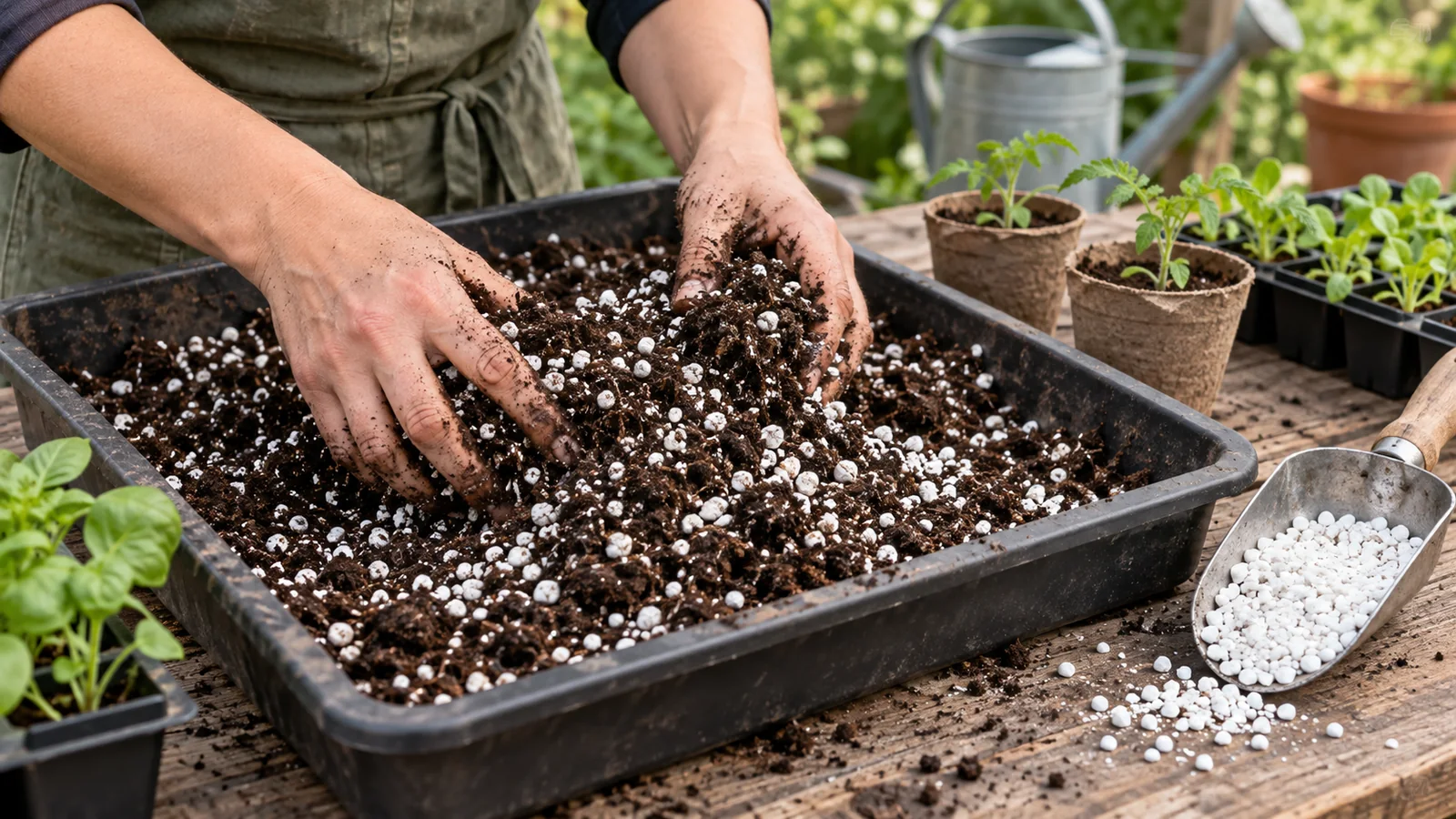
What perlite is and what it does
Horticultural perlite is processed volcanic glass expanded by heat into light, porous particles. In a growing medium, those particles act as a structural component rather than a nutrient source. Penn State Extension lists perlite among propagation materials that can provide drainage and aeration; Oregon State University Extension also describes inorganic amendments as components that can alter porosity. The result depends on particle size, the other ingredients, how much is added and how the container is watered.
Perlite itself does not supply a complete fertilizer program. It does not add organic matter, replace a drainage hole, or make any soil suitable for a pot. If the plant is yellowing or wilting, inspect water, roots, light and pests before changing the mix. A material that improves air space in one medium can make another mix dry too quickly. Think of perlite as one ingredient in a growing medium, not a universal cure.
For background, Penn State Extension includes perlite in its houseplant propagation guide, while Illinois Extension explains the need for container media to balance aeration, drainage and water retention in its container soil guide.
Understand perlite in potting mix
Container roots need access to water and oxygen. The spaces between particles influence how water moves, how much remains available and how easily air reaches the root zone. Adding a coarse, lightweight material can alter that structure, but the change is not determined by the ingredient name alone. A fine or decomposed mix may behave differently from a new bark-based mix, and a small pot dries differently from a deep planter.
Perlite can reduce the density of some mixes and create a more open texture. In a mix that already drains freely, adding more may reduce water retention or increase the need to irrigate. In a dense medium, it may help change the balance of pore spaces, but it cannot correct a blocked outlet, a pot with no hole or a location that stays waterlogged. The plant’s roots, pot shape and watering pattern all matter.
Do not judge a mix only by how quickly water disappears from the top. Water may run through a gap between the root ball and pot wall while the center remains dry, or a fine medium may hold water below the surface. Check moisture at the depth where roots grow. If the plant is healthy and the current mix works, there is no reason to add perlite simply because it appears in a recipe online.
Decide when perlite may help
Consider an amendment when there is a clear reason to change the medium: the current mix is dense, the intended plant needs a more open root environment, a propagation medium needs suitable air and moisture balance, or the product manufacturer recommends an adjustment. Start by checking the plant and the container. Ensure drainage holes are open, remove standing water from saucers and make sure the mix is intended for container use.
For plants that prefer a well-drained medium, a mix containing bark, coarse mineral components or perlite may be appropriate, depending on the species. Illinois Extension describes choosing coarser media for succulents, herbs and perennials and more moisture-retentive mixes for tropical foliage plants. This is a broad comparison, not a fixed formula. Verify the needs of the exact species and variety, especially for orchids, carnivorous plants, bonsai, seedlings and other groups with specialized media.
If a plant is declining, do not repot only because the potting mix contains little visible perlite. Check whether roots are healthy, whether the pot is oversized, whether the medium has compacted and whether water is being applied appropriately. A plant with root rot may need a broader correction, while a dry plant may need a change in watering rather than a more porous mix. Identify the problem before changing the substrate.
Match amendments to plant needs
Different plants require different moisture regimes. Succulents and cacti generally need a medium that drains and dries appropriately for their species and climate; many tropical foliage plants prefer a more even moisture supply. Seed-starting and propagation media may prioritize clean, fine texture and reliable moisture around small roots. These uses should not be treated as interchangeable, and perlite should not be added in the same amount to every container.
Check the growing-medium label and plant-care guidance. Commercial potting mixes often already contain perlite, vermiculite, bark or other ingredients. Adding more without checking can make a mix lighter or drier than intended. For a potted crop, consider how often you can water, whether the container is exposed to wind or sun and how quickly the current mix dries. A high-drainage mix may be impractical if you cannot check the plant regularly.
For outdoor garden beds, perlite is not a universal solution for heavy clay or poor drainage. Soil structure at garden scale differs from the limited volume inside a pot; improving the site may require a different approach, and mixing small amounts of a light amendment into a large bed may not change the underlying conditions. Consult a local extension service for the soil type and crop. Oregon State University’s soil amendment overview explains that amendments need to be selected for the soil and intended use.
Compare perlite with vermiculite and other media
Perlite and vermiculite are both common ingredients, but they do not serve identical roles in every mix. Penn State Extension describes perlite as providing good water drainage and aeration in propagation, while vermiculite holds water well. Coarse bark can contribute structure and drainage while also adding organic material; coir and peat-like components are used for water retention, though their properties differ. The correct combination depends on the plant and the product formulation.
| Ingredient | Typical role in a mix | What to verify |
|---|---|---|
| Perlite | Light mineral component used to alter air space and drainage | Whether the mix is already open and how often it will need moisture checks |
| Vermiculite | Mineral component often used where moisture retention is useful | Whether the plant tolerates the resulting water-holding behavior |
| Bark | Coarse organic structure in some container and specialty mixes | Particle size, decomposition and species compatibility |
| Coir or peat-based ingredients | Components that can hold water within a formulated mix | Product label, wetting behavior and how the mix drains |
| Pumice or coarse mineral grit | Alternative mineral structure in some specialty mixes | Particle size, weight and the needs of the particular plant |
These are general roles, not strict categories: commercial products differ, and two ingredients can be blended to achieve a target balance. Do not assume that a bag labeled “succulent mix” contains a fixed percentage or that a recipe from another climate will behave the same in your home. Compare the ingredient list, intended use and manufacturer guidance before changing an established mix.
Choose an amount without a universal recipe
There is no single percentage or cup measure for every container. The amount depends on the starting mix, particle size, plant, pot, local temperature, watering routine and desired balance of air and water. A recipe designed for cuttings may not suit a mature houseplant or a vegetable planter. If a manufacturer provides a ratio for a specific product, follow that direction and do not assume it applies to another brand or medium.
For a healthy plant that simply needs repotting, begin with a quality mix designed for that plant rather than adding ingredients by default. If you have a clear reason to alter the mix, change a small batch first and observe how it wets and dries before using it across a collection. Use the same plant or a low-risk test container when possible. Record the blend so you can repeat it only if it performs well.
When mixing components by volume, use a consistent container and blend thoroughly so the amendment is distributed rather than concentrated in one layer. Avoid making a large batch based on an unverified internet ratio. Do not use perlite as a substitute for fertilizer: if a plant needs nutrients, select a fertilizer product separately and follow its label.
Mix perlite into a container medium
- Identify the plant and the reason you plan to change the growing medium.
- Check the current mix label for perlite or other aeration ingredients already present.
- Confirm the container has working drainage holes and the plant’s root system will fit.
- Read the perlite package for handling and use directions; keep dust down and follow any warnings.
- Measure components consistently and blend them evenly in a clean container.
- Moisten the mix lightly if it is very dry and dusty, without saturating it.
- Repot at the appropriate depth, keeping the crown or stem base at the correct level for the species.
- Water according to the plant’s needs and observe moisture at root depth over the next few cycles.
- Adjust care based on actual drying behavior, not on the presence of perlite alone.
Do not put a layer of perlite or gravel at the bottom of a pot and expect it to correct the whole medium. Mix amendments through the root zone when appropriate and keep the drainage opening open. If the container is unusually deep or uses a false bottom, follow the planter maker’s instructions and make sure the plant still has adequate root volume.
Fix the actual drainage problem
If water stands on the surface, first check whether the mix is hydrophobic, compacted or too fine for the container. If a pot remains wet for days, examine the drainage hole, pot size, saucer and watering frequency. If water rushes straight through, inspect for gaps between the root ball and the container or a dry mix that is not absorbing water evenly. Perlite may not address any of those causes on its own.
Keep the container outlet clear and remove excess water from a cachepot. A saucer protects the surface but should not become a permanent reservoir unless the plant is grown in a system designed for it. Do not use a coarse bottom layer as a shortcut. Illinois Extension’s container drainage guide explains the importance of an open hole and the myth that gravel improves drainage.
For a garden bed with persistent standing water, inspect site grade, soil type and drainage at the location. A potting ingredient cannot solve a structural water issue across an entire yard. Seek local advice before adding amendments, especially where drainage changes could affect a foundation, neighbor or public path.
Use perlite for propagation where suitable
Perlite is one possible propagation material because it can provide drainage and aeration while supporting cuttings. It may be used alone or blended with other materials depending on the plant and propagation method. Penn State Extension lists perlite among suitable media alongside vermiculite, sand and bark, and notes that the requirements differ across methods. A cutting still needs the correct moisture, light, temperature and hygiene; perlite does not guarantee roots.
Use clean containers and clean material according to the package instructions. Keep the medium appropriately moist for the species without leaving it saturated. Small cuttings can dry quickly in an open, warm room, while a covered propagation setup can stay too wet if airflow is poor. Label the plant and date so you can monitor progress. If a cutting rots, review moisture and cleanliness rather than adding more perlite as the only response.
Once roots have developed, acclimate the plant to the next growing medium and conditions recommended for its species. A propagation substrate may not supply nutrients or have the water-holding balance needed for long-term growth. Transplant gently and avoid leaving a plant indefinitely in a medium chosen only for rooting cuttings.
Handle and store perlite carefully
Dry lightweight particles can become dusty when poured or mixed. Follow the package safety information, work in a ventilated area and avoid creating airborne dust. If the product label advises a mask, gloves or another precaution, use it. Lightly dampening dry material can help keep particles from dispersing, provided the manufacturer permits it. Keep the bag closed when not in use and store it away from children, pets and food.
Do not pour perlite down a sink or drain, where particles may collect. Clean the work area using a method that does not spread dust; follow the product directions. If perlite gets in the eyes or is inhaled and irritation persists, follow the package first-aid instructions and contact an appropriate health professional. This is a handling precaution, not a claim that all products have the same composition or risk profile.
Use horticultural perlite intended for growing media rather than assuming a construction or industrial product is suitable for plants. Check the label for intended use, particle size and any added ingredients. Dispose of unused material according to local guidance and product instructions.
Avoid common perlite mistakes
Using it as fertilizer: perlite is a physical amendment, not a complete nutrient source. Adding it to every plant: an existing mix may already have enough aeration. Following a universal ratio: recipes depend on species, material and conditions. Pouring it as a bottom layer: that does not replace an open drainage hole. Adding it to a garden bed without diagnosis: container and field soil problems need different solutions.
Also avoid repotting a plant only because its leaves look unhealthy; check water, roots, light and pests first. Do not assume a visible white particle is perlite without checking the mix ingredients, and do not leave dry dusty material exposed while mixing. If the current medium is working and the plant is healthy, changing the recipe may add work without improving care. Continue with the parent soil and substrate guide or compare vermiculite for plants when you need to understand moisture-retaining alternatives.