

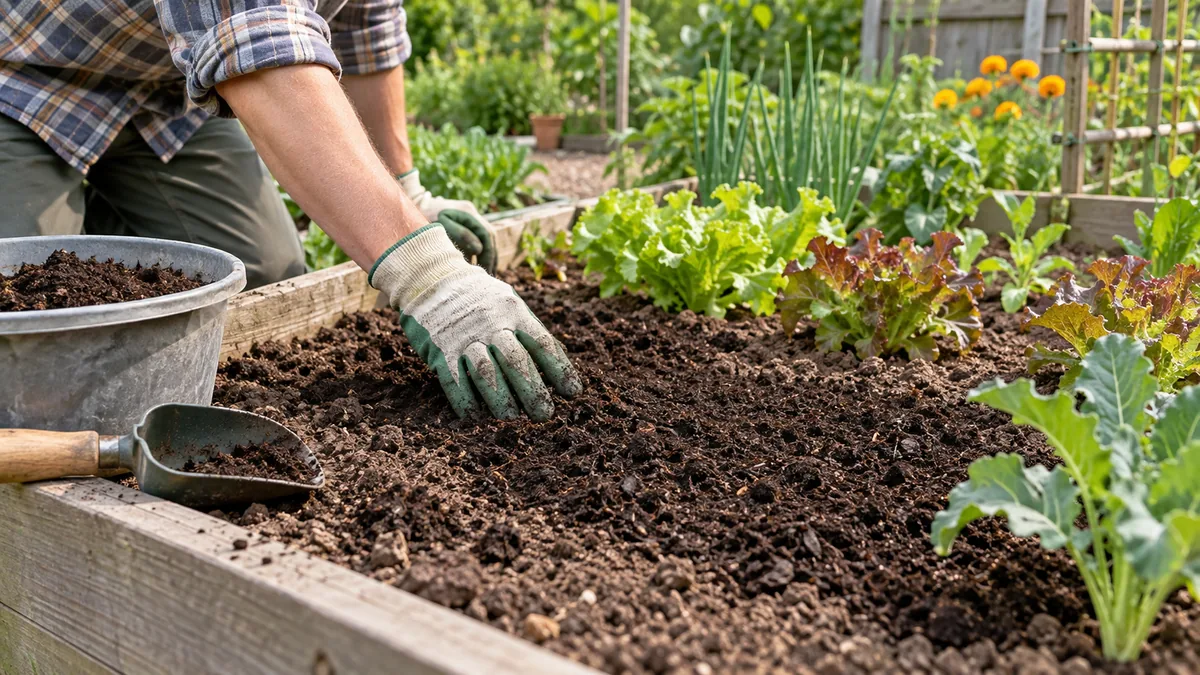
Check maturity and know what is in the compost
Before using a batch, check how it was made, what materials went in and whether the process was completed. Dark, crumbly material with an earthy smell can be a sign of finished compost, but appearance alone does not verify pathogen control or nutrient content. Keep material with recognizable inputs in the pile or use it only as local guidance permits.
If the compost contains manure or you do not know its source, follow food-safety recommendations for the material and crop. UMN Extension explains that treatment and handling affect risk in its guidance on animal-based compost in vegetable production.
Use a soil test before deciding how much to apply
Garden soil may already contain nutrients from earlier compost, manure or fertilizer. Test the soil and read crop recommendations before adding more. When available, a compost analysis can estimate the nutrients the material contributes; compost batches differ in nutrient concentration.
Penn State Extension’s vegetable-garden compost guidance explains how soil and compost test results can inform application and warns that over-application can contribute to nutrient losses. Avoid copying a rate from another region, soil or compost batch.
Plan the application around crop and bed conditions
Use the soil-test recommendation, compost analysis, crop needs and local Extension guidance to decide whether an application is needed. If you cannot test, follow a conservative regional recommendation rather than adding compost on a fixed yearly schedule. Penn State's article above provides a regional example and notes a thin application as a practical approach when analysis is unavailable; it is not a universal rate for every soil or garden.
Measure the bed area and the product volume before spreading. Apply evenly where the guidance recommends, keep material away from stems and crowns, and avoid incorporating it when the soil is wet or easily compacted. Recheck soil results over time instead of repeating the same application automatically.
Use compost differently in beds and containers
For an in-ground bed, the soil test and local crop guidance determine whether compost is useful and how it should be incorporated. In a raised bed, first identify whether the structure is open to native soil or is a bottomed container. For a planter, use a growing medium designed for the container and crop; do not assume pure compost has the drainage, aeration or nutrient balance needed on its own.
See our raised-bed planning guide for fill and drainage decisions. For crop-specific nutrient questions, compare the recommendations in our garden fertilizer guide and follow the soil-test report.
Avoid overusing compost or treating it as complete fertilizer
Compost is an amendment with variable nutrients, not a guaranteed complete fertilizer. Repeated applications based only on plant nitrogen needs can add more phosphorus than the garden requires. Penn State Extension details the calculation using compost and soil testing; UMN Extension also describes problems caused by over-applying compost and manure.
Fresh manure, immature compost, or material from an unknown source may need additional precautions. Follow local food-safety guidance and the supplier’s documentation rather than relying on a general “organic” label.
Read the soil-test report before adding nutrients
A soil test is useful only when you match the result to the crop and the amendment you plan to use. Read the laboratory’s recommended action, the units it uses and any notes about pH, phosphorus, potassium or organic matter. If the report includes a target range or a crop-specific recommendation, follow the lab or local Extension explanation instead of translating a number from an unrelated article. A high nutrient result is a reason to pause before adding more compost.
Keep the test result with a map of the garden beds and a record of prior amendments. If one bed has received compost for several years while another has not, a single sample that mixes both areas may hide the difference. Sample areas that have been managed differently separately, using the laboratory’s directions for sample depth, number of subsamples and containers. Avoid sampling immediately beside a recent amendment pile or fertilizer band because that does not represent the whole bed.
Soil tests do not all measure every nutrient in the same way, and recommendations are calibrated for local soils and crops. Ask the testing laboratory or a regional Extension office how its report should guide a vegetable garden. In particular, do not infer that compost is needed because a soil looks pale, compact or low in organic matter; texture, drainage, pH, nutrient status and plant symptoms are separate observations that may need different responses.
Request a compost analysis when the source is uncertain
Compost varies with its feedstocks, process and maturity. A municipal leaf compost, a manure-based product and a home batch made from mixed garden materials should not be treated as identical. When applying a large volume, using compost regularly or working with a purchased batch, ask whether a recent analysis is available. The report may help identify nutrient concentrations, salts, pH, moisture or other properties relevant to the intended use.
Check that the analysis describes the batch you actually have and find out whether the results are reported on a wet or dry basis. Those details affect how a nutrient value relates to the volume spread on a bed. If the seller cannot provide a current analysis, use a conservative regional recommendation and avoid repeatedly adding material by habit. Penn State’s vegetable garden compost article explains why compost nutrient content and soil test values matter when deciding an application.
Appearance and smell can help flag an obviously unfinished or poorly managed batch, but they do not prove the material is pathogen-free or suitable for every crop. Ask the supplier about feedstocks and process documentation when those questions matter. If you do not know the batch history, do not use it in a way that conflicts with food-safety guidance for edible crops.
Measure the bed and apply compost consistently
Once a test or regional recommendation supports using compost, measure the area rather than estimating from the number of buckets. Record bed length and width, convert to the area units used by the recommendation, and measure the compost volume using the same container each time. This makes the application repeatable and helps you keep a useful record for the next soil test. If beds differ in crop, history or test result, calculate and record them separately.
Spread material evenly and keep it from piling against stems, crowns or young transplants. Whether to mix it into the surface, place it before planting or use it as a top-dressing depends on the crop, compost maturity, soil condition and local recommendation. Work soil only when it is dry enough to crumble rather than smear; turning wet soil can damage its structure. For no-till or perennial beds, follow guidance for that production method rather than digging deeply by default.
For a raised bed, distinguish a shallow layer of compost used as an amendment from the whole growing medium used to fill a container-style structure. Pure compost can have unsuitable drainage, aeration or nutrient properties as the sole medium. For containers and planters, use a crop-appropriate growing mix and treat compost as an ingredient only when a local or product recommendation supports it. Our raised bed guide covers structure, drainage and fill planning separately.
Handle manure-based compost with food safety in mind
“Composted manure” is not a complete description of treatment or handling. Risk depends on the source material, process, storage, cross-contamination and how the finished amendment is used. Ask for documentation when buying it, keep raw manure and finished compost separate, and use clean tools and containers for each. Do not bring unverified material into a bed simply because the package says “natural” or “organic.”
Follow current local food-safety advice for animal-based amendments and edible crops, including any crop-specific interval between application and harvest. Requirements and recommendations can differ by jurisdiction and production setting. The University of Minnesota’s guidance on animal-based compost in vegetable production explains why the production process and handling matter. Home gardeners should apply the relevant local recommendations and product instructions, not assume a generic interval applies everywhere.
Wash harvested produce under running potable water and keep soil and amendment off edible portions, while recognizing that washing does not make an unsafe amendment safe. If a batch’s source or treatment is unknown, choose a documented alternative or ask the local Extension service how to handle it. Keep children and pets away from active piles and store finished material so it cannot be mixed back with raw inputs.
Recognize signs of repeated compost overuse
Adding more compost is not always the answer when vegetables grow poorly. Excess nutrient levels, high salts, unsuitable pH, poor drainage, compaction, inconsistent watering, pests and disease can produce overlapping symptoms. Dark, lush foliage is not proof that nutrient balance is right, and yellow leaves do not automatically mean the bed needs fertilizer. Use the soil-test report and inspect roots, moisture and drainage before making another amendment.
Repeated heavy applications can accumulate nutrients that move beyond the root zone or leave the garden in runoff. If a test reports high phosphorus or another nutrient, stop adding compost and fertilizer containing that nutrient until the lab or regional recommendation says otherwise. Keep leaves and crop residue on the surface only where the crop and disease-management guidance supports it; do not use that as a reason to ignore a soil imbalance.
Do not try to correct a high test result with another untested material. Record the compost source, approximate amount and dates, then ask a local Extension office or soil laboratory for a plan based on the actual report. The same source can behave differently in sandy, clay-rich or container soils, which is why a broad rate copied from another garden is a poor substitute for the test.
Recheck soil and crop response after application
After applying compost, write down the bed, date, source, quantity, incorporation method and crop. Note rainfall or irrigation soon afterward, since runoff or waterlogging can affect the bed independently of compost. During the growing season, observe plant growth and drainage, but do not diagnose nutrient status from appearance alone. Use a repeat soil test at the interval and timing recommended by the laboratory, especially before making another nutrient application.
Compare repeat results with the same lab where possible because laboratories may use different extraction methods and reference ranges. If you change labs, include the method and units when reviewing trends. Keep the records with crop rotations and prior fertilizer use. This turns compost use into a measured soil-management decision and helps prevent an automatic annual application from accumulating nutrients over time.
Frequently asked questions about using compost
If you are still building a compost pile, see the guide to what to add and how to manage it. To compare composting system types, visit our compost bin and system comparison.