

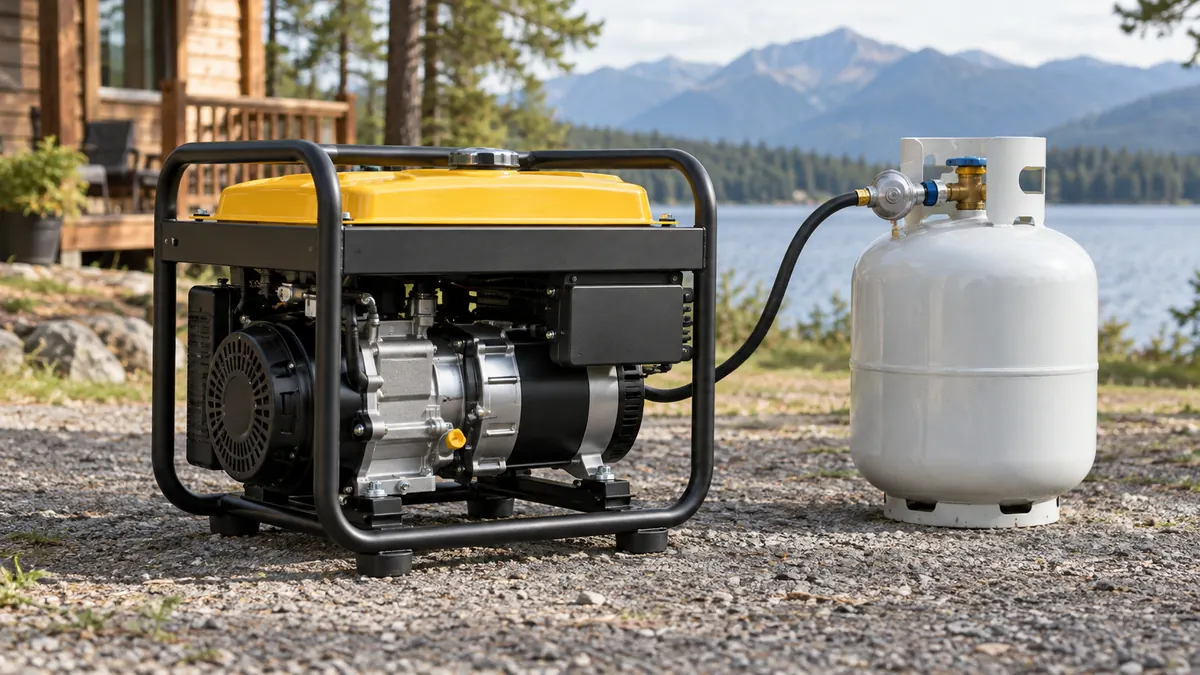
Fuel-specific ratings in two manuals
- DuroMax XP10000EH is gasoline/propane; its manual provides separate fuel-start procedures and identifies the propane regulator.
- Westinghouse WGen12000DF has different running and peak watt ratings for gasoline and propane in its manual.
- The Könner & Söhnen KS 4100iEG is a European 230 V/50 Hz inverter model, not a substitute for the North American 120/240 V examples below. Its current Spain product page is internally inconsistent: a technical footnote says LPG reduces output by 10%, while the “economic choice” marketing section says it runs without power loss. The 2026 English and 2023 Spanish manuals also say LPG reduces output by 10%; an older indexed Spanish storefront copy made the no-loss claim and its former route now returns 404. Follow the current manual supplied with the exact unit rather than generalizing either statement.
- The Könner & Söhnen KS 3000G is a separate European 230 V/50 Hz conventional generator. Its official page lists 3.0 kW maximum and 2.6 kW nominal output and identifies gasoline/LPG operation; the manual does not provide a separate LPG output rating. Its published 15-hour figure is at 50% load and is tied to the gasoline tank, so it does not establish LPG runtime or an equal-power claim.
- A retailer search query is not proof of an exact model, kit or current offer.
| Exact model | Gasoline running / starting | Propane running / starting | Electrical market in cited manual |
|---|---|---|---|
| DuroMax XP10000EH | 8,000 / 10,000 W | 7,600 / 9,500 W | 120/240 V, 60 Hz |
| Westinghouse WGen12000DF | 12,000 / 15,000 W | 10,800 / 13,500 W | 120/240 V, 60 Hz |
These are North American manual ratings. They show why the fuel and output column must travel together: the lower propane figures change the usable capacity, and neither model's 120/240 V, 60 Hz panel should be assumed to match a 230 V/50 Hz electrical installation. Check the precise outlet current and protection limits before using any listed total.
The table deliberately excludes the European K&S models from the North American watt comparison: their manufacturer material specifies 230 V/50 Hz. The KS 4100iEG model guide documents an unresolved conflict between the live Spain page's LPG footnote and marketing copy, as well as the 2026 EN and 2023 ES manuals' 10% reduction. For the KS 3000G, the official manual lists one 3.0/2.6 kW rating pair, but no separate LPG output; the 15-hour runtime is tied to gasoline at 50% load. Neither model supports a universal rule about LPG output. Use the manual and rating plate for the exact unit.
Compare load, outlets, fuel and package
Choose fuel flexibility only after comparing output under both fuels, storage and connection logistics, maintenance instructions, noise data at a stated distance, and the exact outlet panel. Confirm fuel-specific starting instructions in the manual before switching. Do not assume two dual-fuel models have equal propane output or that any hose is compatible.
Choose the fuel and load first
- Match the full model suffix and fuel, then compare running and starting output for that fuel and voltage.
- Check receptacles, circuit protection, transfer-switch requirements, frequency and regional electrical standards.
- Confirm package contents, regulator or hose, maintenance schedule, weight and current local service support.
- Plan outdoor placement more than 20 feet from doors, windows and vents before operating.
Decide whether two fuels solve a real problem
Dual-fuel capability is useful when you have a reliable supply of both approved fuels and value the option to change the operating plan. It adds decisions about fuel-specific capacity, storage, cylinder size, regulator pressure, connection type and changeover procedure. If you will always use one fuel, a gasoline-only model may be simpler to maintain and compare.
Before choosing, write down the situation you are solving: temporary outage, workshop, remote property, travel or another permitted use. For each, identify the essential load, likely run time, fuel available at the location, storage rules and noise restrictions. Then confirm that the exact generator is approved for the intended environment and that its manual allows the planned fuel connection.
Inverter capability is independent of dual-fuel capability. Some dual-fuel units are inverter models, while others use an open-frame conventional design. See the inverter generator guide if power conversion, portability or product-specific THD matters; compare gasoline-only options in the gasoline generator guide.
Compare gasoline and propane for your use
Dual-fuel capability is useful only if the second fuel fits how you can store, source and connect it. Gasoline may be easy to obtain locally but needs approved storage and can degrade during long storage. Propane can be stored in a cylinder when local rules allow, but you must have the right cylinder, regulator, hose and connection sequence for the generator. Neither option removes the need to maintain the engine or to operate it outdoors.
Do not compare fuel choice by convenience alone. Each model has separate output ratings and may use less power on propane than on gasoline. A generator's “10,000 watts” headline may refer to starting output on one fuel; consult the table and identify whether the figure is running or peak output. If the product manual does not list both fuels clearly, ask the manufacturer before purchase.
Propane availability also depends on the country and cylinder system. Check cylinder size, fill or exchange access, storage requirements and local rules for the site. Confirm whether an included regulator supports the intended cylinder and whether an additional approved adapter is needed. Never improvise a connection using a hose intended for another appliance or a different generator.
Size loads and plan runtime by fuel
Make a load list for the exact devices you need. Compare continuous watts with the generator's running rating on the fuel you expect to use. Then consider motor starting demand separately, including whether multiple pumps, compressors or refrigerators could restart at once. If their startup loads overlap, a generator that appears sufficient from running watts alone may trip or overload.
Runtime claims must state the fuel and load conditions. The gasoline tank figure does not predict propane runtime, and a cylinder's nominal capacity does not reveal how long a particular generator can run. Use the manufacturer's fuel-specific tables; if they omit a load or cylinder size, describe it as unknown rather than extrapolating from another model. Keep a margin for startup loads and refueling interruptions.
For backup power, list loads by priority and decide in advance which ones can be turned off when another starts. For a worksite, compare the duty cycle with maintenance intervals and site rules. For travel or recreation, include the generator's weight, the cylinder's weight, transport limits and the noise rules at the destination. The same machine may suit one setting but be impractical in another.
Compare fuel cost with like-for-like data
Do not compare gasoline tank runtime with propane cylinder runtime unless the load and test method are comparable. Use the manufacturer's fuel-consumption figure at the load you expect, then multiply litres per hour by the current gasoline price per litre or kilograms per hour by the local propane price per kilogram. If a manual provides only “hours per tank” at a stated percentage, preserve that condition and do not present it as a full-load estimate.
The calculation is only as useful as its input. Weather, altitude, fuel quality, maintenance and the actual appliance mix can alter consumption. If a model has no published propane consumption at your load, mark the cost as unknown and ask the manufacturer; do not estimate it from another generator's engine size or tank.
Check the hose, regulator and exact package
Model suffixes can identify different fuel systems, outlets or package versions. Before ordering, match the full code on the retailer page to the manufacturer's manual and confirm whether the offer includes the propane regulator, hose, battery, wheel kit, oil and tools. A product photograph may show accessories that are not included in the selected package.
- Verify the actual data plate, voltage, frequency, running and starting ratings, and ratings for each fuel.
- Check the exact cylinder connection and regulator pressure specified in the manual.
- Confirm fuel switching and shutdown procedures; never change fuels while running unless the manual expressly allows it.
- Review local cylinder storage, transport and ventilation requirements before choosing a site.
- Check local warranty and service support because a model sold in another region may not be supported.
If the package or model identity is unclear, request a photograph of the data plate and a copy of the matching manual. Do not treat a retailer category page or a search query as proof of an exact offer.
Plan fuel changeover and test each mode
Before the first use, read the manual's separate starting, warm-up, switching and shutdown steps for gasoline and propane. Some models require the engine to stop before a fuel change; a generic description such as “switches fuels easily” does not establish that a running change is safe. Check how the maker wants the unused fuel supply isolated and inspect the hose and connectors for damage before attaching a cylinder.
Test the generator outdoors with each fuel you plan to rely on. Start with no connected load if the manual requires it, let the engine stabilize as directed, then add known loads in stages while watching the outlet limits and overload indicators. Record the fuel used, load, weather and runtime. This does not replace the manufacturer's rating or certify a home backup setup, but it can expose a package problem or unexpected operating issue before an outage.
Also test the changeover plan as a logistics exercise without improvising a live connection. Check that you can reach the shut-off valve, keep the cylinder upright and secured as required, route the hose clear of hot parts and traffic, and store the spare fuel legally at the site. If the second fuel is only available at a distant exchange point or the listed regulator does not fit your cylinder, the flexibility may not be useful when needed.
Keep a written record with the model suffix, manual revision, fuel-specific ratings and maintenance dates. A later replacement hose, regulator or engine part can change compatibility; check replacements against the model's parts list rather than relying on a generic size. If the manual and product page disagree, ask the manufacturer for a clarification tied to the exact serial or production revision and use the conservative documented limit until it is resolved.
Record a safe test for each fuel
Before relying on a dual-fuel generator for an outage, test it outdoors under the manufacturer's procedure with each fuel you expect to use. Confirm the actual model and manual revision first, because starting and shutdown steps differ. If a manual says to start without electrical loads and wait for the engine to warm, follow that sequence; connect one known load at a time and stay within the rating for the fuel being tested.
For each run, record the fuel, load, elapsed time, weather, indicator readings and any overload or instability. Do not use that short test to invent a full-tank runtime or replace a manufacturer rating, but it can show whether the intended appliance starts and whether cables, plugs or breakers become unusually warm. Stop if the machine behaves abnormally, a gas connection leaks or the manual's limit is reached.
Test the intended electrical plan as well. A generator cord connected directly to a home receptacle is unsafe; a qualified electrician must install approved transfer equipment and verify neutral, grounding and circuit requirements. Keep the machine outdoors with exhaust away from the building even during a brief test, and never test it in a garage, shed, tent or vehicle enclosure. The goal is to discover fit and setup issues before an emergency, not to simulate an outage by bypassing protection.
Store the notes with the manual and repeat the check at the intervals the manufacturer recommends. Fuel sitting in the tank, a discharged starter battery, a damaged hose or a different load mix can change whether the plan still works. A dual-fuel label offers an additional operating option only when the equipment is maintained and both fuel paths are ready.
No cross-model ranking or current offer
This is an informational selection guide, not a tested ranking. The figures above are taken from named manufacturer manuals; they do not verify a current retailer offer, the package shipped or a real-world runtime. Check the exact model, revision and accessory set before purchase, and keep each model's specifications tied to its own fuel and market.
Carbon-monoxide and transfer-switch safety
The CDC advises operating a generator outdoors at least 20 feet from doors, windows and vents; never run one inside a home or garage. Use a CO detector and consult an electrician for building connections. Follow model instructions for propane cylinder placement, regulators, leaks and refuelling.
📚 Sources and references
Authoritative sources consulted to write this guide:
- XP10000EH user manual — DuroMax
- WGen12000DF owner manual — Westinghouse
- Könner & Söhnen KS 4100iEG Spain product page: technical and marketing claims — Könner & Söhnen
- Könner & Söhnen KS 3000G European model specifications — Könner & Söhnen
- Könner & Söhnen KS 3000G generator manual — Könner & Söhnen
- Könner & Söhnen 2023 Spanish inverter-generator manual — Könner & Söhnen
- Könner & Söhnen inverter-generator owner manual — Könner & Söhnen
- CDC generator placement guidance — CDC