

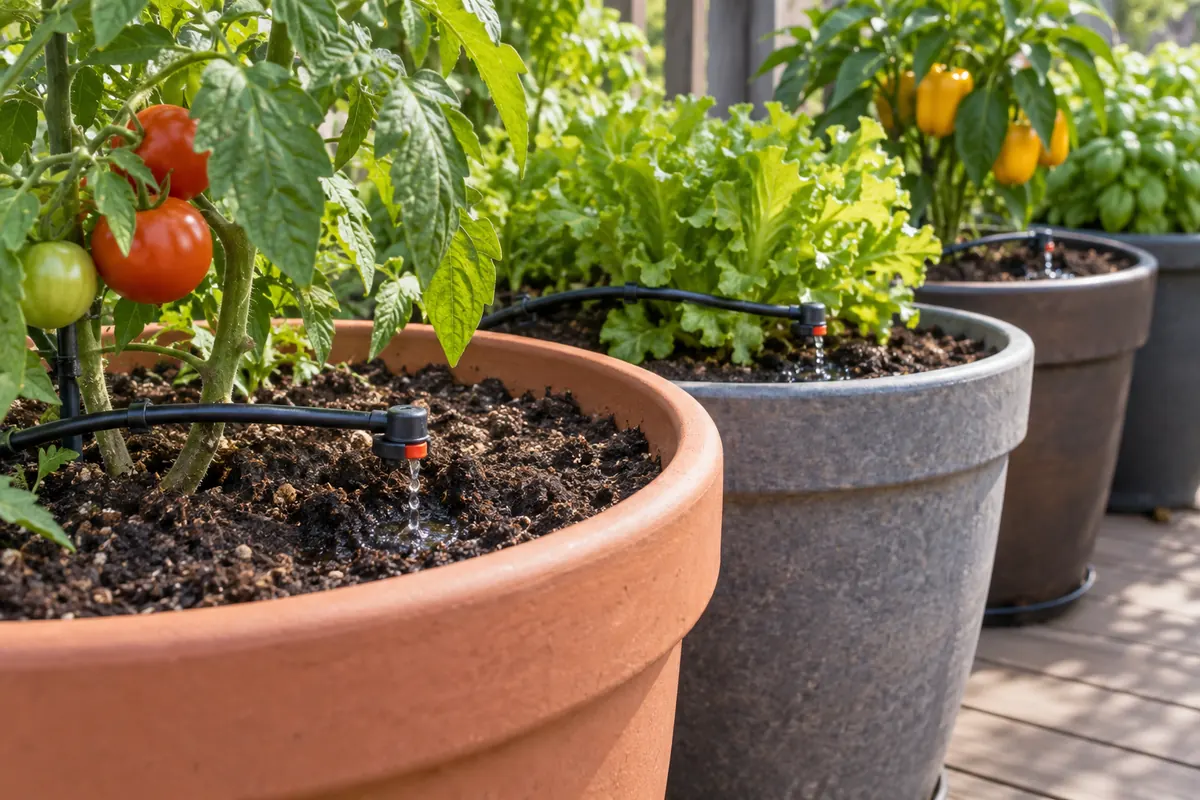
Plan a container drip system for the actual pots
Count every pot and note its size, plant, sunlight, wind exposure and distance from the water source. Sketch where tubing will run and where each pot can be moved for cleaning or repotting. Consider whether water will come from an outdoor faucet, a pump and reservoir, or another system designed for the location. Do not choose a kit from its emitter count alone; verify the exact parts, pressure and layout limits.
Containers on one balcony can have very different moisture needs. A small herb pot in afternoon sun may dry faster than a large shaded planter, while a succulent should not automatically share a schedule with a thirsty vegetable. Group pots only when their needs and exposure are similar. Keep incompatible plants on separate zones or water them by hand.
Check the building rules before connecting tubing to a tap or routing a line across a balcony. Secure it so it does not become a trip hazard or drain onto a lower property. If the setup connects to a household potable-water supply, check local backflow requirements and use approved components.
Compare faucet-fed and reservoir-fed setups
A faucet-fed micro-drip kit can supply a group of pots continuously while the tap is open or through a compatible timer. It needs a correct faucet adapter and may require filtration and pressure control. A reservoir-fed kit typically uses a pump to move water through tubing; check its power source, tank capacity, pump limits and refill routine. Individual self-watering devices operate differently and are covered in the container irrigation comparison.
| Setup | Useful when | Verify before relying on it |
|---|---|---|
| Tap-fed micro-drip | A compatible faucet is nearby and the line can be routed safely | Connector, backflow rules, filter, regulator, timer and outlet flow |
| Pump and reservoir | No tap is available at the pots and the kit is designed for a tank | Tank capacity, pump performance, power, overflow and refill access |
| Individual reservoir device | Only a few pots need a separate water source | Device instructions, capacity, soil contact and test results in that pot |
Neither approach guarantees that a plant can be left alone for a fixed number of days. A reservoir may empty faster than expected, a pump may stop, and a timer can fail or deliver unevenly. Test the actual system under the same exposure and potting mix before depending on it.
Check source, pressure and system parts
Read the kit instructions to identify required tubing, connectors, emitters, filter, pressure regulator, timer, pump and power supply. Some small kits combine several parts in a manifold; others require separate components. Match each fitting to the exact tubing diameter and type. Do not force a connector that appears close enough to fit, because a loose joint can leak or disconnect when pressurized.
For a faucet-fed line, check the source’s available flow and the emitter pressure range. Pressure at the tap and delivered flow at the end of a line are not interchangeable measurements. Line length, elevation, fittings and simultaneous outlets can affect delivery. Utah State Extension’s DIY drip guide explains how to measure available flow and match filtration and pressure control; use the manual for the exact kit rather than copying a generic number.
Filtration matters when the water source contains particles that could block small outlets. Filter type and mesh depend on the emitter and water source. Check the manufacturer’s recommended filtration and cleaning schedule. If a reservoir uses a pump, follow its instructions for water cleanliness and avoid adding fertilizer or other products unless the kit is designed for them.
Map pots, tubing and emitters
Draw the route from the water source to each pot and measure the tubing runs. Keep the line away from doors, walkway edges, chair legs and sharp balcony corners. Leave enough slack to move a pot for inspection without pulling a fitting loose, but avoid loops that can snag. Secure tubing with compatible clips or stakes that do not crush it.
Place the main line where branches can reach pots without crossing foliage or blocking drainage holes. Check whether the kit allows a closed loop or requires a capped end; follow its design. If a pot is moved seasonally, choose a connection that can be disconnected safely and capped as directed. Do not leave open outlets that leak when another pot is removed.
Plan zones around similar plants and exposure. If the line has a single control, every connected pot will receive water on the same schedule. Different plants may require separate emitters, separate timing, or hand watering. Avoid putting a drought-tolerant pot and a water-demanding crop on a shared timer without observing their needs.
Place emitters for root-zone coverage
Position the outlet so water reaches the growing medium near the active roots. Do not bury an emitter unless the manufacturer and plant guidance say that is appropriate. A single point may wet only part of a wide container; observe the moisture pattern and reposition or add outlets only when the product and system capacity allow it. Follow instructions for emitter spacing and distance from the plant stem.
Potting mix can channel water down the side of a container or retain moisture unevenly. After a test cycle, check the mix at more than one point and at root depth. If the top is wet but the root ball remains dry, adjust placement or apply water in a slower pattern. If the pot stays saturated, check drainage, saucer water and plant needs before reducing or moving the emitter.
As roots and plants grow, their water use and root distribution change. Inspect emitter placement after repotting, moving a container or adding a trellis. The correct position is the one that wets the intended root zone without persistent runoff or waterlogging under the actual conditions.
Measure output and set a schedule
Run the system while you are present and collect water from each emitter for the same measured interval. Compare outputs and inspect connections for leaks. If the manufacturer lists a flow rate, check that the operating pressure matches the conditions for that rating. A printed flow value is not a timer duration; it tells you how quickly water may leave under specified conditions.
Start with plant-specific guidance and observe moisture after a complete cycle. Check at root depth, not just on the surface. Adjust runtime or frequency gradually, then recheck in hotter, cooler, windier or wetter weather. Do not use one schedule for all containers solely because they share a line. Keep a note of the runtime, weather and moisture result so you can compare subsequent checks.
For a reservoir kit, measure how quickly the tank level falls during ordinary use and inspect whether each pot receives similar output. For a tap-fed system, check the farthest pot as well as the first one on the line. If output is uneven, review pressure, tubing length, number of emitters and filter condition before extending the runtime.
Make the comparison repeatable: collect output from the first, middle and last outlets for the same interval, using identical containers, then repeat the measurement after cleaning the filter or changing a fitting. A single reading may reflect air in a line or a loose connection. Record the date, runtime and conditions alongside each result. This gives you a baseline to compare with later checks and helps distinguish a system change from a sudden weather-related increase in plant demand.
Measured flow shows how much water leaves an emitter, but not whether it reaches the full root ball. After each test, check several points in the mix and inspect drainage. If output is consistent but one pot remains dry, consider its shape, mix, root growth and emitter position before increasing the whole line’s runtime. If only some outlets are weak, investigate the line or fittings and keep unaffected pots from receiving unnecessary extra water.
Install and test the system
- Read the complete manual and confirm the kit is designed for the selected source and number of containers.
- Check local connection rules and gather only compatible tubing, fittings, filter, regulator, timer or pump.
- Lay out the route while the pots are in place and confirm that doors, drains and paths remain clear.
- Connect the source assembly in the order specified by the maker and keep the shutoff accessible.
- Cut tubing cleanly and install each branch and emitter using the provided connector method.
- Run water or the pump while present, check for leaks and measure several outlet flows.
- Inspect moisture in each root zone after a cycle and adjust placement or timing.
- Repeat the test after moving pots, replacing parts or changing the weather pattern.
Do not leave a new system running unattended before it has completed multiple observed cycles. Make sure overflow from pots or a reservoir cannot damage the building or neighboring property. For electrical pumps, keep plugs and connections protected as specified by the manufacturer and local electrical guidance.
Test reliability before leaving plants
Run the system through several normal watering cycles before a trip and check the plants the next day. Verify the timer clock, batteries, water supply, reservoir level, pump, filter, tubing, outlets and drainage. A timer may turn on but an emitter may be blocked; a tank may be full at departure and empty sooner than expected in hot weather.
Ask someone to inspect the plants if drying would cause serious loss. Leave simple instructions on the shutoff, expected reservoir level and signs of a leak or dry pot. Do not leave an untested stake, bottle or timer as the sole safeguard for a long absence. Watering needs change with temperature, wind, plant size, pot material and medium, so a prior test may not predict a heat wave.
If you have only a few containers, a trusted plant sitter may be more reliable than adding a system. For larger collections, combine automation with periodic checks. The general watering guide explains how to check plant and root-zone needs independently of the timer.
Maintain filters, tubing and reservoirs
Inspect the filter and clean it at the interval and by the method the manufacturer specifies. Check tubing for kinks, UV damage, loose branches and crushed sections. Flush or clean the line only when the manual allows it. Do not use vinegar, bleach, sharp wire or compressed air unless the product maker explicitly permits that method; incompatible cleaning can damage an emitter or seal.
For a reservoir system, empty and clean the tank as directed, check the pump intake and keep debris out. Confirm that the pump primes and that the power supply is protected as specified. If the kit uses batteries, replace them on the maker’s schedule and verify operation after changing them. For winter, drain, disconnect or store components according to the exact manual.
At the start of each season, measure outlet flow again and inspect all pots. A drop in output may mean a blocked filter or emitter, a kink, a leak, low source pressure or an exhausted battery. Keeping a simple baseline measurement helps identify changes before plants show stress.
Troubleshoot dry pots, clogs and leaks
One pot stays dry: check the emitter, branch tube and root-zone placement; compare its output with another outlet. All pots are dry: check the tap or reservoir, pump, timer, filter and source connection. Some pots are too wet: inspect drainage, emitter location and schedule, and consider whether those plants need a separate zone.
Uneven output along a line: verify pressure, line length, emitter requirements and the number of outlets running together. Leak at a branch: shut off the source and check the fitting type, cut quality and seal. Replace damaged parts with compatible components. Emitter clogs repeatedly: review water quality and required filtration before changing cleaning chemicals.
Do not adjust the timer blindly. Measure the outlet, inspect the medium and check root health before deciding whether a plant needs more or less water. If a connection to household plumbing is unsafe or a pump repeatedly fails, stop using the setup and consult the manufacturer or a qualified professional.