

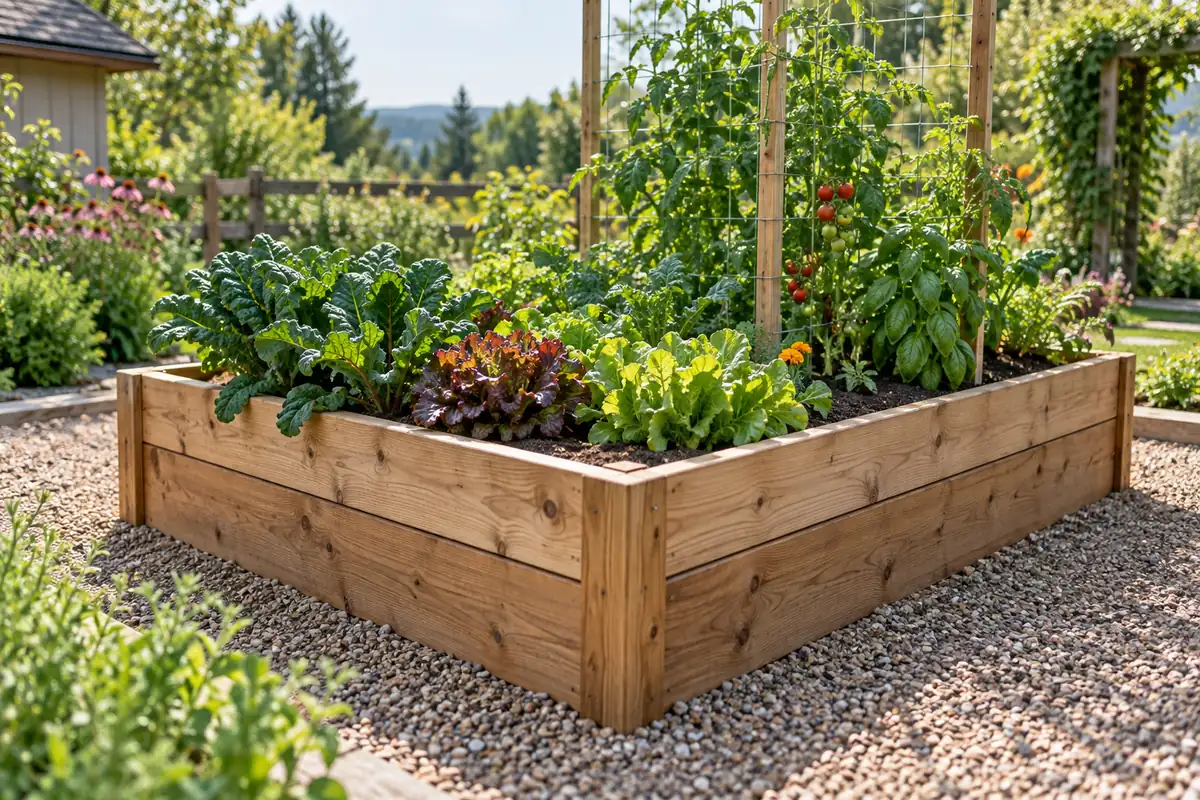
Choose bed width, length and depth for the site
Check where water will drain before assembling the frame. Runoff should not pond against a foundation or flow onto a neighbor’s property. On sloping sites, consult local guidance about erosion and bed stability. If the bed sits near underground utilities, contact the utility locator before digging or driving stakes. These checks are easier before soil and plants make the structure heavy.
For a new gardener, leave one side accessible and start with a manageable footprint. A smaller bed that can be reached, watered and maintained is more useful than a large kit that becomes difficult to weed. Expand after one growing season once you know how much time and space your crops require.
Walk the route between the bed, water source, compost area and storage before choosing the final dimensions. A path that is wide enough for a person may still be too narrow for a wheelbarrow or mobility aid. Leave turning space and keep valves, drains and gates accessible. For a bed that will be tended from a seated position, consider knee clearance and whether tools can reach the center without leaning on the frame. A raised edge does not automatically make a bed accessible; height, path surface and reach all work together.
Sketch the footprint and mark the full mature canopy or support area for planned crops. This helps avoid placing a bed where vines block a path or shade a neighboring planting. If the layout is on a slope, account for runoff and stability. Do not assume that a kit can safely be installed against a retaining wall or near a utility; follow local building and utility guidance.
Measure the space and the distance you can comfortably reach from each path. Keep the growing surface accessible without stepping on it. For a bed reachable from both sides, a width around four feet is one common Extension example, but reduce it when access, mobility or tools require a shorter reach. If a bed is reachable from one side only, make it narrower. Local advice and the user's range matter more than a standard kit size.
Choose length from the layout, access and materials available. Leave room for paths, wheelbarrow turns, irrigation connections and maintenance. To estimate fill volume, multiply the bed’s interior length, width and fill depth, using the same units; compare the result with the volume sold by the supplier.
| Site condition | Planning question | What to verify |
|---|---|---|
| Open ground | Can roots extend into native soil? | Soil condition, drainage and crop root depth |
| Patio or paved surface | Is this a raised bed or a bottomed container? | Drainage design, structural load and waterproofing |
| Limited mobility or reach | Can every part be reached from a safe path? | Working height, path width and seated access |
See Illinois Extension’s raised-bed planning notes for one regional example, and compare them with Utah State University Extension’s raised-bed guide.
Compare materials and construction
For every material, ask what contacts growing medium and whether the maker publishes instructions for edible crops. Inspect cut edges, corners, fasteners and the frame’s resistance to movement. Wood may weather or rot; metal and composite products vary by coating, thickness and construction. Fabric can dry more quickly and may need a supporting frame. No material category is uniformly safe or durable without knowing the specific product and conditions.
Consider how the frame will be emptied, repaired or moved. Permanent masonry is difficult to relocate, while a lightweight kit may require more anchoring. If pressure-treated wood or a coating is involved, consult current local health and Extension advice instead of relying on an old general claim. Keep receipts and instructions for future maintenance.
Compare the product’s dimensions, wall thickness, fasteners, coating, drainage, installation requirements and warranty. Wood, metal, masonry and fabric containers have different weight, maintenance and heat characteristics; verify claims for the specific model and local climate rather than assuming a category performs uniformly.
- Wood: check species, ground contact, treatment and manufacturer instructions. Ask local Extension or public-health sources about any preservative used around edible crops.
- Metal: check coating, edges, structural support and maker guidance for exposure and use. Consider site heat and the crop rather than assuming one temperature effect.
- Masonry or composite: confirm load, stability, drainage and the exact materials in contact with growing media.
- Fabric or lightweight planters: check capacity, support, drainage and how quickly the medium may dry at the intended location.
Select fill for the base and the crop
For an open-bottom bed, inspect the native soil before filling. If drainage is poor, compaction is severe or the site has a contamination history, ask a local soil-testing or environmental-health service how to evaluate it. A raised frame does not make contaminated soil safe by itself, and roots may extend below the bed. For a bottomed planter over paving, confirm that the base drains and that water will not collect under the structure.
Order fill by the bed’s internal dimensions and desired depth, then confirm whether the supplier quotes loose or settled volume. Mixes settle after watering, so avoid ordering solely from an exterior kit dimension. Do not add a gravel layer to solve drainage or rely on a universal compost ratio. A soil test and regional crop guidance are better starting points than an internet recipe.
First determine whether the bed has an open bottom over soil or is a container on a hard surface. For an open-bottom bed, existing soil can be part of the root zone; test it when needed and amend only according to crop and soil guidance. For a bottomed container, use a suitable growing medium and make sure water can escape through the designed outlets.
Avoid filling by a fixed internet recipe. Soil texture, climate, crop and available materials vary. Use the soil-test recommendation and a local Extension guide; for container and raised-bed crops, the USU Extension guide explains planning and growing-media considerations. Do not place gravel at the base as a substitute for drainage.
Check sunlight, access and site constraints
Observe the site through the day and check the light needs of the crops you plan to grow. Place beds where water access, paths and maintenance are practical. Avoid locations where roof runoff, traffic or standing water will affect the growing area. On balconies, decks or rooftops, ask a qualified professional to confirm the structure can support the filled, wet bed and people using the area.
If the site has contaminated soil or a history of industrial use, consult local environmental-health guidance before deciding whether to grow edible crops there. A raised structure does not by itself establish that a site or fill is safe.
Plan watering around crops and layout
Raised beds can dry at a different rate from surrounding ground, but the amount depends on soil, weather, crop, bed construction and exposure. Check moisture in the root zone and adjust the method and schedule as conditions change. Hand watering, a soaker hose or drip system may suit different layouts; compare flow and distribution before relying on a timer.
For a planned drip system, read the regulator, filter and emitter instructions and verify the source flow. See the garden drip design guide and CSU Extension’s home-garden drip guidance.
Match crop roots and spacing to the bed
Use the seed packet, nursery label and local Extension recommendations for mature size, spacing and root depth. Leafy greens, herbs and compact cultivars may suit shallower beds than crops with deeper root systems, but a label or regional table is the right reference for each variety. Leave paths and supports accessible, and avoid crowding plants simply because the bed has a familiar footprint.
For crop-specific planning, start with the vegetable garden hub, then see our guides to lettuce, tomatoes and culinary herbs.
Frequently asked questions
Before buying a kit, write down the site's measurements, access points, crop plan, drainage conditions and the exact assembly location. Use those details to compare product specifications and calculate fill volume.