

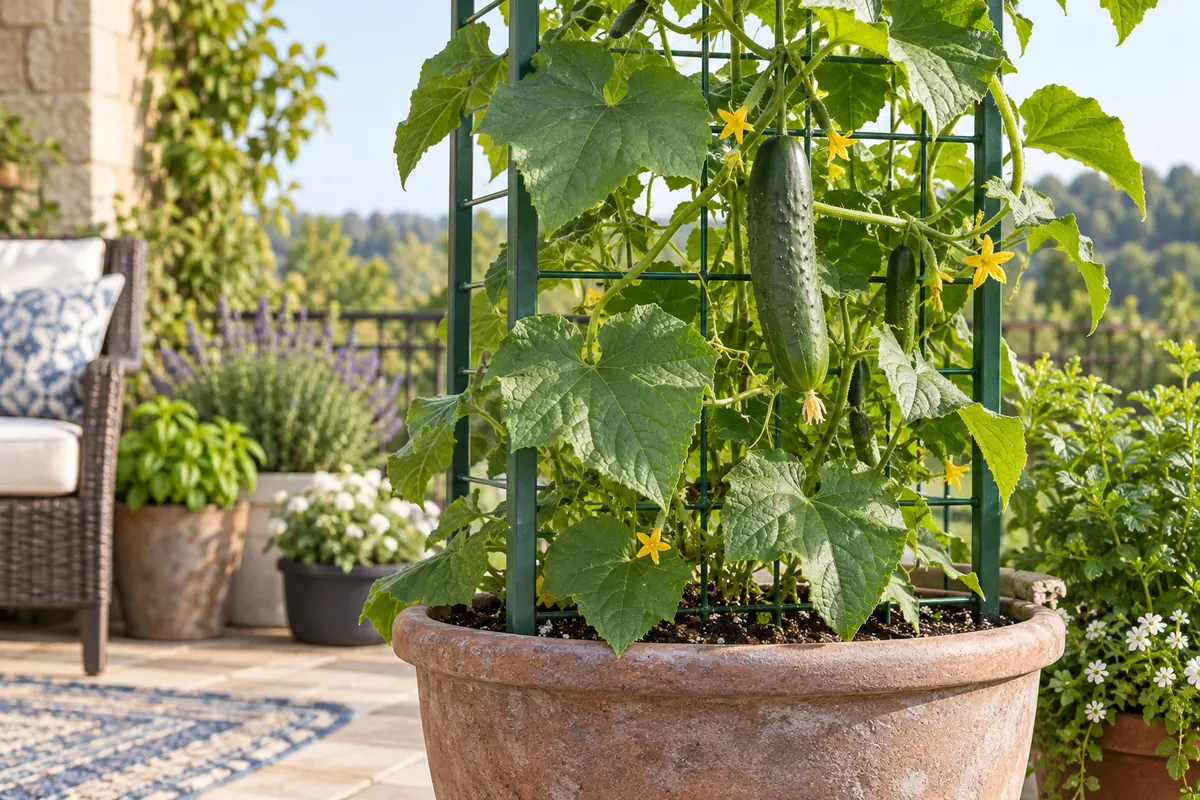
Growing cucumbers in containers requires a cultivar suited to the available root volume and a support strong enough for mature vines and fruit. Match the pot, trellis, light and watering access before sowing, then follow the packet for spacing and crop timing.
Illinois Extension’s container guide offers crop-specific examples; use them with the named cultivar’s label and local growing calendar.
Choose between compact and vining cultivars
Read the cultivar description for bush or vining habit, fruit size, pollination type and disease-resistance information. “Mini” may describe fruit size, not a smaller plant. If a packet names a parthenocarpic cultivar, fruit may develop without pollination under the supplier’s conditions; do not assume this for every cucumber grown in a greenhouse or balcony.
Choose a harvest type that matches how often you can pick. Compare actual packet descriptions rather than relying on a generic “best in pots” ranking. Illinois Extension’s container guide provides regional examples; use local Extension sources for planting dates and disease pressure.
Compare bush or compact cultivars with vining types by mature spread, expected fruit size, trellis requirement and disease resistance. A compact label can help in a small space, but regional conditions and seed-packet details still matter. Do not assume all cucumbers will produce well in a small hanging pot.
Use the Illinois Extension container crop guide as a regional reference and check your seed packet.
Plan a pot, drainage and sturdy trellis
A useful container is one you can water thoroughly without lifting it or reaching through a tangled vine. If a pot is behind a railing or under a bench, test access before planting. Check the trellis attachment point and the direction prevailing winds reach the site; a support that is stable on a calm day can be unsafe in a gust. Choose a support that can be dismantled without pulling the mature vine through it at the end of the season.
For fabric or self-watering containers, follow the product instructions and monitor moisture at several points. Those designs can dry or saturate differently from rigid pots, so do not transfer a schedule from another container.
Plan pot and support as one system. A trellis should attach to a stable point and withstand wind; if fixed only to a light pot, the planting can tip. Check the filled weight and permitted load if the container is elevated. Keep the trellis accessible from both sides for inspection and harvest. A mature canopy needs more room than a seedling suggests.
Choose a pot with open drainage and a watering path beneath foliage. If several plants share it, follow packet spacing and allow for mature growth instead of maximizing seedlings. Make sure runoff can leave safely. Test the support and drainage before sowing so you do not need to force a stake through established roots.
Choose a container with drainage and enough medium for the named cultivar. Support vining plants with a trellis secured against wind and sized for the mature vine; keep it accessible for harvest. Check the filled weight and avoid loading a balcony or railing without confirming its limit.
Use the seed packet or regional Extension table for spacing and volume; one pot size is not right for every cucumber.
Compare cultivar and support requirements
Compare mature size, fruit type and picking size, maturity estimate, pollination notes, resistance codes and support requirement. Suppliers may define “days to maturity” differently, so use the packet’s method. Resistance codes refer to selected pathogens or strains, not immunity; consult the supplier’s glossary and local Extension sources for diseases common in your region.
Do not add extra plants just because seedlings fit at first. Root competition and poor airflow become obvious only after foliage spreads. Check whether the cultivar needs bee pollination if it will grow in an enclosed greenhouse or balcony with few insects. If the packet omits this detail, ask the seed supplier or choose a better-documented variety.
Compare the packet’s growth habit, fruit type, spacing, maturity estimate, disease-resistance information and pollination notes. Use regional Extension recommendations where available. Treat days to maturity as an estimate and confirm how the supplier defines it.
Sow and train according to the packet
Install and stabilize the support before sowing. If a trellis attaches to a wall or railing, confirm that its fixing suits the surface and does not damage it. Sow at packet depth and spacing, or transplant carefully without breaking the root ball. Label cultivar and pollination type, water gently and maintain the packet’s conditions through emergence.
Guide the growing tip toward the support when the plant is established. Leave space to inspect leaves, tendrils and fruit, and keep vines away from paths where they might be stepped on. In a protected structure, consider ventilation and pollinator access before flowering. Do not remove flowers or attempt hand pollination unless the cultivar or local guidance calls for it.
- Set up the container and support before the vine grows.
- Sow at the packet depth and spacing, or transplant carefully if that cultivar is sold as a transplant.
- Place the pot where the crop receives its recommended light and can be watered safely.
- Train vines gently and check ties so stems are not constricted.
- Inspect leaves and fruit regularly for pests, disease and harvest timing.
Check the root zone and label before feeding
If flowers appear but the plant sets few fruits, check the cultivar’s pollination type, whether pollinators visit and whether the plant has enough light. Adding feed is not a reliable fix for pollination or temperature problems. If hand pollination is appropriate for the variety, identify male and female flowers from a trusted horticulture guide and follow its timing; do not assume all greenhouse cucumbers require this.
Review a timer after a rainy spell or a move to a more exposed position. Verify the emitter’s flow into the container and make sure the outlet is not blocked by roots or debris. Keep manual checks in place even with automation, because a blocked line can leave one pot dry while others look healthy.
Large leaves lose water quickly, so a cucumber pot can dry faster as the vine expands. Check below the surface near roots and adjust after heat or wind. Water enough to reach the root zone; a quick sprinkle on dry crusted mix may run around the edge without wetting the core. Persistent saturation deprives roots of air, so watch drainage as well as wilting.
Apply fertilizer according to the label and crop guidance, accounting for nutrients already in the medium. Excess feed cannot fix a crowded root zone, low light or poor pollination. If leaf edges brown or growth stalls, check moisture, drainage and pests before feeding. Test emitters and timers in use, and review the schedule after rainfall or a significant weather change.
Container moisture changes with pot size, weather, wind, vine size and fruit load. Check below the surface and water when the medium needs it; avoid both a fixed daily rule and waterlogging. Apply fertilizer only as directed on a product label and crop guidance.
Train vines for access, airflow and support
Make the support reachable for picking because hidden fruit can grow beyond the size intended by the cultivar. Check the lower foliage and the back of the trellis at each harvest. Use gentle ties that can be opened without cutting stems, and avoid attaching vines to a neighboring plant that has different watering needs. If the plant outgrows a balcony-safe height or reaches a walkway, redirect or prune only according to crop guidance rather than leaving a hazard in place.
Some cucumber flowers are male and some female, depending on cultivar and growth stage; the female flower has a small fruit-like ovary at its base. Pollination needs vary, and some greenhouse cultivars are parthenocarpic. Confirm the cultivar information before removing flowers or trying to transfer pollen, and remember that heat or stress can also affect fruit set.
Guide new growth onto the trellis and use loose ties only when needed. Avoid cinching around the stem or bending it sharply. Check attachments after wind and as fruit load increases. A vertical support saves ground space but may shade nearby plants, so plan for mature foliage and keep the top within safe reach.
Inspect the underside of leaves and stem junctions while the structure is accessible. Remove foliage only when crop-specific advice recommends it; broad defoliation can stress the plant or expose fruit to sun. Harvest at the cultivar’s recommended size and use clean scissors if pulling could tear a vine. At season end, remove debris and clean reusable ties and supports if disease was present.
Guide vines onto a stable support without forcing or sharply bending stems. Keep leaves and fruit reachable for inspection and harvest, and leave enough airflow for the specific site. A trellis can save ground space, but it does not guarantee higher yield or prevent disease.
Check light, pollination, moisture and pest signs
Check the plant after a windy day because vines can rub against rough supports and develop stem damage. Redirect growth gently and pad or reposition an abrasive tie. If a stem is broken, do not bind it with household adhesive; follow local horticulture advice about whether the plant can be trained around the injury. Note the incident so the next trellis can be secured before planting.
At the end of the season, remove vines and inspect the container for roots blocking drainage. Clean supports and ties if disease occurred, and follow local disposal guidance for infected plants. Do not reuse a visibly diseased plant as compost unless the composting method is known to manage the pathogen.
Powdery mildew, downy mildew, bacterial wilt and nutrient stress can produce overlapping leaf symptoms. Look at the pattern of spots and the progression across the plant, then compare it with a university Extension diagnostic resource or ask a local plant clinic. Do not apply fungicide to an unidentified problem. Remove affected material only as recommended and avoid carrying wet leaves through healthy plantings.
If fruit is bitter, do not assume that a larger pot will solve it. Cultivar, environmental stress and harvest stage can all matter; check the seed supplier and local guidance, and discard fruit with an abnormal taste. Record the cultivar and conditions before planting it again.
Misshapen fruit can relate to pollination, temperature stress or cultivar traits. Check whether pollinators can reach flowers and whether the variety needs them before attempting hand pollination. Yellow leaves may reflect normal aging, wet roots, dry roots, pests or disease; inspect the whole plant and medium instead of adding fertilizer first.
Identify mildew and other symptoms with a reliable regional source. Improve access and airflow where practical; use pesticide only when the problem is confirmed and the label covers edible cucumbers. The USU Extension cucumber beetle guide describes identification in its region; seek local advice for your area. If a plant wilts while the pot is moist, inspect drainage and stem base because more water may worsen root problems.
Few fruits: check cultivar, plant stage and pollination requirements. Misshapen fruit: inspect pollination and growing conditions; do not diagnose from shape alone. Yellowing or wilt: check drainage and moisture before adding water or fertilizer. Leaf damage: identify the pest or disease before treating.