

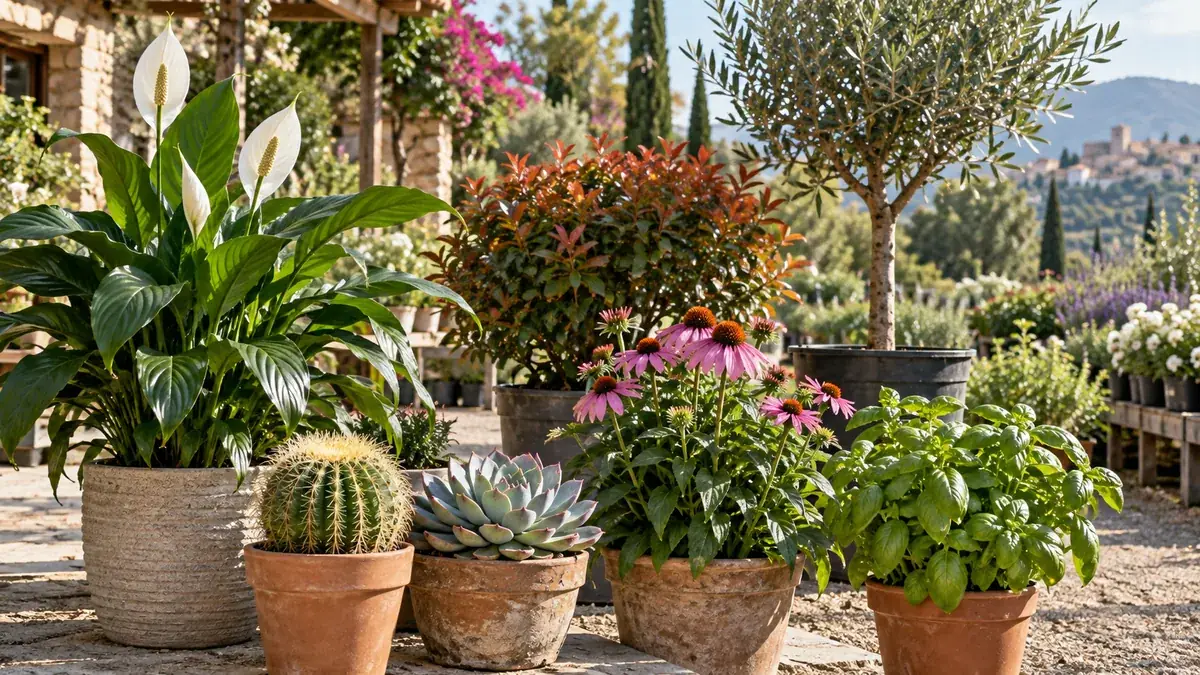
Plant types describe different characteristics
Nursery labels and gardening guides often combine several descriptors. One may explain the plant’s life span, another its stem structure and another the conditions where it is grown. Read each term as an answer to a different question:
| Classification axis | Common labels | Question answered |
|---|---|---|
| Life cycle | Annual, biennial, perennial | How long does the plant live or take to complete its cycle? |
| Growth form | Herbaceous, woody, tree, shrub, climber | What structure, space or support may it need? |
| Foliage | Evergreen, deciduous, semi-evergreen | How does the plant retain or renew its leaves? |
| Growing conditions or use | Indoor, outdoor, shade, aquatic, succulent | Where or under which conditions is it cultivated? |
The Royal Horticultural Society’s gardening glossary defines common terms such as annual, perennial, deciduous and evergreen. Treat a label as a clue to investigate, not a complete care plan.
Types of plants by life cycle
- Annual plants complete their life cycle in one growing season, from germination through flowering and seed production. They are often used for seasonal displays, although some may self-seed.
- Biennial plants generally grow in the first season and flower or set seed in the next. Timing can depend on species, climate and cultivation.
- Perennial plants live through multiple growing seasons. Some retain above-ground stems and leaves; herbaceous perennials may die back and regrow from surviving roots or crowns.
Illinois Extension’s gardening terms guide distinguishes annual, biennial and perennial plants and describes woody and non-woody perennials. These labels help you plan replanting and seasonal changes, but they do not tell you whether the plant can survive your winter. A plant that is perennial in a warm climate may be grown as an annual where frost kills it.
Use the plant’s botanical name and local hardiness advice when the winter response matters. Check the label for whether the plant is sold as a tender annual, half-hardy annual or hardy perennial, and find out what that means for your local climate.
Types of plants by growth form
Growth form helps you plan space, support and future maintenance:
- Herbaceous plants have non-woody stems. Annuals and many perennial flowers fall into this group; some perennials die back to the ground in an unfavorable season.
- Woody plants retain a woody framework. Trees and shrubs are familiar examples, though their form can be influenced by species and pruning.
- Trees commonly grow with a dominant trunk and a canopy. Check mature height and spread against buildings, utility lines and other planting.
- Shrubs commonly have multiple woody stems from near the ground. They range from low spreading forms to large screening plants; see our types of garden shrubs guide.
- Climbers use twining stems, tendrils, roots or other structures to grow vertically. Check how a species attaches and whether its support can carry the mature plant.
- Ground covers are selected for spreading across a surface. Confirm their mature spread and whether they stay within the intended area.
These descriptions are practical rather than mutually exclusive. A woody climber is both woody and climbing; a shrub can be used as a hedge; a perennial can be herbaceous or woody. For the general distinction between shrubs and trees, the RHS shrub overview explains the usual multiple-stem form.
Types of plants by foliage
Evergreen describes plants that retain most of their foliage through the year in suitable conditions. Deciduous describes plants that lose leaves seasonally and renew them later. Some plants are described as semi-evergreen because leaf retention changes with climate or stress.
This axis is independent of life cycle. An evergreen shrub is often both woody and perennial; a deciduous herbaceous perennial may disappear above ground in winter and regrow later. Foliage labels can help you plan privacy, shade and seasonal appearance, but do not predict hardiness or care by themselves.
Types of plants by growing conditions and use
“Indoor” and “outdoor” describe where a plant is being cultivated, not a botanical family. Many common houseplants come from tropical or subtropical habitats but are grown indoors in cooler climates. A plant’s tolerance for sun, shade, dry soil or moisture depends on the species and local conditions.
Other labels describe adaptations or practical uses:
- Succulent describes a plant with water-storing structures. It does not tell you whether the plant is annual or perennial.
- Aquatic or marginal describes plants adapted to water or consistently wet edges; check the required depth and whether they need a container to contain spread.
- Aromatic describes scent or aromatic leaves and may include annual herbs, herbaceous perennials and woody shrubs.
- Flowering is a useful garden feature, not a life-cycle category. Annuals, perennials, shrubs and climbers can all flower.
When a label says “shade tolerant” or “drought tolerant,” look for the conditions and establishment stage behind the phrase. A plant that tolerates dry soil after establishment may still need watering while roots settle. A shade plant may still need bright indirect light rather than a dark room.
Combine plant categories instead of choosing one label
Use more than one axis to describe a plant, then verify that combination by species:
| Example description | Labels that can apply together | What to check next |
|---|---|---|
| A sunflower grown for a seasonal display | Annual, herbaceous and flowering | Sowing time, final height, support and local frost risk. |
| A garden shrub selected for a screen | Woody, usually perennial, evergreen or deciduous, and used for screening | The named cultivar’s width, foliage, hardiness and pruning needs. |
| A succulent kept in a container | Water-storing, container-grown, and annual or perennial depending on species and climate | Drainage, light, winter conditions and the exact species. |
The examples show why a phrase such as “types of plants” can lead to several valid answers. Decide which question matters to your garden, then use the matching label rather than forcing a plant into one exclusive category.
Use a classification checklist to choose a plant
- Define the job. Decide whether you want seasonal flowers, permanent structure, a screen, a climber or a plant for a container.
- Observe the site. Record light, soil drainage, wind, available space and winter conditions.
- Choose relevant labels. Use life cycle to plan replacement and growth form to plan space; use foliage only if seasonal coverage matters.
- Confirm the plant identity. Find its botanical name and exact cultivar rather than trusting a broad common name.
- Check mature needs locally. Compare dimensions, water, soil and hardiness with a reliable regional source or nursery.
- Plan care honestly. Choose a plant that fits the watering, pruning and protection you can provide.
Separate fixed constraints from preferences. Mature size and winter tolerance may rule out a plant; flower color and fragrance can help choose between the remaining options. If a key label is missing, keep researching before planting.
For a real comparison, write one short line for each candidate: botanical name, life cycle, growth form, mature size, light, water and any seasonal change. You do not need to classify every characteristic. Record only the labels that affect the planting decision, and note where each detail came from so you can check it later.
Check plant names and continue by growing space
Common names can refer to more than one species, so confirm a botanical name when plant identity affects safety or care. Kew Science’s Plants of the World Online and World Checklist of Vascular Plants explain how accepted scientific plant names and synonyms are documented. For cultivation, combine the botanical identity with a horticultural source that reflects your region.
For space-specific advice, continue to our guides to indoor plants, outdoor plants and flowering plants. For the broader plant-care directory, return to the plants hub.