

What Fiskars documents about the HS52
The model name is PowerLever Hedge Shears HS52. Fiskars lists article number 1001564 and EAN 6411501967503. Its product page describes handles made from FiberComp and the PowerLever mechanism. These identifiers help distinguish the HS52 from Fiskars' similarly named manual shears and powered hedge trimmers.
| Item | Fiskars catalogue or product page | How to interpret it |
|---|---|---|
| Model / article number | HS52 / 1001564 | Check both identifiers on a listing or box |
| EAN | 6411501967503 | Useful for separating this variant from similarly named tools |
| Packaged dimensions | 58.8 × 14.8 × 7.2 cm | Fiskars labels catalogue dimensions as packaging measurements |
| Packaged weight | 0.61 kg | Not a separately measured bare-tool weight |
| Handle material | FiberComp | Manufacturer-described shaft material |
| Cutting mechanism | PowerLever | Performance statement is from Fiskars, not independent testing |
The earlier version of this page used inconsistent dimensions and unsupported claims about branch capacity, blade treatment and warranty. Those claims have been removed. The available catalogue dimensions refer to the packaged product, so compare them with care: the 58.8 cm figure should not be described as a precise working reach or guaranteed unboxed length.
How to read the PowerLever claim
Fiskars says the HS52's PowerLever mechanism makes cutting up to 2.5 times easier than a standard mechanism. Its 2026 catalogue also describes up to 200% more cutting power compared with Fiskars tools without gearing. Both statements are manufacturer claims. The cited pages do not publish a test protocol, sample size, hedge species, branch diameter or independent measurements, so they do not prove that every cut takes a fixed fraction of the effort.
The mechanism is one factor in how the shears feel. Sharp, correctly aligned blades, the diameter and condition of the shoot, the user's hand span, grip, posture and number of repetitions all affect effort. A leverage mechanism cannot turn hedge shears into a lopper or saw. If a shoot does not pass between the blades and cut cleanly with normal hand pressure, stop and choose a tool designed for that branch.
FiberComp is the manufacturer's description of the shaft material. Fiskars positions the handles as lightweight and strong. The catalogue does not give a durability test for the exact shaft, and the model-specific page should not be used to promise a service life. Inspect the handles and pivot before work and stop if a handle is cracked or the blades move out of alignment.
Where manual hedge shears fit
Manual hedge shears suit localized trimming and shaping where individual small shoots can be cut with a scissor action. They avoid a motor, fuel, extension cord and battery. That can be useful for a short hedge, a touch-up after powered trimming, or a small amount of soft growth. They are less suited to long faces, frequent heavy work or thick woody growth because the operator supplies all cutting force and repeats each stroke by hand.
The RHS says hand shears are suitable for small hedges and soft growth, while larger hedges are easier to trim with powered equipment. It also recommends secateurs or loppers for thick or low growth and for large-leaved evergreen hedges when avoiding cut leaf surfaces matters. Match the tool to the plant and task rather than choosing by the brand's power claim alone.
Use the HS52 as a hedge shear, not as a precision pruner. Before trimming, identify the hedge species and its pruning season. Some plants flower on older growth, and a hard trim at the wrong time can remove the next flowering growth. For large reductions or renovation pruning, get species-specific advice; a hedge shear is for shaping and light trimming, not structural pruning.
The long handles offer more reach than compact hand pruners, but they do not make the tool telescopic. Keep both feet on stable ground and work within a comfortable reach. Do not lean from a ladder while holding open shears. If the upper surface cannot be reached safely from ground level, use an appropriate pole tool or arrange professional help.
Compare documented hand-shear models
Fiskars identifies the HS52 as article 1001564, EAN 6411501967503, with a FiberComp shaft and PowerLever mechanism. Bahco's P51-F brochure gives a 57 cm overall length, 25 cm blade and 1,085 g weight; GARDENA gives 540 mm overall length and a 230 mm blade for the Classic Hedge Clippers 540 / 391-20. Those are different manufacturers' published values and should not be read as a measured ranking.
The Fiskars 2026 catalogue figure of 58.8 × 14.8 × 7.2 cm and 0.61 kg is a packaged measurement in the source set used here. It is not a bare-tool length or an apples-to-apples unboxed weight. If fit and fatigue matter, hold the exact tool in working position and confirm its current product code before buying.
PowerLever is a manufacturer design claim. Fiskars says the mechanism makes cutting up to 2.5 times easier than a standard mechanism, but the cited product materials do not describe an independent test method or allowable branch diameter. The claim must not be translated into “cuts branches 2.5 times thicker” or “requires 2.5 times less force” under all conditions. Use it to understand the intended mechanism, then cut only growth that passes cleanly between the blades.
Plan the hedge task before cutting
Manual shears work best on short hedge faces, small soft shoots and finishing work where selective cuts are useful. On a long hedge, each stroke adds hand and arm effort; a powered hedge trimmer may be more practical if its noise, battery and blade reach suit the site. For an overgrown hedge, cut thick branches with a suitable lopper or pruning saw rather than forcing them through the HS52.
Check the plant's seasonal growth before trimming. Flowering shrubs may form buds on old or new wood at different times, so a generic calendar can remove flowers. Confirm the species and its pruning window, then take small amounts and step back to review the shape. RHS guidance recommends a slightly narrower top for many formal hedges so light reaches lower leaves; adapt this to the plant and desired form.
Before work, inspect the hedge for wire, ties and hidden obstacles. Keep feet stable, use both hands and keep the free hand behind the cutting line. Work at a height you can reach without leaning or standing on a ladder while holding open shears. If high growth cannot be reached safely, choose a suitable pole tool or professional service.
Limits of the available evidence
The manufacturer sources support the product identity, catalogue measurements, shaft material and the design claim. They do not provide a maximum cut diameter, blade length, exact unboxed weight, independent force comparison, sharpening interval or current US warranty. We do not infer those values from a retailer snippet or from another Fiskars model.
Regional availability may differ. The cited product page is Fiskars UK and the catalogue is global English-language material. That evidence does not prove a North American package, warranty or spare-part route. Check article number 1001564, EAN 6411501967503 and local Fiskars support before buying. Similar HS codes or older article numbers are not automatically interchangeable.
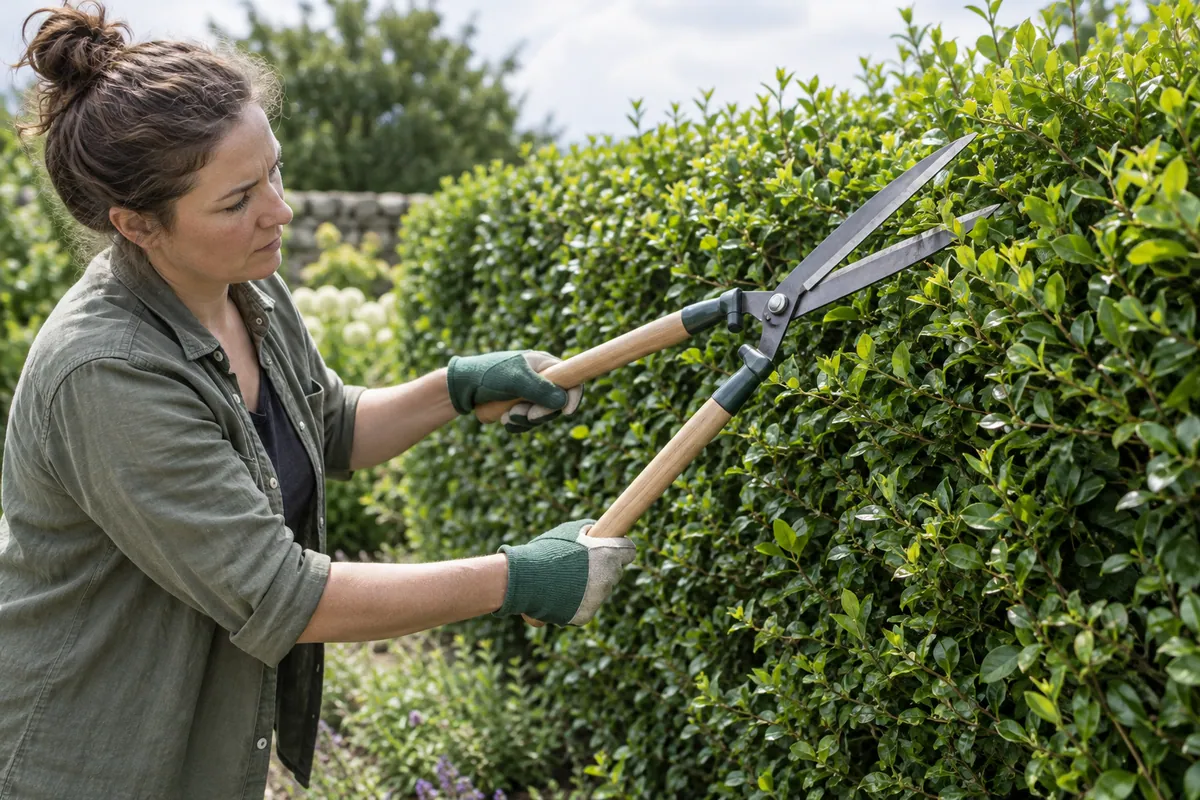
The hero image is illustrative. It depicts the category and use context, not Fiskars branding or the product's exact blade, handle or pivot geometry. Use manufacturer product images and documentation to confirm appearance and package contents.
Use, cleaning and inspection
- Check the hedge for wire, stones, nests and other obstructions before cutting.
- Hold the handles securely and make controlled cuts through shoots that fit freely between the blades.
- Keep hands behind the cutting edges and do not force the pivot or extend the handles with a pipe.
- Stop if blades bind, twist or fail to close fully; use a different tool for thicker wood.
- After work, remove sap and plant debris, dry the blades, and store the shears closed where children cannot reach them.
Follow Fiskars' current care instructions for cleaning and lubrication. The RHS tool-care guidance supports keeping cutting tools clean and sharp, but does not establish a model-specific service interval for HS52. If blades are nicked, loose or misaligned, check whether the tool is serviceable and use a competent sharpening or repair service. Do not file a complex cutting edge without knowing its geometry.
Check the article number and EAN rather than searching only for “PowerLever” or “Fiskars hedge scissors”; product names can span different generations. Inspect the blade pivot, handles, cutting edges and return movement before use. The product photograph and the HS52 illustration on this page are not a substitute for checking the exact tool markings.
Before each session, look for cracks, loose fasteners, pivot play, corrosion and damage to the cutting edges. Test the closing movement away from your body. Do not use the shears if either handle is damaged or the blades can slip past each other. A sound mechanism and clean cut matter more than a claimed leverage multiplier.
Check the exact regional version
The official reference used here is Fiskars UK article 1001564, EAN 6411501967503. If you are comparing a product in another region, check that those identifiers appear on the package and confirm the local warranty, replacement-part route and current care instructions with Fiskars. Do not assume a similar HS code or a product photo identifies the same generation.
For category-level selection criteria, read the manual hedge shears guide. To compare source-backed model references, see the Bahco P51-F documentation and the GARDENA Classic 540 page. These are documentation comparisons rather than a tested ranking.