

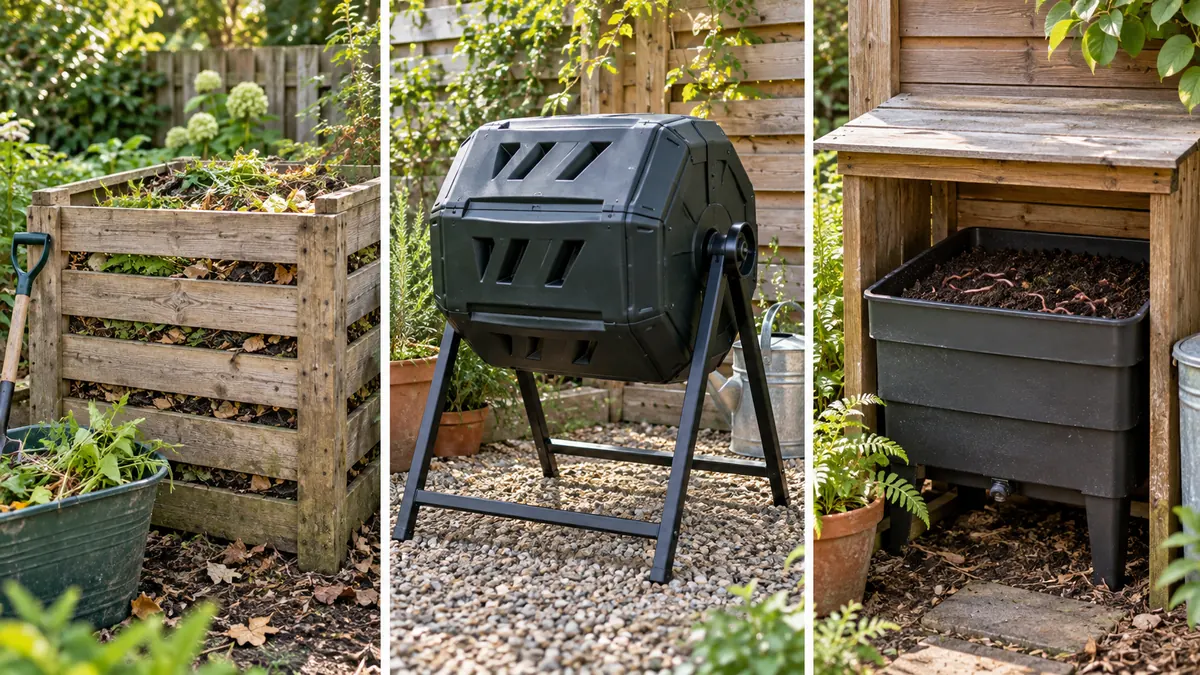
Match the system to feedstock, space and upkeep
Before comparing a bin, estimate how much plant material you collect and how often. Decide whether you need room for a pile or second curing area, whether the system must sit indoors, and how you will access the finished material. Check local rules for food scraps, odors, wildlife and collection programs.
Utah State Extension’s home composting guide explains the materials and conditions involved in a home pile. Choose a system you can operate within its instructions rather than relying on a universal “fastest” or “best” label.
Compare composting systems and their limits
| System | May suit | Check before choosing |
|---|---|---|
| Open pile | Yard waste with room to build and turn or leave it | Local restrictions, wildlife, access and exposure to rain |
| Static bin | A defined footprint and gradual addition of suitable material | Loading opening, aeration, base, pest access and emptying |
| Tumbler | Turning a batch without using a fork | Batch capacity, loading effort, emptying and curing space |
| Worm bin | Some food scraps where an indoor or sheltered setup is practical | Bedding, worm species, temperature, moisture and feed limits |
| Bokashi | Fermenting food scraps in a sealed bucket | The required post-fermentation step and local handling rules |
Vermicomposting uses composting worms and has its own setup requirements; see USU Extension’s vermicomposting guide and Penn State Extension’s worm-bin guide. Do not treat worm bins and ordinary tumblers as interchangeable systems.
Compare a specific bin by usable details
- Capacity and dimensions: compare interior usable space with the volume of material you collect and the location where the bin will sit.
- Loading and access: check the lid, feed opening, turning method, bottom door and clearance needed to remove finished material.
- Construction: review the listed materials, fasteners, assembly, warranty and care instructions for the exact model.
- Base and location: check drainage, ground contact, ventilation, shade and whether the design is intended for a patio or soil.
- Pests and local rules: verify how the system closes, which inputs it accepts and what your municipality allows.
Product listings can omit important details. Confirm specifications in the manufacturer manual and ask the seller or manufacturer about missing capacity or compatibility information. We make no hands-on performance or durability claim.
Choose by the household’s material stream
A household producing mostly leaves and small prunings may value volume and easy turning. A kitchen producing a small amount of vegetable scraps may need a compact option with specific feed instructions. If you have mixed yard waste, consider whether one bin is large enough for the batch and whether you have space for material to finish after active processing.
Keep the expected input list beside the product manual. If a system does not accept one of your common materials, plan a second disposal route before purchase. Municipal green-waste or food-scrap programs may accept materials that a home system should not.
Use this checklist before purchase
- Measure the site, access path and clearance needed for the lid or drum.
- Estimate the incoming material volume and separate yard waste from food scraps.
- Check local food-scrap, wildlife and waste rules.
- Read the exact manufacturer manual for accepted inputs, operation and emptying.
- Check whether the system needs curing space, bedding, a starter culture or other consumables.
- Compare the total product dimensions, warranty and replacement-part availability.
Learn to operate the system you choose
Once you choose a system, see our separate step-by-step guide to composting at home for suitable inputs, moisture and aeration checks, troubleshooting and signs of maturity. Keeping system selection separate from operating instructions helps avoid assuming that every method takes the same materials or follows the same process.
Choose between batch and continuous composting
A batch system receives a defined load, which is then processed together while new material waits in a separate space or container. This can make it easier to track one batch and decide when it is ready, but it may require a second bin or a temporary place for new scraps. A continuous system accepts material over time, which can be convenient for a steady household stream, but fresh inputs and finished material may occupy different areas and need careful access.
Ask how the system separates material at different stages. Some static bins have an access door near the base, but a small opening can make it awkward to remove material with a shovel. A tumbler may hold one batch or multiple chambers depending on its design; verify the actual configuration rather than assuming every rotating drum has separate curing compartments. Worm bins usually offer staged trays or harvesting methods described by their specific instructions, while bokashi buckets need a place and plan for the post-fermentation step.
Think through the entire cycle: where new material enters, where active compost rests, how you turn or aerate it, and where finished material cures before use. If the product design does not provide enough space for those steps, the stated capacity may not represent the volume you can use at one time.
Compare tumblers with static compost bins in practice
A tumbler keeps material off the ground and lets the user rotate a drum rather than turn a pile with a fork. That can be useful where lifting and turning a heap is difficult, but the drum still has a weight limit in practice: a full container can be harder to rotate, and a narrow opening can complicate loading or unloading. Look for usable volume, the emptying method, latch design, support frame, bearing parts and whether the instructions call for a particular fill level.
A static bin often offers a larger opening and may accept leaves or prunings more easily. A single bin can be simple to maintain, but turning the pile or removing material may require access around it. A multi-bin system can separate fresh inputs from active and finished material, at the cost of a larger footprint. Check whether the base is open to soil, whether the sides ventilate, and how the lid or panels fit together.
Neither design guarantees a faster result. Processing depends on input size and mix, moisture, aeration, temperature, volume and how consistently the system is managed. Claims such as “finished compost in a few weeks” should be compared with the manufacturer's stated conditions and with a guide from a local Extension service. If you cannot meet those conditions, choose based on access and capacity rather than a best-case timeline.
Estimate space and usable capacity
Measure the full outside dimensions, lid swing, door clearance and the route used to carry a bucket to the opening. Include space to turn a pile, rotate a drum, remove the finished material and clean around the base. A composter that fits the footprint but cannot be opened or emptied in place may be difficult to use. If it will sit on a patio, confirm the load is supported and that drainage will not stain or damage the surface.
Estimate weekly or seasonal inputs rather than relying on a household-size label. Leaves and prunings arrive in bursts, while kitchen scraps arrive throughout the year. Their volumes also change as they are chopped or settle. If a product gives capacity in gallons or litres, compare that figure with the amount you actually handle and check whether it refers to the internal drum or the complete exterior unit.
Account for access in winter or wet weather. A bin at the far end of the yard may be inconvenient when paths are muddy; a small indoor worm bin needs a stable location where temperature and moisture can be managed. The best location is one that suits local rules and that you can use safely in ordinary conditions.
Plan for odor, pests and wet-weather management
Odor and pest control depend on what enters the system and how it is managed, not just on the lid or the material. A closed lid may reduce access for animals, but check seams, vents, the base and any drainage openings. A tumbler can limit access only if its doors close securely. A worm bin needs a location and feed plan suited to worms; adding unsuitable scraps or too much food can create odors and attract insects.
Consider shade, rainfall and drainage at the site. A pile exposed to heavy rain may become wetter than intended; a sealed patio container may drain differently from an open-bottom bin on soil. Keep a source of dry leaves or another appropriate carbon-rich material available if local guidance recommends balancing wet kitchen scraps. Follow the accepted-input list for the system, and avoid materials prohibited by the manufacturer or municipality.
Before purchase, read the troubleshooting instructions. Find out whether the lid, screen or base can be cleaned, how liquid is handled, and whether replacement parts are available. A design that is difficult to inspect can hide a blockage or excess moisture until it becomes a larger problem.
Check product claims against the intended use
Retail listings may use “composter” for systems that work differently. A product described as a compost bin may be a dry storage container, a tumbling composter, a worm system or a bokashi fermentation bucket. Verify the exact model, included pieces, assembly instructions, intended inputs, capacity, dimensions and warranty on the manufacturer page before buying. Look for a manual or support page; if those are missing, ask the manufacturer or seller for the details instead of assuming.
For independent guidance, compare the proposed method with an Extension resource that explains the process. Utah State University's home composting guide, its vermicomposting overview and Penn State's worm-bin guide cover different system types. They help explain what the product must support; they do not certify a specific marketplace listing.
This comparison is a selection guide, not a hands-on product test. We do not claim a model is the “best” based on durability, odor control or speed without a documented test. If a future product card is added, it should identify an exact model whose current listing and specifications have been checked separately.