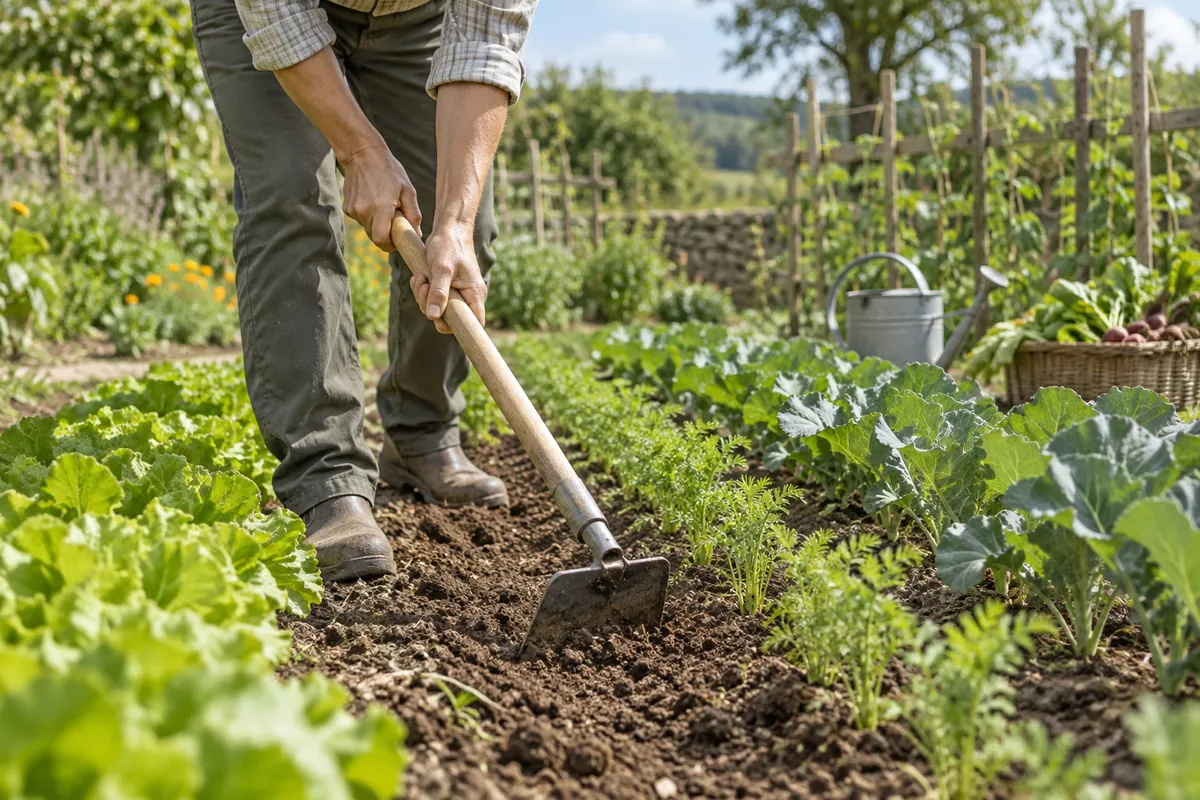
Your vegetable garden is overrun with weeds because your hoe is dull and requires constant effort to cut through soil. Or you want the right hoe for seed planting and cultivation but aren't sure which style to buy. This comparison covers the best garden hoes of 2026 for weeding, soil cultivation, and vegetable gardening — with honest guidance on hoe styles, blade designs, and which models make garden maintenance easier.
▷ Best garden hoes of 2026
Fiskars Ergo Hoe — Ergonomic Weeding
- ✓ Lightweight fiberglass handle design
- ✓ Sharp flat blade for precise weeding
- ✓ Ergonomic angled handle reduces strain
- ✓ Comfortable grip for extended use
- ✓ Durable carbon steel blade
- ✓ Lifetime warranty
Price from Amazon.com · ships within US
Flexrake CLA333 Cultivator Hoe — Multi-Purpose
- ✓ Oscillating blade cuts on push and pull
- ✓ Reduces weeding effort significantly
- ✓ Works for shallow cultivation too
- ✓ Lightweight aluminum construction
- ✓ Perfect for vegetable gardens
- ✓ Durable professional-grade
Price from Amazon.com · ships within US
Valley Cultivator Long Handle Hoe — Heavy Duty
- ✓ Long handle for reduced bending strain
- ✓ Sturdy steel blade for deep cultivation
- ✓ Excellent for breaking compacted soil
- ✓ Ideal for large vegetable gardens
- ✓ Professional construction
- ✓ Lifetime warranty
Price from Amazon.com · ships within US
Comparison: hoe type, blade design & handle
| Model | Type | Blade | Handle | Best For |
|---|---|---|---|---|
| Fiskars Ergo | Standard | Flat, sharp | Ergonomic | Weeding comfort |
| Flexrake CLA333 | Oscillating | Dual-action | Standard | Weeding effort |
| Valley Cultivator | Standard | Heavy-duty | Long reach | Heavy cultivation |
Buying guide: Choose based on your primary need. If you're starting a new vegetable garden or clearing established beds for the first time, a standard hoe like the Fiskars Ergo is the best entry point — it handles 80% of garden tasks competently. If you maintain an established garden with regular weeding cycles, an oscillating hoe becomes essential because the reduced effort saves you significant time over a season. If you do lots of direct seeding (carrots, lettuce, beets in rows), add a Warren hoe as a third tool. Most vegetable gardeners end up owning 2–3 hoes because each design excels at different tasks, and having the right tool for the job makes the work substantially easier.
Types of garden hoes: standard, oscillating, warren & more
Standard hoe (flat blade)
Standard hoe: A flat rectangular blade perpendicular to the handle. Cuts on the downstroke only. Best for weeding, breaking soil clods, and creating seed furrows. The most versatile hoe design. The flat blade is typically 4–6 inches wide, providing sufficient surface area to slice weeds and soil in a single motion. Standard hoes work best on damp soil where the blade can cut cleanly through roots. On very dry, compacted soil, the blade can bounce or skip. Standard hoes are effective for both weeding and deeper cultivation work, making them the first choice for gardeners who can only afford one hoe.
The effectiveness of a standard hoe depends heavily on blade sharpness. A sharp standard hoe slices weeds cleanly at or just below soil level, killing them instantly. A dull standard hoe crushes weeds and requires multiple passes to destroy root systems. Seasoned gardeners often keep a standard hoe specifically sharpened for weeding and a separate, duller hoe for heavy cultivation and soil-breaking work where sharpness doesn't matter as much.
Oscillating hoe (scuffle hoe)
Oscillating hoe (scuffle hoe): A flat or slightly curved blade that pivots on the handle, cutting on both the push and pull strokes. Excellent for shallow weeding just below the soil surface without disturbing deep roots. Great for maintenance weeding in established beds. Oscillating hoes are specifically designed to slice weed seedlings at a depth of ½–1 inch below the surface, which is where most annual weed roots establish in the first 2–3 weeks of growth.
The two-way cutting action of an oscillating hoe significantly reduces the effort required compared to a standard hoe. You simply push and pull in rhythm without the up-and-down motion required with a standard hoe. This makes oscillating hoes ideal for gardeners with joint pain or those doing extended weeding sessions. The trade-off is that oscillating hoes only work effectively on shallow surface weeds; they cannot break compacted soil or dig deep cultivation as a standard hoe can. For vegetable gardeners maintaining established beds, an oscillating hoe is often preferred because it preserves the soil structure and root systems of nearby plants.
Warren hoe (pointed/triangular blade)
Warren hoe: A triangular or pointed blade that creates V-shaped furrows. Designed for planting seeds in rows. Less common for general weeding but essential for vegetable gardeners doing direct seeding. The pointed blade allows you to push it into soil and drag it backward, creating a uniform V-shaped furrow perfect for placing seeds at consistent spacing and depth. Warren hoes are available in different angles — some have an acute angle (sharper point) for fine-line seed furrows, while others have a more obtuse angle for larger furrows suitable for larger seeds like beans.
Warren hoes are less intuitive than standard hoes for beginners, but once you master the technique, they're incredibly efficient for direct seeding. The furrow created is self-contained and uniform, making seed spacing precise. Warren hoes are less useful for general weeding because the pointed blade doesn't provide the broad cutting action needed to slice multiple weeds efficiently.
Stirrup hoe (hula hoe)
Stirrup hoe (hula hoe): A rectangular loop of blade suspended below the handle on thin metal arms. Cuts weeds by slicing horizontally just below the soil surface on both forward and backward strokes. Stirrup hoes are excellent for weeding between planted rows and around established plants without disturbing soil. The design is intuitive — you simply push the hoe forward and pull it back, and the blade does the cutting. Minimal effort is required compared to a standard hoe.
Stirrup hoes work best on light, well-cultivated soil and are not effective on hard, compacted ground. They're primarily a maintenance tool for established gardens rather than a tool for initial bed preparation. Some gardeners consider a stirrup hoe and an oscillating hoe to be roughly equivalent in function, though stirrup hoes offer slightly better maneuverability in tight spaces between plants.
Collinear hoe (Japanese-style hoe)
Collinear hoe: A low-angled blade (approximately 30°) on a long handle, combining characteristics of a hoe and a knife. Also called a Japanese weeding hoe, this design allows you to work while standing nearly upright, reducing back strain significantly. The blade is thin and sharp, functioning more like a weeding knife than a traditional hoe. Collinear hoes excel at precision weeding in tight spaces and are particularly popular with gardeners who experience back pain.
Collinear hoes require a different technique than standard hoes — instead of chopping downward, you slice horizontally just below the soil surface with a gentle sawing motion. They're not suitable for heavy cultivation or breaking compacted soil but are superior for detailed weeding work, especially in crowded perennial beds where you must avoid damaging nearby plants. The learning curve is steeper than a standard hoe, but practitioners often find collinear hoes become their favorite once technique is established.
Garden hoes for vegetable gardens
For vegetable gardeners, a combination of hoes is ideal: a standard flat-blade hoe for initial bed prep and deep weeding, and an oscillating hoe for maintenance weeding between plants once the garden is established. A warren hoe is useful if you do lots of direct seeding in rows. Total investment: $60–100 for a complete set of three quality hoes.
If limited to one hoe, choose a standard flat-blade hoe like the Fiskars Ergo — it covers most tasks adequately and is the most versatile single tool. The Fiskars' ergonomic handle also reduces back strain, which is important because improper hoeing posture is the leading cause of back pain among vegetable gardeners.
Timing matters for vegetable garden weeding. Hoe when weeds are small — seedlings under 1 inch are sliced off in seconds and die quickly in sun. Weeds allowed to grow 3–4 inches establish root systems that require repeated hoeing to kill. A weekly pass through established beds with an oscillating hoe takes 10–15 minutes and eliminates the need for major weeding sessions later. The key habit: hoe after rain when soil is soft but before weeds reach visible size. Post-rain hoeing is dramatically more efficient because wet soil releases weed roots cleanly; dry soil compacts around roots and requires more force to break.
Hoe height timing for succession plantings: If you practice succession planting (planting new crops every 2–3 weeks), hoe lightly between planting cycles to remove weed seedlings at their most vulnerable stage. This prevents a major weed explosion mid-season. Many vegetable gardeners find that 15 minutes of preventive hoeing every 7–10 days eliminates 90% of weeding effort compared to waiting until weeds are visible.
How to use a garden hoe effectively
Weeding technique for standard hoes
For weeding with a standard hoe, use short, controlled strokes that slice just below the soil surface (½–1 inch deep), cutting off weed roots without deep disturbance to surrounding plants. Let the blade do the work — pushing down firmly at a slight angle is more effective than yanking or making aggressive downward chops. The goal is to sever the weed root cleanly in one motion rather than crushing or bruising it. Slice rather than chop. This technique works best when soil is moist (within 24 hours of rain) and weeds are small (under 2 inches tall).
Proper posture prevents back strain during weeding. Stand with feet shoulder-width apart, knees slightly bent, and keep the hoe handle at a slight forward angle (about 15–20° from vertical). Avoid hunching forward or twisting your torso — let your legs and core provide the movement, not your back. Many back injuries occur because gardeners work in a bent-over posture for extended periods. An ergonomic hoe with an angled handle (like the Fiskars Ergo) forces naturally better posture and reduces strain significantly.
Using an oscillating hoe
Oscillating hoes require minimal downward pressure — let the blade's natural cutting action do the work. Simply push the hoe forward smoothly, then pull it back toward you. The blade cuts weeds on both strokes, so light, rhythmic movements are more effective than aggressive pressure. Oscillating hoes work best on soil depth of ½–¾ inch, so avoid trying to dig deeper with an oscillating hoe; a standard hoe is better for deeper work.
The advantage of oscillating hoes is sustained ergonomic use — because minimal force is required, you can work for extended periods without fatigue. Many gardeners use oscillating hoes for 30–45 minutes of continuous weeding without significant effort.
Creating seed furrows
To create a furrow for direct seeding, use a Warren or standard hoe held at approximately 45° to vertical and drag the blade along your planting row. For small seeds (carrots, lettuce), create a shallow furrow (½–¾ inch). For larger seeds (beans, peas), create a deeper furrow (1–1.5 inches). The Warren hoe's triangular blade naturally creates a V-shaped furrow perfect for seed placement. The furrow should be straight and uniform in depth; wavy or uneven depth results in poor germination at variable depths.
After placing seeds, use the back of the hoe head or a rake to gently fill the furrow, pressing soil firmly over seeds. Adequate soil-to-seed contact is critical for germination.
Hoe depth guide
Depth of hoeing depends on your task. For weeding established gardens, ½–¾ inch is ideal — deep enough to sever root systems of annual weeds but shallow enough to avoid disturbing perennial plants' roots. For breaking soil clods during cultivation, dig 2–3 inches deep. For initial bed preparation (turning compost or amendments into soil), aim for 4–6 inches. Always consider what's below — if you're working near established plants, stay shallow. If you're preparing bare ground, dig deeper for thorough mixing.
Garden hoe maintenance and sharpening
Sharpening frequency
Hoes rarely need sharpening for most gardeners — they dull from rock and soil contact but remain functional longer than cutting tools like pruners. However, a sharp hoe is dramatically more effective and requires less effort. Most casual gardeners should sharpen hoes annually (at the start of spring) or whenever they notice the blade requires more pressure to cut weeds cleanly. A sharp hoe slices weeds effortlessly; a dull hoe crushes and bruises them, requiring multiple passes. If you're doing heavy weeding (20+ hours per season), sharpen mid-season as well.
Sharpening method
Secure the hoe in a vice or stable position so the blade is upright. Use a mill bastard file (cost: $8–15) held at the original bevel angle on the top cutting edge only — typically 45°, though some hoes have different angles. Push the file away from you in smooth, even strokes along the entire blade edge, maintaining a consistent angle throughout. Complete 6–10 passes on each side of the blade. After sharpening, test sharpness by carefully dragging your thumb across (not along) the blade edge — a sharp blade will catch your thumbnail. Remove any burr from the back face with a single light pass of the file held flat.
Total sharpening time: 5–10 minutes. The first time you sharpen a hoe may take longer as you learn proper technique, but it becomes quick and routine with practice. Many gardeners sharpen hoes while listening to podcasts as part of spring garden preparation.
Cleaning and storing
After each season, wipe the blade clean with a dry cloth and remove any soil or rust spots with a fine wire brush. If rust appears, scrub with medium-grit sandpaper (80–120 grit) or a brass wire brush until the surface is clean. Apply a light oil coat (linseed oil or mineral oil) in fall before storage — this prevents rust formation during winter. A light oil coating takes 5 minutes and extends hoe life by decades.
Store hoes in a dry location, ideally hanging from a wall or hook to keep the blade away from moisture and soil. Never store hoes blade-down in soil or standing against a damp wall; moisture causes rust that weakens the blade. A properly maintained hoe lasts 15–20 years easily, with some well-cared-for hoes lasting 30+ years.