

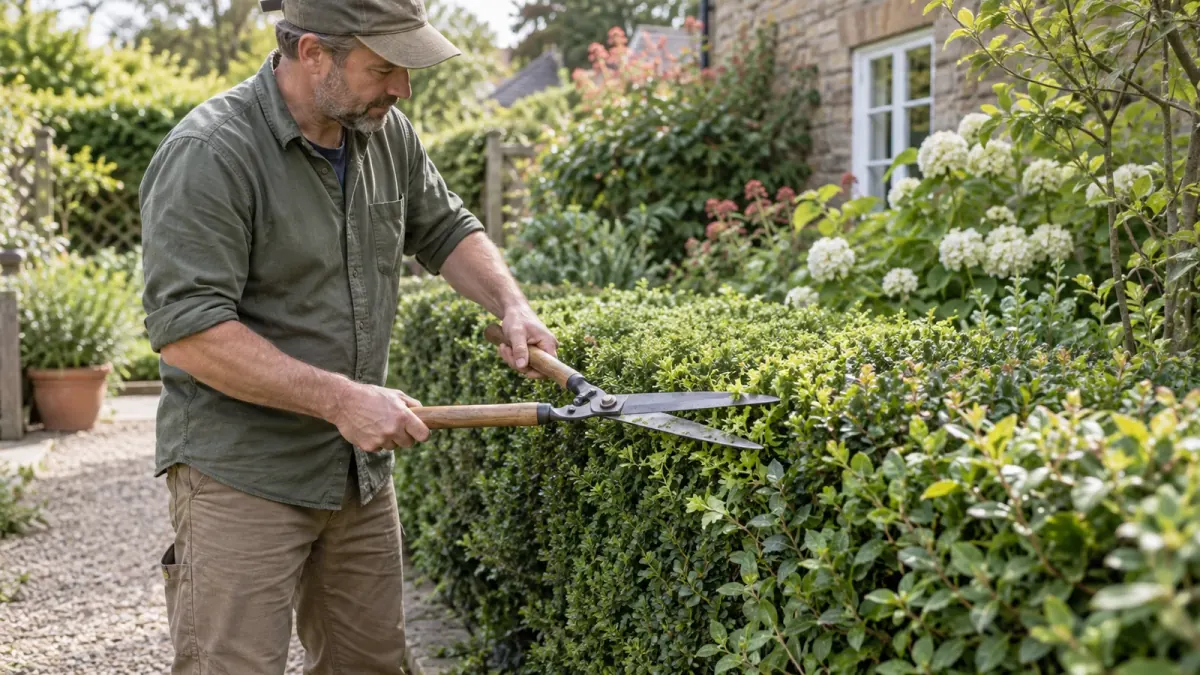
Bahco P51-F specifications from the brochure
| Specification | Bahco brochure | How to interpret it |
|---|---|---|
| Tool type | Manual hedge shears | Hand-operated; no battery or engine |
| Model code | P51-F | Check the complete code on the tool and package |
| Overall length | 570 mm (57 cm) | Length of the whole tool, not the blade |
| Blade length | 250 mm (25 cm) | Blade dimension, not hedge coverage per stroke |
| Listed weight | 1,085 g | Published tool value; balance depends on grip and work |
| Handle material | Steel | Inspect condition, grip and joint before use |
| Blade detail | Partially serrated section for branches up to 10 mm | Use the maker-stated limit only for that section and intended cut |
| Shock absorption | Rubber shock absorbers | Feature does not remove hand fatigue or impact from heavy use |
These details distinguish the P51-F from short bypass secateurs and powered hedge trimmers. They do not establish a maximum branch diameter, force at the handles, edge life or comfort during a long session. Bahco's wording “heavy-duty” is a product description, not a measured capacity or independent durability test.
What this manual hedge shear is designed to do
A long-handled manual shear can be useful for small corrections, shaping a hedge face and trimming soft growth where a powered tool would be excessive. The tool avoids fuel, charging and motor maintenance; the trade-off is repeated hand and arm movement. The operator controls each cut directly, which can help when working around the edge of a bed or a nearby plant, provided the blades and branches remain in view.
Overall length is not the same as reach. The 570 mm measurement includes the handles and blades; it does not mean the user can safely extend the tool that far beyond a stable stance or maintain control above shoulder height. Before starting, hold the handles at a comfortable opening, check that they clear nearby fencing and confirm that the hedge can be reached from the ground.
For a long, dense or tall hedge, manual shears may require many repeated cuts and become tiring. They are not a pole tool, a lopper or a pruning saw. Use a lopper for thicker branches that fit its design, and a pruning saw for wood that needs a controlled single cut. Never twist the P51-F through a branch that does not close cleanly.
| Hedge job | Is the P51-F a reasonable fit? | Decision point |
|---|---|---|
| Small touch-ups to soft growth | Potentially, if the stems close cleanly between the blades | Test a visible, accessible shoot; stop if it crushes or binds |
| Long formal hedge face | Possible for short sections; repeated strokes can become tiring | Compare the area with the time and hand effort you can sustain |
| High hedge or growth above shoulder level | No, it is not a pole tool | Use a tool designed for the reach from safe ground or get help |
| Woody limbs or branches under tension | Not on the evidence available for this model | Choose a suitable lopper or pruning saw and control the release |
Cutting limits and what Bahco does not publish
The cited brochure lists dimensions, weight and steel handles, but it does not give a maximum branch diameter. A 250 mm blade cannot be converted into a cutting-capacity figure, and the “heavy-duty” description does not make the tool suitable for unlimited wood thickness. Do not import a capacity claim from another Bahco shear or a retailer page with a similar model name.
Use a small test on a soft, accessible shoot only if the tool is in good condition and the manual or maker allows the task. The blades should close through the growth without crushing it or requiring the handles to be twisted. If the cut tears, binds or needs substantial force, stop and choose a tool for the branch. Dry wood, knots and branches under tension need particular care because they can split or spring when released.
It is also useful to separate trimming from structural pruning. Hedge shears are intended to shape multiple fine shoots along a surface. They do not replace a saw for removing a limb at its origin. Large cuts can change the plant's form and health, so identify the species and the correct pruning season independently of the tool choice.
How it differs from two other manual shears
Manufacturer data helps identify models, but published dimensions are not a cutting test. GARDENA lists its Classic Hedge Clippers 540 with 540 mm overall length and a 230 mm blade. The Bahco P51-F is 570 mm overall with a 250 mm blade. Fiskars PowerLever HS52 is another manual model; its current catalog data should be checked carefully because package measurements are not necessarily the dimensions of the unboxed tool.
| Reference | Published information | Evidence limit |
|---|---|---|
| Bahco P51-F | 570 mm overall, 250 mm blade, 1,085 g | No maximum branch diameter in the cited brochure |
| GARDENA Classic 540 / 391-20 | 540 mm overall, 230 mm blade | Manufacturer does not publish a branch limit on the referenced page |
| Fiskars PowerLever HS52 / 1001564 | PowerLever; catalogue lists 0.61 kg and package dimensions | Do not treat package dimensions or catalogue mass as a direct use test |
The table is useful for checking product identity and rough size. It does not establish which shear is sharper, easier to use, more durable or faster. Materials, blade geometry, edge alignment, pivot friction, hand size and the type of growth all affect the experience. If comfort is a priority, handle a comparable tool before buying and assess how far the blades open and whether the grip suits your hands.
Plan and make controlled hedge cuts
Walk along both sides of the hedge and look for wire, irrigation tubing, fencing, nests and thick branches before cutting. Clear people from the work area and establish stable footing. Keep the handles in front of the body and make short, controlled strokes in growth that fits the blades. Avoid reaching sideways or closing the shear near the other hand.
For a formal hedge, mark the intended top line and work in small sections, stepping back to check the shape. The Royal Horticultural Society notes that many hedges are shaped slightly narrower at the top so light reaches the lower foliage, but the correct profile depends on species and the desired form. For shrubs with large leaves, individual cuts may create a neater appearance than clipping across foliage. Identify the plant before pruning so you do not remove next season's flower buds.
Do not stand on a ladder while operating open hand shears. If the hedge is above safe ground reach, use a tool built for that reach or seek professional help. For branches that are under tension, too large for a clean shear cut or likely to spring, switch to the correct pruning tool and plan the release path.
Clean, inspect and store the P51-F
Before each session, look for nicks, corrosion, loose fasteners, pivot play and cracked or bent handles. Close the blades away from your body and check that the edges meet evenly. If the tool binds or a joint shifts, stop and arrange repair rather than forcing the handles. Do not use the shears to cut wire, pry a limb, scrape a wall or break a jam.
After trimming, remove sap and plant residue, dry the blades and store the tool closed in a dry place. RHS general tool-care guidance recommends keeping cutting tools clean and sharp; it does not define a Bahco-specific service interval. Follow the maker's current instructions for lubrication, sharpening, spare parts and repair. If sharpening would change the bevel or alignment, use a qualified service option.
Keep the blades protected in storage and away from children or anyone who might grasp the cutting edge. Check the pivot before the next use and apply only suitable maintenance products. Steel handles and cutting blades should not be left wet or exposed to corrosive garden chemicals.
Verify the exact model before buying
Ask the seller to confirm the P51-F code, steel-handle design, 570 mm overall length, 250 mm blade and condition. Similar Bahco model names or stock photographs do not establish the exact tool. For a used unit, inspect the pivot, blades, grip and signs of repair; request clear images of both the full tool and its markings.
For a new or used tool, inspect the partial serration, blade alignment, pivot play, shock absorbers and steel handles. Confirm the P51-F marking and ask Bahco or the local service channel about spare parts before relying on the shears for regular work. Do not treat the “heavy-duty” description as a substitute for inspecting the actual cutting edges or matching the tool to the branches.
For broader selection criteria and tool-type differences, use the manual hedge shears guide and compare the GARDENA Classic 540 or Fiskars PowerLever HS52 reference pages. Those models are separate products; neither is presented as a replacement part or identical specification.