

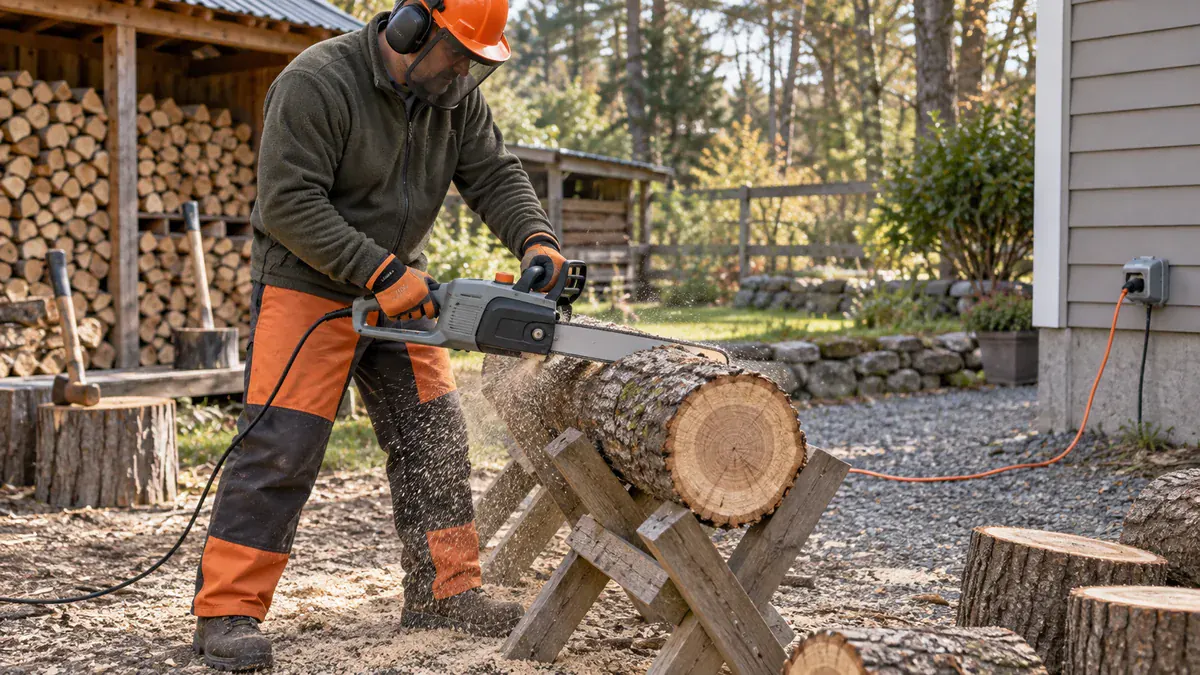
What corded power changes
- Oregon CS1500: 15 A, 18-inch bar, 48.0 ft/s no-load chain speed and automatic oiling; Oregon also lists a chain brake and tool-less tensioning.
- Craftsman CMECS600 and WORX WG303.1 listings identified those named models, but the checked destination could not receive them.
- The Oregon CS1500 listing was the only model in the former group with an offer visible during the review; availability can change by delivery address.
Exact-listing reference: Oregon CS1500 18-inch corded chainsaw. The listing matched the manufacturer model and had an offer visible during the October 2026 check.
Plan circuit, cord and work area
Start with the location: if the cord can cross the cutting zone or snag on limbs, a cordless or gas saw may be a better fit. Check the rated circuit and extension-cord gauge/length in the manual, then compare bar, chain pitch, replacement chain availability, oiling and chain-brake operation. Do not infer comparative cutting performance from current ratings alone.
Choose around the outlet
- Confirm the voltage and circuit requirements, and plan an outdoor-rated cord of the gauge and length stated in the manual.
- Match bar length, pitch, gauge and drive-link count to the exact saw before buying replacement chain.
- Check chain-brake, automatic lubrication, tensioning and sharpening instructions for the model and year.
- Plan cable routing away from the cutting area and confirm suitable outdoor power access for the full task.
Choose between corded, battery and gas
A corded electric chainsaw is easiest to assess when a rated outdoor outlet is available close to the work and the cable can stay outside the cutting zone. It avoids battery capacity planning and engine fuel, but the user must manage the live cord for every cut and relocation. The actual power supply and cord must meet the saw manual; a long or undersized lead can create electrical and performance problems.
A battery saw removes the trailing cable but depends on the specified pack, its charge, temperature and duty cycle. For an extended session, check how many compatible batteries are included, whether they are charged, and whether the manufacturer publishes runtime conditions. A gasoline saw can be more mobile, but adds engine maintenance, fuel handling, exhaust and noise. Those differences do not by themselves make one format safer or suitable for every operator.
Before choosing, map the area and identify the material: pruning a downed branch, bucking supported firewood and felling a tree are different tasks. If the work involves a standing tree, overhead branches or wood under tension, use a trained and equipped professional. For a broader model-format comparison, see the battery chainsaw guide and gas chainsaw guide.
Match bar, chain and replacement parts
Bar length is not a safe cutting-diameter rating. A long bar can reach farther but can add weight and changes how the tool handles; the exact manual defines the bars and chains approved for that saw. Do not select a bar solely because its advertised length equals the diameter of a log. The operator's experience, wood support, chain condition and cutting position matter as well.
Replacement chains are identified by several linked dimensions: pitch, gauge and drive-link count. The chain packaging and saw manual must match all three; bar length by itself is not enough. A chain with the wrong gauge may not fit the bar groove, and a wrong pitch or link count can prevent correct fit or tension. Keep the old chain's markings and model number, but verify them against the current manufacturer parts list before ordering.
Also check the bar's oiling holes and groove, the sprocket condition and whether replacement bars are supported for the exact model. PowerSharp systems use their compatible chain and sharpening accessory; a conventional sharpening file or a generic chain should not be assumed to work with every self-sharpening model. The manual is the authority for compatible parts and adjustment procedures.
Inspect and maintain a corded saw
Unplug the saw before inspecting the chain, bar or oil system. Follow the manual's checks for the chain brake, trigger lock, handles, fasteners, chain tension and lubrication before each use. Stop if a guard is missing, the brake is unreliable, the switch is damaged, the chain does not receive oil or the cord insulation is cut. Do not repair mains wiring unless qualified to do so.
After a session, allow the saw to cool, disconnect it from power and clean the bar groove and oil outlet according to the manufacturer instructions. Check the chain for cracks, bent or missing cutters, and unusual wear; a damaged chain should be replaced, not sharpened into service. Keep the chain correctly tensioned because a loose chain can derail, while overtightening can increase heat and wear. Adjust only as the model manual describes.
Sharpening angle, file size and depth-gauge setting depend on the chain specification. Follow the chain maker's chart or use a qualified service shop if you cannot identify the exact chain. Record chain and bar part numbers before a replacement is needed, so a later purchase does not rely on the appearance of a similar model.
Oregon CS1500 as a documented example
The Oregon CS1500 is described by Oregon as an 18-inch, 15-amp saw with PowerSharp self-sharpening. The manufacturer lists sharpening in 3–5 seconds; the process and chain inspection still need to follow the manual. That manufacturer claim is not our independent test result.
Keep the cord and chain under control
OSHA says electric chainsaws should use an extension cord sized to the manufacturer's instructions, and damaged saws or disabled safety devices must not be used. Keep the cord behind and away from the cut, use a GFCI-protected supply where required, and follow all chainsaw PPE and operating instructions. Before every cut, check the cable path, footing, log support, escape space and presence of other people. Do not cut with the bar tip or try to free a pinched bar while the chain is moving.
OSHA's chainsaw guidance calls for task-appropriate head, eye/face, hearing, hand, foot and leg protection. Use the equipment and protective clothing required by the saw manual and applicable rules. Protective equipment reduces exposure; it does not make overhead work, felling, ladder use or wood under tension safe for an untrained operator. Stop and get qualified help when the work exceeds the task described in the manual.
Before starting, walk the extension route with the saw unplugged. Keep the lead behind the operator, away from the bar, log supports, sharp edges and other people; choose a route that will remain clear as each cut is completed. Use a cord and outdoor receptacle with the rating specified by the saw maker, inspect the plug and insulation, and use the required residual-current or ground-fault protection for the location. A longer cable can increase voltage drop, so do not solve reach by substituting a thinner cord.
Choose the outlet and the job as one system. A 120 V saw may need a dedicated circuit when other tools or appliances draw power nearby; the current rating on the chainsaw does not mean an older household circuit has spare capacity. Review breaker and cord requirements in the manual, and stop if a plug or connection becomes hot, discoloured or loose. Never tape over a damaged cable or continue cutting after a breaker trips repeatedly.
For a worksite away from a building, do not assume a portable battery station or inverter will run a mains chainsaw. The supply must be rated for the tool's voltage, continuous input and any starting demand, and the connection must be suitable for outdoor use. Compare the complete electrical setup with the saw manual before taking the tool to a remote location. If that equipment is impractical, a compatible battery saw may be simpler, but it still needs the right packs and safe operating conditions.
Check the electrical circuit as well as the saw. A 15-amp tool can share a circuit with other loads, and a breaker trip may signal an overloaded circuit rather than a faulty chainsaw. Do not bypass protection or use an adapter to fit a different voltage or receptacle. If the outlet, breaker, cord gauge or permitted length is unclear, consult the manual and a qualified electrician. Stop work in rain, standing water or any condition where the tool's manual disallows operation.