

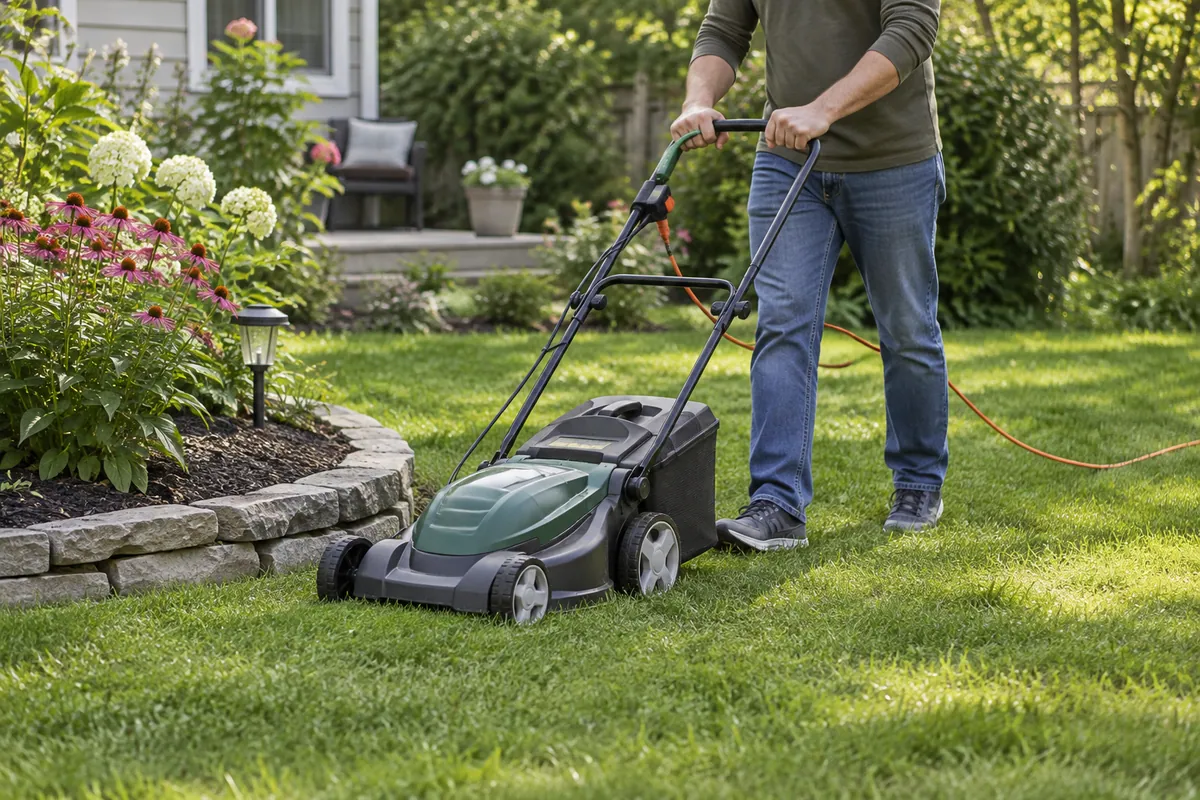
Is a corded mower a fit for your lawn?
Start with the outlet and the shape of the grass. A small, open lawn near an appropriate outdoor outlet is easier to serve than a larger yard divided by beds, trees, paths and separate sections. Walk the route you would take while mowing. Include the distance around the lawn perimeter and the movement needed to turn; a straight-line measurement to the far corner understates the cable run.
Consider where the cord will trail as you move. It should remain behind you and outside the cutting area, following the machine’s cord-retention instructions. If the route crosses a driveway, walkway or shared space, or if you would need to connect several cords, a battery mower may be simpler. Do not modify the mower’s plug, retainer or electrical parts.
Measure the whole cable route
Before buying, confirm the mower’s rated voltage and current draw, then read the manual for cord type, conductor size and maximum length. The required wire size depends on both the appliance load and total cable length. BLACK+DECKER’s extension-cord guidance provides a chart for its outdoor tools and tells users to inspect insulation and connections; the mower manual takes precedence for a specific model.
Use an outdoor-rated cord that is in good condition and compatible with the mower. Keep plugs and connections away from standing water, and do not operate electrical equipment in wet conditions unless the manual allows it. If an outlet, ground fault protection or wiring is in doubt, have it checked by a qualified electrician rather than using an improvised adapter.
Plan a safe mowing route with the cord
Before starting, decide which outlet you will use and where the cord can trail without crossing the blade path. Work away from the outlet in a pattern that leaves the cable behind you, then reposition it only when the mower is stopped. Follow the model’s cord retainer instructions; a retainer reduces accidental unplugging but does not make it safe to cut, drive over or pull the cable.
Walk the complete route without power first. Identify shrubs, fence corners, play areas, steps and narrow turns where a loop could catch or pull the mower sideways. Move loose objects and keep other people out of the work area. If the lawn has a central obstacle, plan how to mow around it while keeping the cord behind the operator rather than dragging it across a freshly cut path or under the deck.
- Inspect the cord, plug and mower inlet for cuts, exposed conductors, heat damage or loose connections; do not use damaged equipment.
- Use the cord type, gauge and maximum length stated for the exact mower. Do not join multiple cords unless the manufacturer expressly permits that configuration.
- Keep connections dry, away from puddles and positioned where the mower cannot run over them.
- Stop the machine and disconnect power before clearing a snag, moving the retainer or inspecting the blade.
- Stop if the cord warms, the motor loses power, a breaker trips repeatedly or the plug becomes loose; have the cause checked rather than bypassing protection.
A ground-fault circuit interrupter can reduce shock risk in outdoor electrical use when installed and tested as directed, but it cannot make a damaged cord, wet connector or unsuitable outlet safe. Use the local electrical code and the mower manual. If you are unsure about the outlet or protective device, ask a qualified electrician before operating the mower.
For a lawn where every practical route crosses a public walkway, requires a chain of extensions, or puts the cord near water, compare a battery mower instead. The decision is about the safe route and power access as much as the grass area.
Keep the mower’s handle and cord retainer between you and the cable as the manual describes. Do not mow backward over the cord or turn sharply in a way that pulls it toward the blade. When you finish one section, pause the mower before moving the cable to a new route. These small setup choices reduce accidental cuts and let you see whether the cord length is workable before committing to a full session.
If the motor slows in thick grass, stop and consult the manual rather than repeatedly pushing the mower through a heavy load. The blade may need attention, the grass may be too tall for one pass, or the cord setup may not meet the tool’s requirements. Disconnect the machine before inspection, and do not remove guards or change the cord-retention system to make the mower reach farther.
Store the extension cord separately from the mower blade and sharp edges. Coil it loosely after use, inspect it again before the next session and keep it dry. A cable that was safe when new can become unsuitable after abrasion, a crushed plug or damage from a mower wheel.
Plan the cable route by lawn section
A single open rectangle is the simplest layout, but gardens with an island bed, trees or a side strip need a route plan. Sketch the outlet, the furthest grass edge, fixed obstacles and the points where you must turn. Measure the path the cord will follow around those objects; straight-line distance from the socket to the furthest point is only a lower bound. Include enough slack for normal turns without leaving a loose loop near the blade or a walkway.
For separate grass sections, decide whether the cord can pass between them without crossing a road, door, shared path or water feature. A cable across a route used by other people creates a trip risk even when it is long enough. If the safe path requires multiple extensions, confirm that the exact mower manual allows that arrangement and count the total length from the outlet to the mower. BLACK+DECKER’s U.S. extension-cord guidance explains that minimum wire size depends on tool current and total cord length; its table is a model-family reference, not a universal substitute for another mower’s instructions.
When the cord cannot remain behind you for every pass, plan a different mowing pattern before starting or choose another power source. Do not move the cord across the blade path while the mower is running. A route that works only if you repeatedly lift, cross or reposition an energized cable is not a practical fit.
Compare the mower after the outlet check
Once the power route is plausible, compare the machine’s fit and cut. The motor rating, cutting width and grass-catching features describe different things; they do not independently establish lawn size or cut quality. Use the manual and product sheet for the exact model number, and compare models in the same market and electrical system.
| Decision point | Why check it |
|---|---|
| Cutting width and gate width | A deck that cuts more per pass still needs to fit the route, turning space and storage door. |
| Height adjustment | Check the available range and whether the control changes one or several wheels. |
| Catcher and discharge parts | Confirm which attachments are included and whether the manual permits mulching or side discharge. |
| Handle and storage | Measure the folded handle and mower footprint, then confirm the cord can be stored separately. |
| Service and replacement blade | Check the correct blade part number and how to disconnect power before maintenance. |
A 20-inch deck or a 13-amp motor is a specification, not a guarantee that the mower will handle every lawn size or grass condition. The BLACK+DECKER BEMW213 product page illustrates this distinction: use its model-specific measurements only when you are assessing that exact U.S. mower, then compare access, cable conditions and the operator instructions in your own setup.
If a lawn often grows tall between cuts, plan to mow when the grass is dry and use the machine’s supported cutting height. Minnesota Extension notes that sharp blades and removing objects before mowing support a cleaner and safer cut; its lawn-height advice is specific to regional grass and climate, so do not transfer one height recommendation to every turf type.
Compare cutting width, height and collection
Once cable reach is plausible, compare the machine. A wider cutting deck can reduce passes on an open lawn but may be harder to maneuver between beds and store in a narrow shed. Check the actual deck width, cutting-height range, adjustment mechanism, handle folding, catcher volume and whether the package supports bagging, mulching or side discharge.
Use manufacturer data to compare models rather than category labels such as “heavy duty” or “best for large yards.” For example, the BLACK+DECKER BEMW213 manufacturer page lists a 20-inch deck, 13-amp motor and six cutting-height settings. That is a model-specific specification, not proof that it fits every lawn or that a particular cutting result is guaranteed.
Grass conditions also matter. Minnesota Extension recommends keeping mower blades sharp and removing debris before mowing. If the lawn has become tall, follow the mower and lawn-care guidance for staged cuts rather than forcing a small machine through dense growth.
Use the mower and extension cord safely
- Read the operator’s manual and use the supplied cord-retention system.
- Inspect the cable, plug and mower before each session; replace damaged parts through the manufacturer or a qualified service provider.
- Keep children, pets and other people away from the mowing area. Pick up sticks, stones and wire that could be struck by the blade.
- Disconnect the power before clearing grass, inspecting the blade or adjusting the machine.
- Wear sturdy closed-toe footwear and eye protection where the manual recommends it.
Never pull the mower by its cable or use the cable as a handle. If the cord becomes tangled, stop the mower and disconnect power before correcting the route. Keep guards, discharge components and other safety devices in place.
Keep plugs and connections out of standing water and away from sprinklers. Do not run a lead through a doorway or window where it can be crushed, pinched or cut; if the route requires that, choose another power source or mowing method. Use only outdoor-rated equipment and the protection required by the machine manual and local electrical rules. Unplug by the plug body rather than pulling the cable.
If a circuit trips, a plug becomes hot, or the mower repeatedly loses power, stop and inspect the setup with the machine disconnected. Do not solve the problem by using a thinner or longer extension lead than the manufacturer permits. Check the mower’s current manual for voltage, current draw, maximum lead length and any residual-current protection requirements, and have an electrician assess a questionable outdoor socket.
Cleaning, blade care and storage
Unplug the mower before cleaning or inspection and use the cleaning method in its manual. Keep the underside clear without spraying water into electrical components. Check the blade for wear, damage or looseness; sharpen or replace it according to the maker’s instructions. Store the machine dry, with the cable coiled loosely and protected from sharp edges, heat and moisture.
When a battery or gas mower makes more sense
Choose a battery mower when cord reach or cable routing would limit the job and the available battery kit can handle the lawn. Consider a gas mower when you need longer sessions away from an outlet and are prepared to follow fuel and engine-maintenance instructions. For a whole-yard comparison, return to the lawn mower buying guide; each power type has a different setup and upkeep cost.
Frequently asked questions
Frequently Asked Questions
Manufacturer and safety sources
Extension-cord sizing, outlet protection and mower operation depend on the exact machine and local electrical rules. Use these references as checks, then follow the manual and applicable local code.
- 13 Amp 20 in. Corded Electric Lawn Mower (BEMW213) — BLACK+DECKER
- What extension cord should I use for my outdoor power tool? — BLACK+DECKER Support
- Mowers and mowing safety — University of Minnesota Extension