

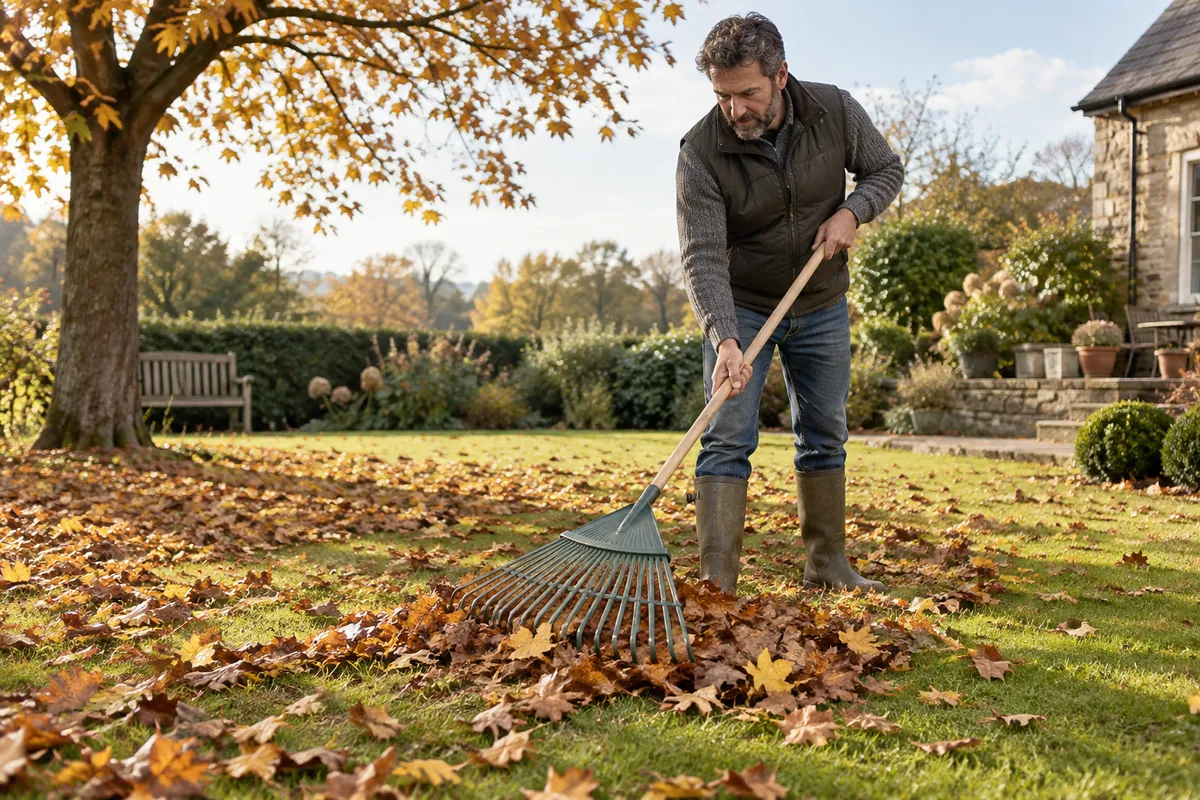
Leaf rake vs. garden rake: start with the tines
Penn State Extension distinguishes leaf rakes from rigid bow rakes by the work they do. Leaf rakes have long tines that flex around fixed objects and light material. Bow rakes have short, stout metal tines on a rigid head, useful for leveling and moving heavier material such as soil and rocks.
That difference explains why one rake rarely performs every job well. A flexible head can gather leaves without dragging as much soil, but it will not level a bed efficiently. A rigid head can shift soil, yet may catch or disturb plants if used carelessly through shrubs or delicate ground cover.
Common types of garden rake
| Rake | Head and tine feel | Typical task |
|---|---|---|
| Leaf rake | Wide head with long, flexible tines; may be metal, bamboo, or plastic | Collecting leaves and other light debris around plants |
| Bow or soil rake | Rigid head with short, stout tines | Leveling a seedbed, breaking surface clods, moving soil or small stones |
| Hand rake | Small head and short handle | Clearing or grooming material in containers and tight beds |
| Lawn or thatch rake | Specialized head intended for lawn debris or thatch | Use only for the task described by the manufacturer |
Some products combine or modify these designs. Check the tine stiffness, spacing, head angle, and the maker’s description instead of assuming that all metal rakes are alike.
Choose a rake for leaves, soil, or gravel
For leaves and light debris, choose a flexible leaf rake that can move between plants without snagging. A broader head can cover open lawn more quickly, but a narrower head may be easier to steer around borders and beds. Choose a size you can lift and control through a full stroke.
For leveling a bed, use a rigid bow rake. Turn the head so the tines or back edge are positioned for the job described by the manufacturer. Work the surface in short passes and step carefully to avoid compacting the area you have just prepared.
For gravel or heavier material, use a sturdy rigid head designed for that load. A flexible leaf rake can bend or become frustrating to control. Clear larger debris by hand when practical and avoid pulling heavy rocks toward your feet.
For containers and tight spaces, a hand rake gives more precise control. It is easier to keep away from stems and roots than a full-size head. Use it lightly; a small tool can still damage roots when pushed deep into the growing medium.
Use the soil rake to prepare a seedbed
Illinois Extension describes a rake as a tool for preparing a seedbed and breaking up large soil clods. A practical sequence is to loosen the ground with a suitable digging tool, remove stones or large debris that interfere with planting, then use the rigid rake to level the surface. A rake is intended for surface work; it will not correct compacted soil below the depth of its tines.
Work in more than one direction only if the bed needs it, and finish with a surface that suits the crop or seed packet. For very small seeds, large clods can make planting depth uneven. For larger transplants, a perfectly fine surface may not be necessary. Avoid pulverizing the soil into dust or repeatedly raking a bed that is already level.
After sowing, follow the seed packet for planting depth and covering. Small seeds often need only a light covering; do not bury every crop to the same depth.
Make leaf cleanup easier with short passes
On open lawn, a wider flexible rake can gather more leaves per pass. In planting beds, use shorter strokes and a narrower head so you can guide the tines around stems and branches. Pulling a large pile across the whole yard can strain your grip and catch on roots; move several small piles to a tarp, bucket, or compost area instead.
Dry leaves move differently from damp or matted leaves. If the material is stuck to the ground, lift it gently with the tines rather than digging into the turf. Use the rake for plant debris, not as a substitute for a lawn scarifier or a tool designed to remove thatch. Check the maker’s directions before using a specialized lawn rake because its tines and action differ from a light leaf rake.
Compare head width, handle, and balance
Head width affects both coverage and control. A wide leaf rake needs fewer passes across open ground but may be awkward in narrow paths. A smaller head gives more precision in beds. Handle length changes your working posture and reach. Penn State Extension recommends selecting tools with attention to ergonomics, handle options, and the way the head meets the ground.
Try a few strokes with the rake held at a normal working angle. You should be able to guide it without raising your shoulders or leaning far forward. Check the connection between head and handle, the grip comfort, and whether the tool feels balanced at the end of a stroke. If you have reduced hand strength or mobility, a lighter head and shorter work sessions may help more than a wider rake.
Do not choose head width by garden size alone. A wide head can be awkward around closely spaced plants, while a narrow rake may make an open lawn take longer. For a mixed garden, decide whether most of your time goes to open areas, beds, or containers. The most useful width is the one you can steer in the narrowest regular space without losing the coverage you need.
Test fit and balance before choosing a head
If you can handle a rake before buying, stand as you would during ordinary work and hold the handle without raising your shoulders. Make a few short strokes at a comfortable angle. Check whether the head stays easy to guide at the end of the stroke, whether the grip allows a relaxed hold, and whether the handle reaches the area without forcing you to lean forward. A rake that feels manageable empty may feel different after leaves or soil begin to catch between the tines.
Use the material you expect to rake as part of the decision. A broad, flexible head can cover open ground, but the same width may snag in a crowded bed. Damp or matted leaves can take more effort to move than a loose layer, so short passes and smaller piles can be easier to steer than one heavy pull. For soil work, the rigid head should meet the surface at a controllable angle; do not push the tool beyond the depth and job its design supports.
Before choosing between similar designs, inspect the head-to-handle connection and ask whether the handle or head can be replaced if it loosens or wears. Check for bent tines, cracked joints, sharp edges, and a grip that slips when your hands are gloved. Illinois Extension and Penn State Extension both emphasize selecting tools for the task and for comfortable use; fit, control, and maintainability are more useful checks than color or a broad “all-purpose” label.
Rake with control around plants and paths
Use smooth strokes and keep the tines away from stems, irrigation lines, and exposed roots. On a slope, work from a stable position and avoid pulling debris toward your feet. Wear gloves if the material includes thorny cuttings or sharp debris, and do not leave the rake with its head pointing up where someone could step on it.
When leveling soil, avoid working it while saturated. Wet ground is easier to compact, and a rake cannot correct a drainage or grading problem by itself. For uneven areas that need substantial reshaping, use the right soil-moving tools and check the site before changing runoff paths.
Clean and store the rake
Remove leaves and soil from the tines after use. Dry metal heads before storage and check that the handle remains tight and free of cracks or splinters. Store the rake on a wall hook or with its tines protected, out of walkways and away from children. Follow the manufacturer’s instructions for any replacement head or handle.
If you are setting up a small garden, begin with the rake that matches the recurring job: a leaf rake for seasonal cleanup or a rigid rake for preparing and leveling soil. Add a second design only when the tasks differ enough that one head cannot do both comfortably.