

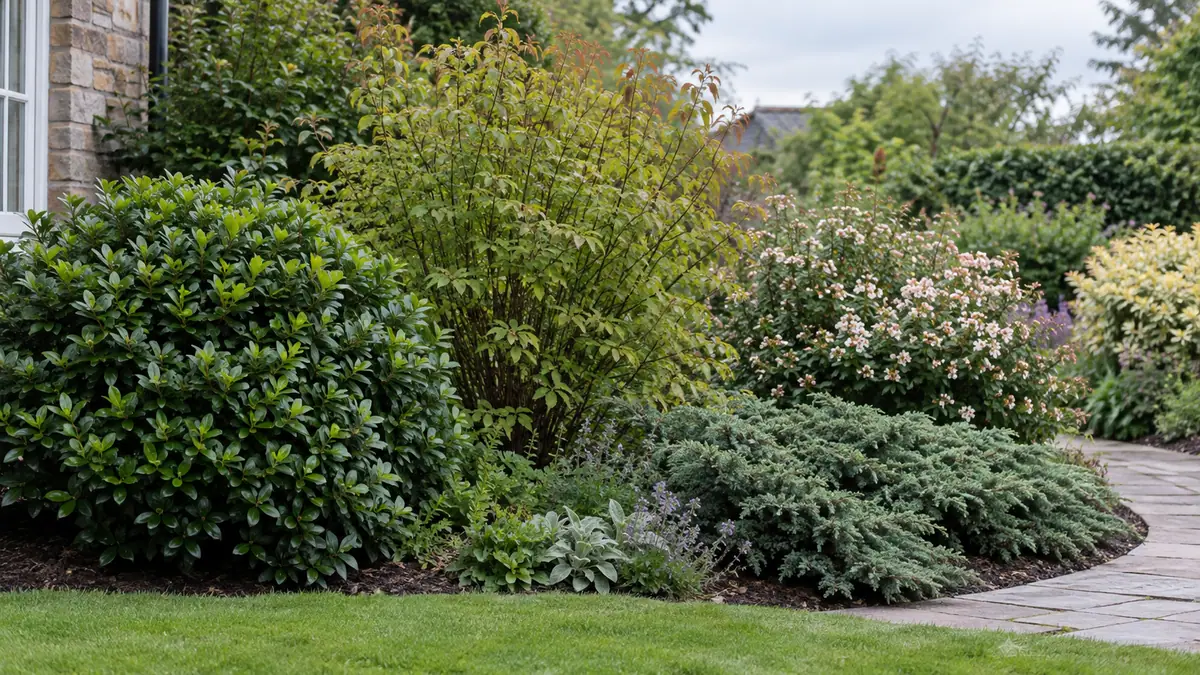
What counts as a shrub?
A shrub is a woody plant that commonly develops several stems from near ground level rather than one dominant trunk. The distinction from a small tree is not always absolute: growth habit can vary, and gardeners sometimes train or prune a plant into a different shape. The Royal Horticultural Society’s shrub overview describes the usual multi-stem form and notes that shrubs vary widely in size and seasonal interest.
“Shrub” describes a growth form, not a single botanical family or a guarantee of a particular height. A low ground-cover shrub and a large screen may both be shrubs but need different space and maintenance. Always check the botanical name and mature dimensions of the exact plant or cultivar.
Types of shrubs by foliage
Foliage gives a quick way to predict how much structure a shrub may provide outside its flowering period:
- Evergreen shrubs retain most of their foliage throughout the year in suitable conditions. They can provide a persistent screen or backdrop, but leaf retention depends on species, climate and stress.
- Deciduous shrubs lose leaves seasonally. They may reveal branch shape or allow more light into a bed during the dormant period, and some provide autumn color.
- Semi-evergreen shrubs retain some leaves in mild conditions but may lose more in colder or drier weather. The term needs to be checked against local conditions.
These labels do not tell you whether a shrub is suitable for your yard. The RHS guide to growing shrubs explains that both evergreen and deciduous shrubs can provide structure, flowers and wildlife value. Its plant advice reflects UK conditions; confirm hardiness and seasonal behavior locally.
Evergreen also does not mean green only: foliage can be silver, gold, red, purple or variegated. A leaf-color label is descriptive rather than a substitute for checking sun exposure, soil and mature size.
Types of shrubs by flowers, fruit and foliage
Some shrubs are chosen mainly for flowers; others for foliage color, fragrance, fruit or bark. A flowering shrub can also be evergreen or deciduous, and flower timing can differ between species and cultivars. Record the season of interest you want, then verify it against a local plant reference rather than relying on a universal month-by-month list.
Flowering habit matters when you later prune. Some shrubs form flower buds on older growth; others flower on newer stems. Cutting at the wrong time can remove the next display. The Penn State Extension guide to pruning flowering shrubs explains why identifying the plant and its flowering wood matters. Use regional advice for the exact species before making major cuts.
Fruit and seed heads may extend visual interest or provide food for wildlife, but they can also drop onto paths or be unsuitable near children and pets. Check the botanical name and trusted regional safety information before placing a shrub where people can reach it.
Types of shrubs by mature form
Shape and mature size make another useful comparison:
| Form | What it describes | Planning question |
|---|---|---|
| Low or ground-covering | A shrub that spreads close to the soil and covers a wider area than it grows tall. | Will it reach paths, neighboring beds or boundaries? The RHS ground-cover shrub guide describes this growth habit. |
| Compact or mounded | A relatively contained rounded canopy, though the final dimensions still vary. | Does the label list mature width as well as height? |
| Upright or vase-shaped | A taller outline that uses vertical space and can form part of a screen. | Will branches block a window, path or access point at maturity? |
| Arching or spreading | Branches extend outward or curve, creating a wider outline. | Is there room for the natural form without repeated clipping? |
Words such as compact, dwarf and fast-growing are relative. Check the cultivar’s dimensions and age at the stated size. A shrub sold as compact may still outgrow a narrow strip, while a taller species can sometimes be kept in a large container if its needs are met.
Types of shrubs by garden role
Garden role is a design choice rather than a botanical category. It helps you shortlist plants before comparing species:
- Screening or hedge shrubs: used to mark a boundary or soften a view. Decide whether you need year-round foliage, a formal clipped line or a looser mixed screen. A hedge is the planting arrangement; the plants may be shrubs with different growth habits.
- Specimen shrubs: positioned as a focal point for flowers, foliage, fragrance or form. Leave space to see and maintain the whole plant.
- Border shrubs: mixed with perennials or grasses to provide woody structure and seasonal contrast.
- Ground-cover shrubs: spread horizontally to cover soil. Check the species’ spread and whether it is appropriate near other plants or property boundaries.
- Wildlife-supporting shrubs: may offer flowers, fruit or shelter. Confirm regional suitability and avoid plants listed as invasive locally.
For a screening design, check mature height and width and leave access for trimming. For a flowering border, record the bloom period and pruning habit. For a small garden, a naturally suitable size is usually easier to manage than repeated hard cutting. The RHS notes that shrubs can serve as focal plants, hedges, ground cover and backdrops; those uses depend on each plant’s form and the site.
See how shrub categories overlap
Do not treat the categories above as a single ranking. A shrub may fit several descriptions at once. The table shows how to read the labels without assuming they are alternatives:
| Description on a label | Classification axis | What it does not tell you |
|---|---|---|
| Evergreen | Foliage retention | Mature dimensions, flower timing or hardiness in your area. |
| Flowering | Seasonal feature | Whether pruning before bloom will remove buds. |
| Ground cover | Growth form or garden use | Whether spread is controlled or appropriate for a boundary. |
| Hedge plant | A likely landscape use | How dense it grows, how often it needs cutting or how wide it becomes. |
This framework also helps separate shrub classifications from broad plant types. For the wider distinction between trees, shrubs, herbaceous plants and plant life cycles, see our types of plants guide.
Compare the label before choosing a shrub type
Once you know the category you want, compare the exact cultivar rather than relying on its common name. Record the botanical name, mature height and width, foliage behavior, flowering period, light, soil moisture and pruning needs. If the information is missing, ask a nursery or check a regional horticultural source before planting.
A shortlist can be a simple table rather than a numeric score. Give each candidate a column for its botanical name, the role you want it to fill, its mature dimensions, the label or source that confirms those dimensions, and any care requirement you cannot provide. Mark each condition as suitable, unsuitable or still unverified. This prevents a descriptive label such as “dwarf,” “fast” or “low maintenance” from replacing the details that affect the actual planting.
For example, a shrub may match the desired flower color but still be unsuitable if it will exceed the bed’s width or needs a pruning routine you cannot maintain. Keep only candidates that meet the site’s essential constraints, then choose among them by flower, foliage or seasonal preference.
Then match the plant to the site: available space, soil drainage, sun, wind, winter conditions and maintenance access. Check regional invasive-species guidance before planting a shrub that spreads freely. A source written for another climate can help explain a type, but it cannot establish that the species is suitable in your area.
For site selection, establishment, watering and routine care, continue with the garden shrubs guide. For flowering varieties and bloom-specific pruning, see our flowering shrubs page.