

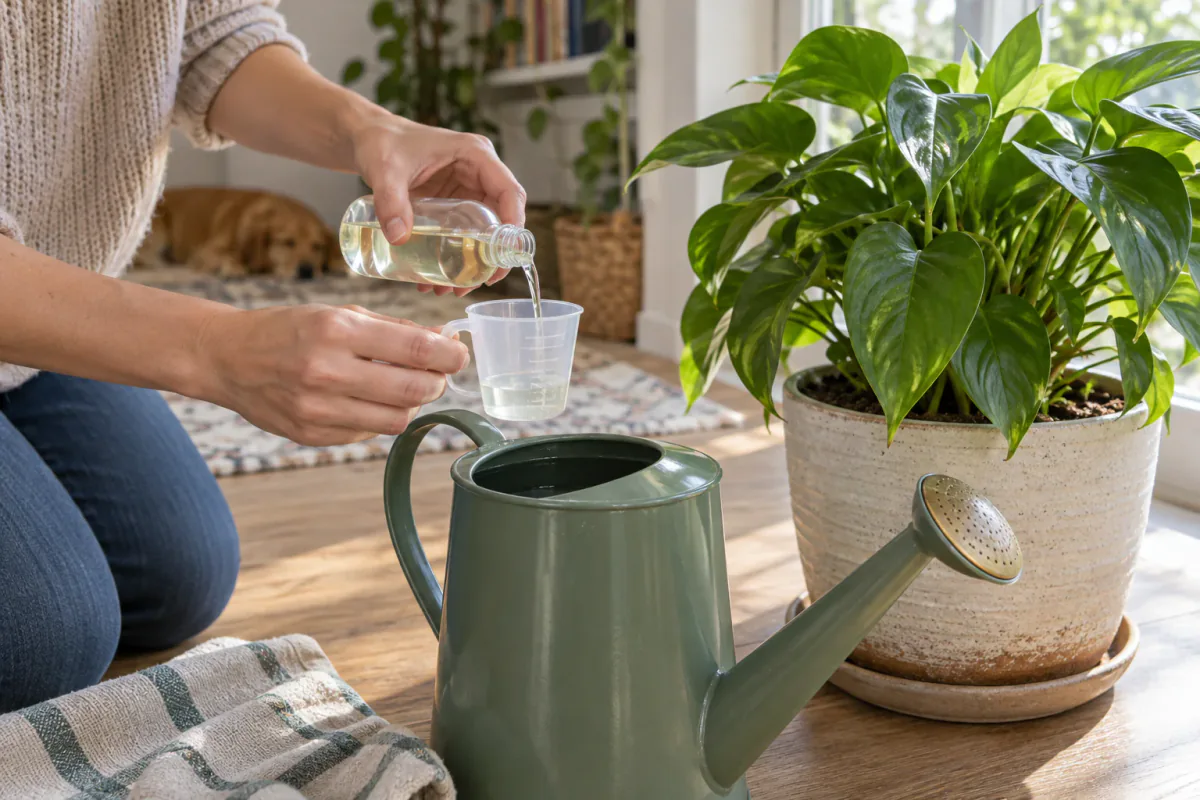
What liquid fertilizer does
Fertilizers supply plant nutrients in a form and proportion stated on the product label. A concentrated liquid must be diluted as directed; a ready-to-use product should be used only in the manner stated by its maker. Water-soluble fertilizer dissolves in the watering solution and makes nutrients available to roots as that solution moves through the growing medium. This can be useful when a plant in a container needs supplemental nutrients, but it can also be overapplied if the dose is guessed or the product is used too often.
Fertilizer does not replace light, suitable temperatures, healthy roots, water or oxygen in the root zone. It does not treat insect damage or a blocked drain. A plant that is already stressed may respond poorly to an additional salt load. Start by identifying the species and its normal growth cycle, then check whether the medium already includes fertilizer. University of Minnesota Extension’s container fertilizing guidance describes liquid soluble and slow-release choices and stresses following label directions to avoid overfertilizing.
Compare liquid and slow-release fertilizers
“Liquid fertilizer” describes a delivery form, not one uniform nutrient profile. A concentrated liquid is diluted before use; a ready-to-use solution is applied as sold; a dry soluble fertilizer is mixed with water; and a slow-release granular product releases nutrients over a longer period according to its formulation and conditions. A liquid feed can be easier to dose for individual pots, while slow-release products may reduce the need for repeated mixing. Neither type is automatically better for every plant or situation.
Containers have a limited root volume. Repeated watering can carry some nutrients through drainage holes, so a potted plant may need attention during its growing season. At the same time, a container can accumulate salts if fertilizer is repeatedly applied without regard to the label, watering or mix. The University of Minnesota notes that both soluble and slow-release fertilizers can be used in containers and that the label should guide rate and timing. Its advice on the different fertilizer forms is more useful than choosing by liquid appearance alone.
For garden beds, soluble liquid feeding may be practical for a specific need or crop, but it can be less efficient if rain or irrigation moves nutrients away from roots. Use soil-test results and local extension recommendations for garden beds rather than transferring a container schedule to open ground. Organic and mineral products can also differ in nutrient concentration, release and permitted use; read the active ingredients and crop label.
Decide whether a plant needs feeding
Look at the whole plant and its growing conditions before reaching for fertilizer. Check whether it receives the light recommended for its species, whether the root zone is too wet or too dry, whether drainage is open, and whether roots are crowded or damaged. Inspect the underside of leaves and stems for pests. Consider whether the plant is in active growth, dormant, recently repotted or recovering from transplant shock. A symptom such as yellowing can have several causes and does not prove a nutrient deficiency.
For a container, read the potting-mix bag or the nursery label. Some mixes contain a starter charge or slow-release fertilizer; adding liquid feed immediately may create an unnecessary dose. If the plant is healthy and producing new growth, there may be no reason to change its routine. If growth is poor, identify the likely cause first and consult plant-specific extension advice. A soil test is more informative for many garden-bed nutrient questions than visual guessing.
Keep expectations realistic. Fertilizer supplies nutrients; it does not make a shade plant thrive in intense sun, correct compacted or waterlogged media, repair root rot, or prevent a pest outbreak. When the diagnosis is uncertain, improve the growing conditions and observe new growth before applying a product. If the plant is an edible crop, make sure the fertilizer label permits that crop and states any pre-harvest directions.
Read the N-P-K analysis and label
The N-P-K numbers describe the fertilizer’s guaranteed analysis for nitrogen, phosphate and potash, expressed according to the relevant labeling convention. They do not tell the complete story of a product and should not be compared as a simple quality score. A higher number is not automatically stronger in a useful way. Check whether secondary or micronutrients are listed, whether the product is intended for indoor plants, vegetables, flowers or another use, and whether the crop label gives special directions.
Read the full label before opening the bottle. Find the dilution rate, application method, maximum frequency, storage advice, protective measures, and warnings for children, pets, wildlife or edible crops. Follow the most restrictive applicable instruction. Do not assume a generic houseplant dilution is safe for every species or that a product can be used in hydroponics, a pond or a seedling tray unless the label says so.
Compare products by what they contain, where they can be used, how they are applied and what the label requires. A bloom-focused formula or tomato feed may be marketed with a particular nutrient balance, but it should still be selected according to the crop and label. Avoid choosing only from the front-panel claims, bottle color or a high N-P-K number.
Measure and dilute accurately
Use the measuring device and water volume specified on the label. Do not pour concentrate by eye, use a kitchen utensil that may later contact food, or add “a little extra” to speed results. For a simple arithmetic check, multiply the labeled amount per unit of water by the amount of water you are preparing. For example, if a label calls for 5 millilitres per litre and you are preparing 2 litres, the corresponding amount is 10 millilitres. That example demonstrates the calculation only; use the rate printed on your own product.
Mix only the amount you can use as directed, and use clean equipment. Do not combine fertilizers, pesticides, household cleaners or other products unless their labels explicitly permit the combination. A liquid can settle or separate in storage, so follow the maker’s instructions on shaking or mixing. Never transfer concentrate into an unmarked drink bottle, and keep it in its original container with the label readable.
If measuring tools are unavailable, do not guess the dose. Check whether the manufacturer offers a compatible cap or pump measure or choose a product with instructions you can follow accurately. A concentrated liquid may require a very small amount; overestimating that amount can damage roots and leaves. Store the bottle securely and clean any spill according to the label.
Apply fertilizer to the root zone
Apply the diluted product in the way specified on the label. Some products are meant for root-zone watering; others permit foliar use. Do not spray leaves unless that route is explicitly allowed and appropriate for the plant. Avoid treating foliage in direct hot sun or conditions the label warns against. Keep fertilizer off paths, decks and waterways, and clean spills promptly using the product instructions.
Before feeding a potted plant, check whether the medium is extremely dry or the roots are damaged. A concentrated solution contacting a dry root ball can add stress. If the label allows, water the plant as appropriate for its species first and apply the fertilizer solution evenly around the root zone, not just at one point near the stem. Stop if liquid is pooling or running across the surface; a compacted mix may need attention rather than more fertilizer.
Do not leave runoff sitting in a cachepot or saucer. Repeated drainage can carry nutrients into the water below the pot, where they may harm aquatic life if discarded carelessly. Follow local disposal instructions and never pour concentrated fertilizer into a storm drain, pond or stream. The University of Minnesota container guide explains that excess fertilizer can damage plants and contribute nutrients to the environment.
Choose timing for pots and garden plants
Follow the product’s frequency and the plant’s growth cycle rather than applying on an arbitrary weekly schedule. Many ornamental plants use more nutrients during active growth and less during dormancy, but exact timing differs by species, climate, light and product. A recently purchased plant may already have fertilizer in its medium. A freshly repotted plant may also need time to establish; check the mix label and plant-specific guidance before adding more.
Container vegetable recommendations vary by crop and local growing conditions. Penn State Extension’s container vegetable guide offers a regional program that combines a slow-release product at planting with later soluble applications. That example is not a universal prescription; check the label and local crop advice, particularly for edible plants. Do not copy an interval from another gardener if your fertilizer has a different concentration or release profile.
For garden beds, use a soil test where appropriate and apply the nutrient only when it addresses an identified need. Avoid applying before heavy rain or onto hard surfaces where it can wash into drains. For houseplants, adjust to the indoor light and growth rate, which can differ from outdoor plants of the same species. Keep notes on dates and rates so you do not repeat an application simply because you cannot remember the last one.
Recognize overfertilizing and other stress
Signs associated with excessive fertilizer can include leaf-tip burn, wilting, poor growth or a crust on the growing medium, but these signs overlap with drought, root damage, temperature stress and poor drainage. If a plant declines after feeding, stop additional applications, read the label and review how much was used. Check moisture and roots, and seek species-specific extension or horticultural advice before attempting a corrective treatment. Flushing a pot may be inappropriate where drainage is poor or the plant is already waterlogged.
Do not assume pale leaves need nitrogen. Yellowing can result from too little or too much water, unsuitable light, root-bound conditions, disease, pests or nutrient imbalance. Look for a pattern: which leaves are affected, whether the change is on new or old growth, and whether several plants show the same issue. Compare the plant’s care history and inspect the root zone. A soil or media test can help where the cause remains unclear.
When a plant is stressed, reduce variables. Confirm water and light first, isolate pest problems and avoid applying multiple products at once. Record what changed and wait for new growth to assess the response. Existing damaged leaves may not regain their former appearance even after the underlying problem is corrected.
Choose a product for the plant and crop
For indoor foliage, choose a product labeled for houseplants and follow the rate for that use. For flowering plants, do not assume a “bloom” formula is necessary unless the plant and label guidance support it. For vegetables, confirm the product is labeled for edible crops and observe any harvest interval or protective instructions. For seedlings and cuttings, use only a product appropriate for that stage; young roots may be more sensitive to concentrated solutions.
For hydroponics, orchids, carnivorous plants, citrus, succulents and other specialized groups, use guidance written for that growing system or species. An all-purpose liquid feed may not match the required nutrients, pH or salt tolerance. Do not adapt a hydroponic recipe to potting soil or vice versa. If the medium already contains nutrients, account for that before supplementing.
Compare the label’s actual use directions rather than choosing by vague categories such as “natural,” “professional” or “fast action.” Check the nutrient analysis, permitted crops, application method, dose, frequency, storage and safety statements. When two products are both suitable, choose the one whose instructions you can follow consistently and accurately.
Keep a simple feeding record
A short record helps prevent repeated dosing and makes it easier to identify what changed. Note the plant or crop, product name, label dilution, amount used, date and observed condition. For containers, include the potting medium and whether it already included fertilizer. For outdoor crops, record weather and watering if those affect growth. This is especially useful when several people care for the same plants.
Review the record before the next application and compare the plant with its normal growth cycle. If growth has improved, continue only according to the label. If the plant has worsened, do not increase the concentration automatically. Recheck the diagnosis and ask a local extension service or qualified horticulturist if symptoms persist. Keep the product label accessible and replace it if it becomes unreadable.
Avoid common liquid-fertilizer mistakes
Measuring by eye: small errors matter with concentrated products. Feeding every time you water: that may exceed the label’s intended rate. Choosing by N-P-K alone: crop use and concentration also matter. Fertilizing a sick plant without diagnosis: nutrition may not be the cause. Combining products: compatibility must be stated on the labels. Ignoring pre-fertilized potting mix: the plant may already be receiving nutrients.
Also avoid pouring runoff into a storm drain, using fertilizer outside its labeled crop or application method, and storing concentrate in an unmarked container. Do not infer that liquid products are automatically gentler than granular products. Both can harm plants or the environment if overapplied. For broader nutrient advice, see our plant fertilizer guide and the parent soil and substrate hub.