

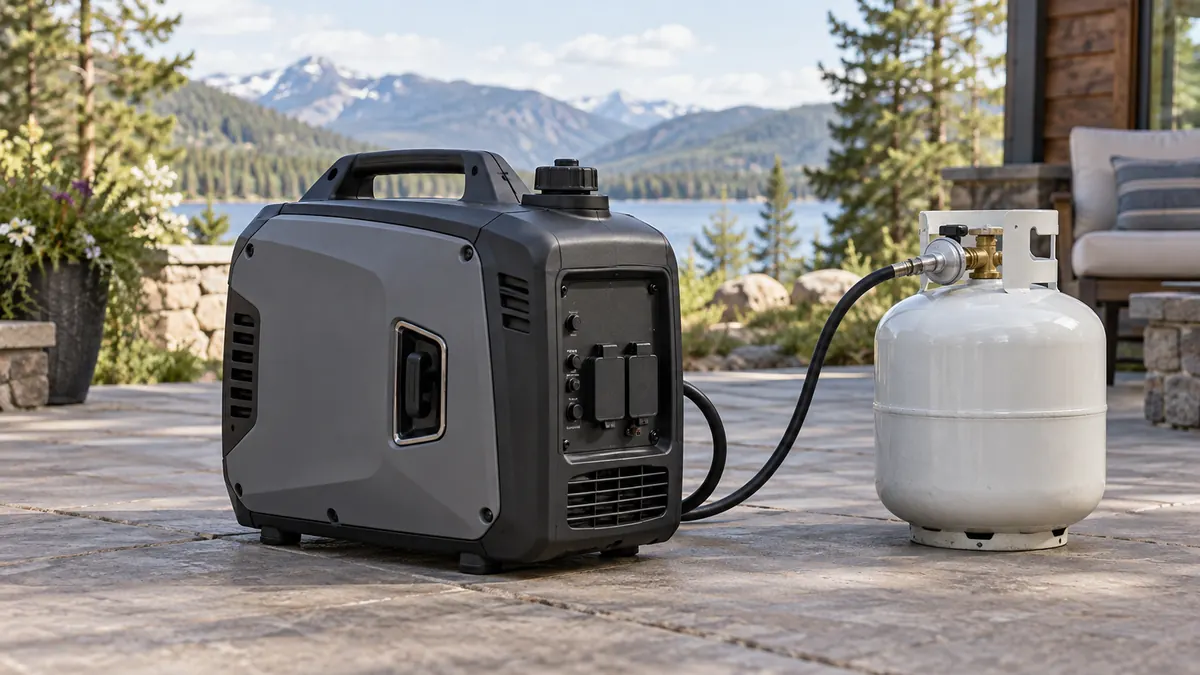
This page covers the European 230 V / 50 Hz Könner & Söhnen KS 4100iEG, also identified in manufacturer data with SKU “KS 4100iE G”. It is a hybrid petrol-and-LPG inverter generator. This is a documentary review; we have not physically tested fuel use, noise, vibration or output under load.
Important LPG caveat: the manufacturer evidence does not agree. The 2026 English and 2023 Spanish manuals state that LPG reduces generator power by 10%. An older indexed Spanish K&S product-page copy said the generator ran on LPG without losing power. The two regional product-page URLs checked for this guide returned 404 on 10 October 2026, so their live status and current wording could not be confirmed. Use the manual supplied with the exact unit and check its rating plate and LPG instructions before sizing a sustained load.
Do not confuse it with the petrol-only KS 4100iE. The added “G” identifies a different fuel system. A listing that only says “KS 4100iE” or “4,000 W” is not enough to prove it includes the LPG hose, reducer or the correct manual.
Identify the exact KS 4100iEG variant
The model name is the first check, but confirm it against the rating plate, product SKU, packaging and the manual supplied with the unit. K&S documentation identifies the hybrid model as KS 4100iEG and gives SKU KS 4100iE G. Those forms refer to the hybrid version in that documentation; they are distinct from the petrol-only KS 4100iE.
Market matters as well. The documented European unit supplies 230 V at 50 Hz through Schuko outlets. It is not a US 120 V / 60 Hz generator. Do not use this guide to select an electrical product for a different voltage or plug standard.
Manufacturer specifications
| Published item | KS 4100iEG | How to use the figure |
|---|---|---|
| Voltage / frequency | 230 V / 50 Hz | European-market electrical standard |
| Petrol output | 3.6 kW rated / 4.0 kW maximum | Use rated power for sustained loads |
| LPG output | 2026 EN / 2023 ES manuals: 10% power reduction; older indexed K&S Spanish product-page copy said no loss | Regional product-page URLs returned 404; use the exact unit manual and rating plate |
| Outlets | 2 × Schuko 230 V | Combined load remains limited by generator capacity |
| Engine / fuel tank | 223 cm³ / 12.5 L petrol | Fuel use varies with load and conditions |
| Runtime at 50% load | 8.1 h on petrol, per manufacturer | Not an LPG runtime or a guaranteed field result |
| Noise / net weight | 2026 EN manual: 70/97 dB LpA at 7 m / LwA; 38 kg | 2023 ES manual lists 70/95 dB; check the supplied revision |
| Starting / ATS / parallel | Manual / electric start | 2026 EN manual marks ATS input and parallel socket absent; do not transfer KS 4100iE features |
Manufacturer figures describe specified test conditions and a manual revision. They do not establish the runtime or output you will get with a particular appliance, fuel blend, temperature or maintenance condition. The product-page URLs reviewed for this guide returned 404 on 10 October 2026, so this page relies on the official manuals for specifications and identifies the regional product-page copy as historical evidence.
Petrol and LPG output
The 2026 English and 2023 Spanish manuals list 3.6 kW rated and 4.0 kW maximum output on petrol and state in a footnote that LPG operation reduces generator power by 10%. An older indexed Spanish K&S product-page copy said the LPG generator ran without losing power. The product-page URLs checked for this guide returned 404 on 10 October 2026, so their current wording could not be confirmed. Treat the conflict as a difference between manual revisions and historical regional product copy; use the manual supplied with the exact unit and its rating plate before planning a sustained load.
Fuel economics cannot be inferred from that output difference alone. Compare the model’s fuel-consumption figures at a comparable load with current local prices per litre and per kilogram. A cylinder’s usable quantity, regulator and ambient conditions also affect a real setup. No universal LPG saving or runtime can be promised.
Plan loads and starting current
List the appliances you expect to run at the same time. Record each unit’s running input and, for motors, pumps, compressors and refrigerators, its start-up current or starting watts. Add the running loads, then check whether the largest starting event fits within the generator’s available headroom. A device that fits on paper while running can still trip protection or fail to start if its inrush demand is high.
Do not assume that each Schuko outlet can supply the full generator rating independently. The total load across both outlets shares the machine’s capacity. Avoid stacking several high-current appliances onto adapters or undersized extension leads. If a load is safety-critical, sensitive or hard-wired, compare its requirements with the manual and ask a qualified electrician.
The inverter label describes the generator’s conversion system; it does not mean that every electronic appliance is automatically compatible. Check the appliance manual for voltage, frequency, waveform or total harmonic distortion requirements, and confirm the generator’s published data for the exact variant.
The model-code distinction also affects household backup. The 2026 manual’s specification table marks the KS 4100iEG as having neither ATS input nor a parallel socket, while an older indexed K&S product-page copy described a parallel connection. The petrol-only KS 4100iE has different feature listings. Do not assume the iEG can be expanded or switched automatically because a page describes a related model; confirm the rating plate, manual revision and approved accessories first.
Build a load worksheet for each fuel
Before connecting equipment, make a short worksheet with the appliance name, running watts, starting demand and whether it must run continuously. Use the appliance nameplate or manufacturer manual rather than a generic online estimate. Add the running loads that will operate together, then identify which motor, pump or compressor may start while the other devices are already on. The 4.0 kW maximum figure is not a continuous-use target; the model manual says loads above 80% of rated power are not recommended for service life.
Prepare a separate plan for petrol and LPG. The K&S manuals state a 10% output reduction on LPG, so do not size a propane setup from the petrol maximum rating or assume the old product-page copy applies to the unit in front of you. If the load only fits when every figure is treated as a peak, remove or stagger non-essential appliances. Do not add a calculated LPG rating unless the current manual or rating plate for that unit supplies it.
The 2026 English manual gives 8 hours 5 minutes at 50% load on petrol for this model. That is a manufacturer test figure for the stated fuel and load; it is not an LPG runtime promise or a prediction for a different temperature, fuel quality or service condition. Confirm ventilation, refuelling intervals and cable requirements in the manual before relying on the generator for a long outage.
LPG connection and operating limits
The manufacturer describes the KS 4100iEG as a petrol-and-LPG model and lists an LPG hose with reducer in its product materials. Check that the connection kit supplied with the selected variant matches the cylinder and local gas system. Do not substitute an unrelated regulator, hose or adapter, or assume that the unit can connect to natural gas or a fixed tank because it accepts LPG.
Use the model-specific manual for connection, fuel selection, starting and shutdown. The sequence can differ between generators; do not transfer instructions from another K&S model. Never connect or disconnect a cylinder while the engine is running. If you smell gas or find a damaged hose or connector, do not start the generator; follow the supplier’s safety instructions and get qualified help.
Outdoor use and electrical safety
Run the generator outdoors only. Combustion exhaust contains carbon monoxide, which is colourless and can be fatal. Keep the exhaust directed away from buildings, doors, windows and air intakes, and follow the separation distances in the current manual and local guidance. A shed, garage, basement, porch or open window is not a safe location.
Keep the machine dry and stable, allow ventilation around it, and protect cables from heat, water and mechanical damage. Do not back-feed a building through a wall socket. Connecting a generator to household wiring requires suitable transfer equipment and installation by a qualified electrician under local rules. The product listing’s electric start does not imply automatic household transfer.
Checks before buying
- Match the full model code. Confirm KS 4100iEG / SKU KS 4100iE G rather than the petrol-only KS 4100iE.
- Confirm the market. Check 230 V, 50 Hz, Schuko outlets and the appropriate local manual.
- Size the load for the fuel. Use the exact unit manual’s rating for that fuel, account for start-up peaks and leave headroom; the K&S manuals state a 10% LPG power reduction.
- Check what the box includes. Verify the LPG hose, reducer, battery, charging cable and other accessories for the exact seller package.
- Plan safe operation. Identify an outdoor location and a professionally designed transfer setup if household wiring is involved.
- Compare warranty and service. Confirm the responsible seller, local support, return conditions and current manual before ordering.