

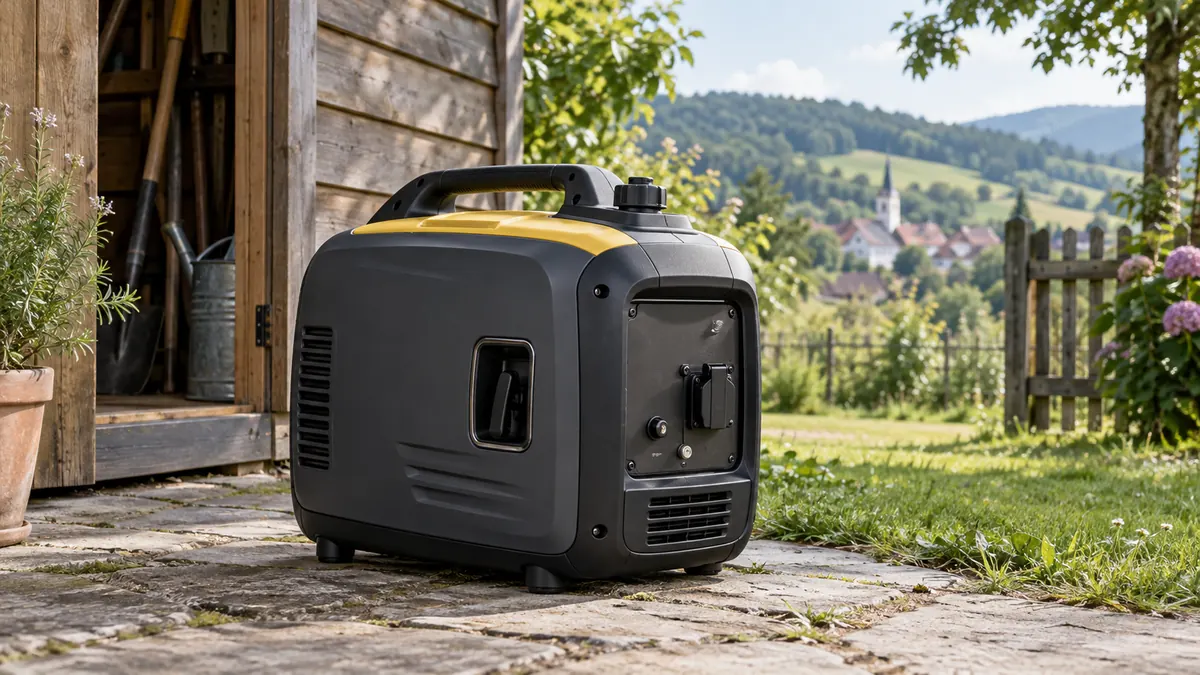
KS 4100iE official EU specifications
The manufacturer page and 2026 owner manual identify the KS 4100iE as a gasoline-only, single-cylinder, four-stroke inverter generator for the European electrical market. The suffix matters: the KS 4100iEG is a separate dual-fuel product. This page covers the iE only and does not transfer the EG's LPG system or fuel-specific figures.
| Item | Manufacturer data for KS 4100iE | How to interpret it |
|---|---|---|
| Output | 3.6 kW nominal; 4.0 kW maximum | Use nominal output for sustained load planning; do not assume maximum is continuous |
| Electrical market | 230 V, 50 Hz; 17.4 A maximum; two Schuko 230 V sockets | Not the North American 120/240 V, 60 Hz panel |
| Fuel and engine | Gasoline; KS 240i, 223 cm³, 7.5 hp | Use the fuel type and grade in the matching manual |
| Tank and stated runtime | 12.5 L; 8.1 hours at 50% load | Manufacturer condition, not an independent test or promise at another load |
| Starting and transport | Manual/electric start; 1.6 Ah battery; 36.7 kg net | Confirm battery condition and full package before ordering |
| Sound data | 70 dB LpA at 7 m; 97 dB LWA in the 2026 manual | The current product page lists 95 dB LWA; confirm the data for the exact unit |
| Other listed features | LED voltage/frequency/hour display, USB outputs, 0.6 L oil capacity and external ATS connection | Check the exact control panel and compatible ATS accessory |
Read the output and runtime ratings
The 3.6 kW nominal figure describes the maker's continuous rating; 4.0 kW is listed separately as the maximum. Build a load list from the device nameplates and include the start-up draw of motors, pumps and compressors. Compare that combined demand with the exact outlet, circuit and generator limits rather than adding the two figures together. The manual says continuous loads above 80% of rated output are not recommended to support service life. Applied to 3.6 kW, that is 2.88 kW as a planning reference, not a new manufacturer power rating or a substitute for the manual.
The runtime figure also has a condition: K&S lists 8.1 hours at 50% load. Actual time changes with the connected load, fuel, temperature, altitude and maintenance condition. Do not divide the tank size by runtime and present the result as a universal fuel-consumption rate; the source does not supply a full operating curve for each load. If you need a full-night or backup interval, calculate it from the intended load and ask the manufacturer for the matching fuel-use data.
The 2026 manual lists 70 dB LpA at 7 m and 97 dB LWA, while the manufacturer's product page lists 70/95 dB. The documents therefore disagree on sound power; check the manual and rating data for the exact unit before comparing it with another generator. LpA measured at a stated distance and LWA are different measures, so do not compare them as if both were readings at the operator's position. If noise affects neighbours or a campsite, look for the same measurement distance and test condition for every model under consideration.
Match inverter output and package to the load
The official specification identifies the KS 4100iE as gasoline-only; it belongs in an inverter-generator comparison, not a dual-fuel list. It uses European 230 V/50 Hz output and Schuko sockets; check the exact equipment and installation requirements. The official product page showed the item unavailable during this review, and no exact Amazon.com listing was verified.
Check the regional variant and rating
- Match the full model suffix and fuel, then compare running and starting output for that fuel and voltage.
- Check receptacles, circuit protection, transfer-switch requirements, frequency and regional electrical standards.
- Confirm package contents, regulator or hose, maintenance schedule, weight and current local service support.
- Plan outdoor placement more than 20 feet from doors, windows and vents before operating.
It may be worth considering when the intended appliances use the same 230 V/50 Hz system, the load is within the documented nominal output, and portability around a 36.7 kg machine is manageable. The figures do not establish that it can power a whole house, run every appliance at once, or safely connect to a building circuit. For those jobs, list priority loads and have an electrician size the transfer equipment. If you are comparing another fuel format, review the gasoline generator guide or the dual-fuel selection guide before comparing price or package contents.
Where the European KS 4100iE can fit
The documented 3.6 kW nominal output gives a starting point for a short list of 230 V appliances, not a whole-home suitability verdict. Add the continuous demand of the items you would actually run together and leave room for the startup current of any motor. If one load is essential but its inrush demand is unknown, resolve that value before treating the generator as a match. The 4.0 kW maximum rating does not turn into extra continuous capacity.
The manufacturer also advises against continuous loads above 80% of nominal power to support engine service life. On the published 3.6 kW rating, 2.88 kW is a planning ceiling derived from that instruction; it is not a separate rating or a promise of stable performance under all temperatures and altitudes. Use the manual's environmental limits and avoid operating at the limit for long periods when a lower load plan is possible.
Transport is another practical filter. At 36.7 kg net, it is wheeled but not a one-hand carry generator. Measure the storage opening and route, check steps and lifting points, and confirm whether the seller includes the battery and wheel/handle assembly for the exact package. For a fixed site, ask an electrician to check the transfer setup; for recreation, verify site noise rules and where exhaust can disperse. These conditions can matter more than the difference between similar headline watt figures.
Starting, battery and external ATS connection
The manufacturer lists both manual and electric starting, and the manual gives separate start instructions for the pull starter and the electric-start switch. That can be useful if a charged starter battery is unavailable, but it does not remove the need for the pre-start oil and fuel checks. Follow the manual's warm-up, load connection and shutdown sequence; it says to connect appliances only after the generator has started and warmed up.
The product page marks an ATS output connection, and the manufacturer's article describes a compatible external KS ATS 4/25 unit. That means a connection option, not an included automatic transfer switch. The product page does not say that the generator alone provides unattended household backup. Confirm accessory compatibility, installation, neutral/earthing arrangement and transfer procedure with the manufacturer and a qualified electrician. Never backfeed a home circuit through a wall socket.
Similarly, “inverter” is a product class, not permission to connect every electronic device. Check the load's voltage, frequency, grounding and power-quality requirements against the current manual. The manual specifically warns against using the generator as a substitute for the mains when feeding grid-tied or hybrid inverters, because backfeed can damage the generator.
Break-in, care and operating limits
The 2026 owner manual calls for a restrained first 20 operating hours: keep loads at or below 50% of nominal output during commissioning, then change the oil as directed. For this model's 3.6 kW nominal rating, that means a break-in load no higher than 1.8 kW under the cited manual's instruction. Follow the exact service intervals and oil type in the manual that ships with the product; a generic generator schedule may not match it.
Before each use, inspect the area, generator, plugs and cables; check oil and fuel; and use the manual's grounding and protective-device instructions for the application. Keep it dry and ventilated, away from flammable material, and never operate it in a home, garage or enclosed area because exhaust contains carbon monoxide. Stop and cool the engine before refuelling. These are portable-engine safety controls, not optional accessories.
Why US listings cannot be inferred
Do not apply this model's 230 V/50 Hz ratings to North American 120/240 V, 60 Hz equipment or assume that a plug adapter converts voltage or frequency. The maker's page marked the product unavailable during this review; we have not verified an exact Amazon.com offer. An English-language manual does not turn a European model into a North American one. If a seller offers a similarly named generator in another country, match its data plate, SKU and manual before applying any of the figures above. The parent portable generator guide explains how fuel and electrical market change the comparison.
Generator placement and electrical safety
The CDC advises keeping a generator outdoors at least 20 feet from doors, windows and vents; never run one in a home or garage. Use a CO detector and have an electrician handle any building connection. Follow the model manual for fuel, grounding and maintenance.