


▷ Best inverter generators 2026
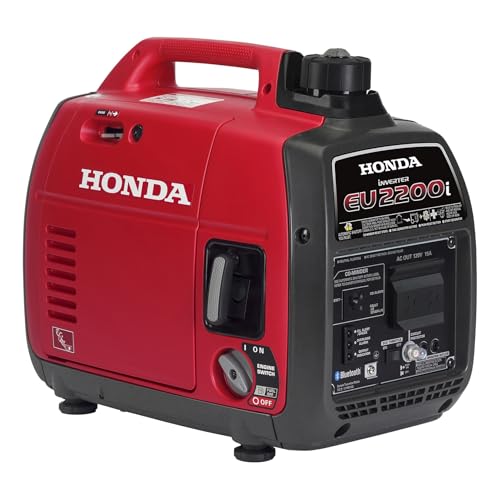
Honda EU2200i — 2200-Watt Super Quiet Inverter Generator with CO-Minder
- ✓ Power: 2,200W surge / 1,800W rated — parallel-ready for 4,400W total
- ✓ Noise: 48.5–57 dB(A) — quieter than a normal conversation at light load
- ✓ Runtime: up to 8.1 hours on 0.95 gallons at 25% load
- ✓ CO-Minder: auto-shutoff if CO levels rise — essential safety feature
- ✓ Weight: 47.4 lbs — portable with ergonomic handle
- ✓ Bluetooth app control (Honda My Generator) — remote monitoring & start
Price from Amazon.com · ships within US

Westinghouse iGen2200 — 1800W Rated, Super Quiet, Parallel Capable
- ✓ Power: 2,200W peak / 1,800W rated — solid output for the price
- ✓ Noise: 52 dB(A) — comparable to the Honda at a fraction of the cost
- ✓ Runtime: up to 12 hours on 1.2 gallons at 25% load — class-leading tank
- ✓ Parallel capable: add a second unit for up to 4,400W combined
- ✓ Weight: 46 lbs — nearly identical portability to Honda
- ✓ CARB compliant — legal in all 50 states including California
Price from Amazon.com · ships within US
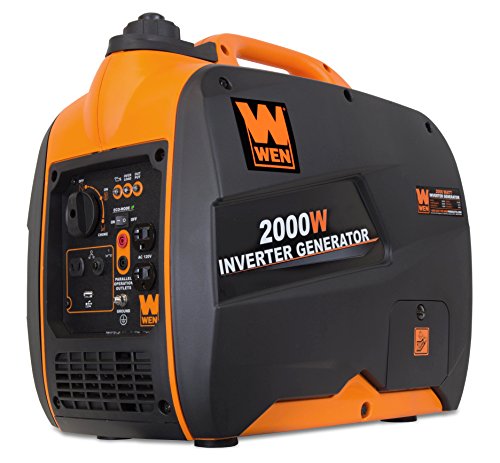
WEN 56200i — 2000W Surge / 1600W Rated Inverter Generator, CARB Compliant
- ✓ Power: 2,000W surge / 1,600W rated — sufficient for camping and light backup
- ✓ Noise: 51 dB(A) at quarter load — genuinely quiet for its price range
- ✓ Fuel shutoff valve — prevents carburetor damage during storage
- ✓ Parallel capable with a second WEN 56200i for 3,200W combined
- ✓ Weight: 48 lbs — similar portability to Honda at one-quarter the price
- ✓ CARB compliant — best-selling budget inverter generator on Amazon
Price from Amazon.com · ships within US
Inverter vs conventional generators: the key differences
A conventional generator runs its engine at a fixed 3,600 rpm and routes AC power directly to the outlets. The output works fine for power tools and appliances with simple electric motors, but the current contains voltage fluctuations and harmonic distortion that stress — and can eventually damage — sensitive electronics like laptops, phone chargers, TVs, and modern inverter-driven appliances (refrigerators, AC units with variable-speed compressors).
An inverter generator runs the same basic combustion engine, but adds a digital conversion stage between the engine and the outlets. AC power is first rectified to DC, then cleaned and stabilized, then converted back to smooth AC using digital inverter electronics. The output has a THD (Total Harmonic Distortion) below 3% — well within the 5% threshold that manufacturers of sensitive equipment require for warranty coverage.
The second major advantage is variable engine speed. Instead of running at a constant 3,600 rpm regardless of load, the inverter's control system matches engine rpm to actual demand. Charging a phone? The engine idles at 1,500 rpm and barely whispers. Running a power saw? It spins up to 3,600 rpm. This automatic throttling produces the quietness inverter generators are known for — and the fuel savings. A conventional 2,000-watt generator burns 0.4–0.5 gallons per hour at half load; a comparable inverter burns 0.1–0.2 gallons in the same conditions.
The trade-off is cost. Inverter generators carry a 40–100% price premium over conventional generators of the same rated wattage. For loads that are purely resistive — basic power tools, simple pumps, incandescent lighting — a conventional generator is more economical. For anything with electronics, an inverter is the right choice.
Honda vs Westinghouse vs WEN: full comparison
The three models cover the full price spectrum of the 2,000–2,200 watt segment:
The Honda EU2200i is the benchmark that every other inverter generator is compared against. Honda's proprietary inverter electronics produce the cleanest output in its class (THD effectively unmeasurable in most real-world tests), and the engine reliability is legendary — documented cases of EU2000i and EU2200i units running 10,000+ hours with standard maintenance. The CO-Minder carbon monoxide auto-shutoff is a genuine safety differentiator. At 48.5 dB under light load, it approaches true near-silence. The Bluetooth My Generator app adds remote start/stop and service reminders. Premium price, premium everything.
The Westinghouse iGen2200 is the rational choice for most buyers. At roughly half the Honda's price, it delivers 90% of the performance in the categories that matter most: noise (52 dB vs 48.5 dB — a barely perceptible difference), output power (1,800W rated vs 1,800W rated — identical), and parallel capability. The standout spec is the 12-hour runtime on 1.2 gallons at 25% load — significantly better than the Honda's 8.1 hours on 0.95 gallons. With nearly 9,000 Amazon reviews and a 4.5-star average, it has one of the strongest real-world satisfaction records of any portable generator at any price.
The WEN 56200i is the right choice when budget is the primary constraint. At under $300, it delivers genuine inverter performance: 51 dB noise, pure sine wave output, and CARB compliance for all-state legality. The rated 1,600 watts is a honest limitation for demanding loads — it will not run a large window AC unit, for example — but for camping essentials (lights, phone charging, a small fan, a coffee maker) it is more than adequate. With over 11,000 Amazon ratings, it is the best-selling budget inverter generator and has a strong track record for reliability at its price point.
Spec comparison table
| Spec | Honda EU2200i | Westinghouse iGen2200 | WEN 56200i |
|---|---|---|---|
| Price (approx.) | ~$1,000–1,100 | ~$380–450 | ~$230–290 |
| Rated watts | 1,800W | 1,800W | 1,600W |
| Peak / surge watts | 2,200W | 2,200W | 2,000W |
| Noise at 25% load | 48.5 dB(A) ✅ | 52 dB(A) | 51 dB(A) |
| Runtime at 25% load | 8.1 hrs / 0.95 gal | 12 hrs / 1.2 gal ✅ | 6.0 hrs / 0.5 gal |
| Weight | 47.4 lbs | 46.0 lbs | 48.5 lbs |
| CO shutoff | Yes (CO-Minder) ✅ | No | No |
| Parallel capable | Yes | Yes | Yes |
| Best for | Max reliability, CO safety | Best value, long runtime | Budget camping use |
How to choose the right wattage
The most common mistake is buying just enough wattage with no headroom. Electric motors draw 3–4× their running wattage during startup — a 500-watt fridge can require 1,500 watts to start. Size your generator to handle the highest startup surge you will encounter, not just the steady-state running load.
Camping and RV basics (lights, phone charging, small fan, coffee maker): 1,600–2,000 rated watts. All three models here cover this comfortably.
Home backup essentials (refrigerator, lights, phone charging, router): 2,000 rated watts minimum. The Honda and Westinghouse cover this with margin; the WEN is borderline depending on the refrigerator compressor startup.
RV with air conditioning: A 13,500 BTU RV AC unit requires about 1,700 running watts and 2,800–3,300 startup watts. A single 2,200-watt inverter will not reliably start it. Two units in parallel (3,600W combined) is the solution.
Power tools: Most circular saws, drills, and sanders run fine on 2,000W. Air compressors and table saws may need 3,000+ startup watts — size up or use parallel operation.
Use cases: camping, RV, home backup, job sites
Camping: Inverter generators are the standard in campgrounds that allow generators at all — their 51–57 dB noise level at quarter load is tolerable in shared outdoor spaces where a conventional generator would be unacceptable. The WEN and Westinghouse are popular choices; the Honda is common in RV parks where reliability matters most.
RV travel: Honda EU2200i is the dominant RV generator due to its proven long-term reliability, compact footprint, and the parallel option for AC power. Most serious RVers carry two EU2200i units. The Westinghouse iGen2200's longer runtime (12 hours per tank) reduces refueling stops on travel days.
Home backup during outages: Prioritize a model with CO-Minder (Honda) if running near occupied spaces. Never run any generator indoors or in a garage. Keep the unit 20+ feet from windows and doors. For multi-day outages, the Westinghouse's 12-hour tank is the practical advantage.
Job sites: For sensitive electronics (laptop, charger stations, LED lighting), any of the three works. For power tools requiring higher startup wattage, use parallel operation or step up to a 3,000–4,000W inverter. See our complete generator buying guide for larger capacity options.
Parallel operation: double the power, same quiet
All three generators support parallel operation — connecting two identical units with a parallel kit to combine their output. Two Honda EU2200i units in parallel produce up to 4,400 watts, sufficient for a 13,500 BTU RV air conditioner, while the combined noise remains well under 60 dB.
The Honda EU2200i has a dedicated companion model (ASIN B08YJP5HC7) designed for parallel use with a built-in parallel port. For the Westinghouse and WEN, parallel kits are available as accessories. Important: only parallel identical models from the same manufacturer — cross-brand parallel is electrically incompatible and potentially dangerous.
Fuel consumption and runtime by load
Real-world runtime is best estimated by load level rather than manufacturer specs (which are measured at 25% load in controlled conditions). At 25% load (roughly: a refrigerator + phone charging + LED lights), the Honda runs 8.1 hours on 0.95 gallons and the Westinghouse runs an exceptional 12 hours on 1.2 gallons. At 50% load (add a TV or a small window fan), runtime drops roughly proportionally. At full load (running a power saw plus other loads), expect 3–4 hours per tank.
Practical storage tip: ethanol-blend gasoline (E10, common at US gas stations) degrades in 30–60 days and leaves carburetor deposits that are the leading cause of startup failures in stored generators. Use a fuel stabilizer if storing more than 30 days, or better, drain the carb before seasonal storage by closing the fuel petcock and running the engine dry.
Maintenance and ownership costs
Oil changes: First change at 20 hours (break-in), then every 100 hours or once per season. Use SAE 10W-30 motor oil. A $5–8 oil change every 100 hours is the single most impactful maintenance action. All three models use standard 4-stroke engine oil.
Air filter: Clean the foam pre-filter every 50 hours; replace the paper element every 200 hours or annually. A dirty air filter increases fuel consumption and reduces power output.
Spark plug: Inspect annually; replace every 200 hours. A NGK spark plug for any of these engines costs $3–5 and takes 5 minutes to swap.
Carburetor: The number one failure point for stored generators. Drain the carb before any storage period longer than 30 days, or add fuel stabilizer. A carburetor cleaning or replacement costs $40–80 if neglected — easily avoided with a 30-second fuel shutoff habit at end of each use.
Long-term value: Honda parts and authorized service are available nationwide, making the EU2200i the most serviceable option long-term. Westinghouse and WEN have good parts availability through Amazon and online dealers. For a generator used 50–100 hours per year with proper maintenance, all three should provide 10–15 years of reliable service.