

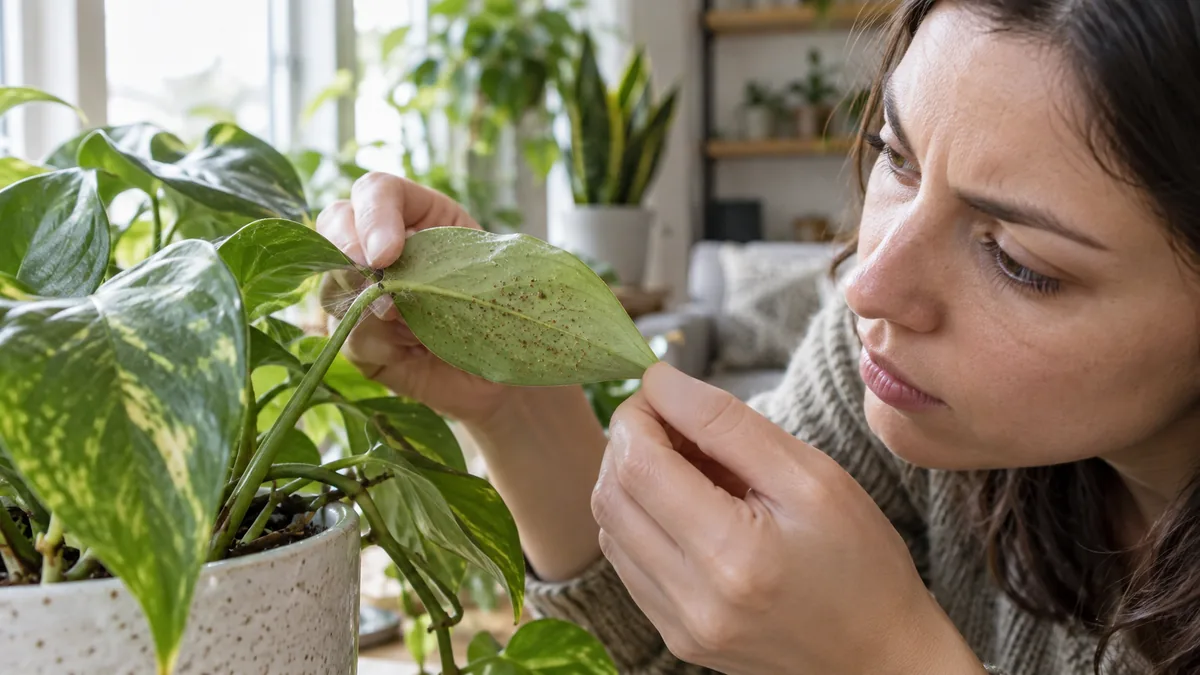
What to check before treating a houseplant
- Separate a plant with convincing signs. Move it away from neighboring foliage if practical and avoid letting leaves touch. Wash your hands and clean tools after handling a suspected infestation.
- Inspect the whole plant. Check the top and underside of leaves, new growth, leaf joints, stems, pot rim and the soil surface. Use a hand lens or phone light when insects are too small to see clearly.
- Look for evidence of an organism. Moving insects or mites, shed skins, eggs, honeydew, fine webbing or flies emerging from the pot help narrow the possibilities. A close photograph can make it easier to compare what you see with an Extension identification guide.
- Review recent care and conditions. Note when you watered, whether the pot drains, recent moves or repotting, drafts, heating and changes in light. Keep these details separate from pest signs; a stressed plant can be vulnerable, but stress alone does not identify a pest.
UC Integrated Pest Management notes that many houseplant problems result from watering, roots, light, sanitation or the indoor environment rather than insects. Its houseplant problem guide compares common signs and causes. If you find no direct pest evidence, check the care conditions first and observe the new growth before applying a pesticide.
Do not diagnose from one symptom alone. Yellowing may follow overwatering, dry roots, low light or pest feeding; sticky leaves can have more than one cause; pale dots may be mite injury or another kind of damage. If the plant is valuable, several plants are affected, or the symptoms do not match a reliable guide, ask a local Extension service, nursery diagnostician or qualified horticulture professional before escalating.
Identify common houseplant pests by their signs
| What you notice | Possible cause | How to check | Measured first step |
|---|---|---|---|
| Pale stippling, bronzing and sometimes very fine webbing | Spider mites or another mite | Inspect leaf undersides and stems closely for tiny moving mites; use a hand lens. | Separate the plant, remove heavily affected leaves when appropriate and rinse foliage only if the plant tolerates it. |
| Small clusters on soft tips; curled or sticky new leaves | Aphids | Look at new shoots and leaf undersides for live insects and shed skins; honeydew may attract ants. | Remove a small colony by hand or rinse a sturdy plant without damaging tender growth. |
| White, cottony-looking material in folds or leaf joints | Mealybugs | Check where leaves meet stems, along veins and at the base of the plant; root-feeding forms can be harder to spot. | Isolate the plant and remove a localized cluster; inspect nearby plants and the hidden parts again. |
| Dark, mosquito-like flies around a persistently damp pot | Fungus gnats | Check whether adults gather around the soil and whether the mix stays wet; sticky cards can monitor adults. | Review watering and drainage for that species, remove debris and keep traps out of reach of children and pets. |
| White powdery patches or residue on leaves | Powdery mildew, mineral residue or another mark | Check whether the patch spreads across leaf tissue; a white mark alone does not identify an insect. | Do not apply insecticide on appearance alone; confirm whether it is disease, residue or growing-condition damage. |
This comparison is a starting point, not a species-level diagnosis. Spider mites are arachnids rather than insects, and some pests are so small that color alone is unreliable. Fungus gnat adults can be conspicuous even when the plant is healthy; larvae feed in the potting medium, but a few flying adults do not prove serious root injury. See the University of Minnesota Extension indoor-plant pest guide when you need more identification detail.
For suspected mites, inspect several leaves instead of relying on one pale patch. A fine web, stippling and tiny moving specks together are more persuasive than leaf discoloration alone; a hand lens or a white sheet held beneath a branch can make movement easier to see. Aphids are usually visible as soft-bodied clusters on fresh growth, while mealybugs often hide in creases and leaf joints. Honeydew can point to sap-feeding insects, but it is not a species test. If the evidence remains ambiguous, compare clear photographs with a university Extension guide before buying a control product.
Fungus gnats are often confused with fruit flies or other small indoor flies. Watch where they gather: adults associated with houseplants tend to stay near pots and damp growing media. Their presence is a reason to inspect watering and drainage, not to assume that the roots are badly damaged. If you can see larvae or the plant is wilting, check roots and soil condition carefully; excess moisture, root decay and other potting problems can cause similar decline. Do not let a yellow sticky card be the only diagnostic evidence, because it identifies captured adults but not the source or severity of the problem.
A step-by-step response to a suspected pest
1. Decide whether the pest is confirmed and action is warranted
Find the organism or a pattern that a trusted diagnostic source supports before choosing a control. Record the plant species, affected areas, approximate number of plants and whether the damage is spreading. If only a few insects are present and the plant is otherwise growing well, monitoring may be more appropriate than immediate treatment. Some leaf damage remains after a pest has gone, so new insects and new growth are more useful measures than expecting old leaves to look perfect.
2. Isolate and use a physical measure where suitable
Separate an affected indoor plant if possible. For a small colony, hand removal or a water rinse can reduce exposed soft-bodied insects or mites when the plant can tolerate handling and moisture. Aim carefully at leaf undersides and stems, support delicate growth and avoid leaving the pot waterlogged. Remove severely affected leaves only when doing so will not harm the plant more than the infestation. Bag and discard infested material rather than leaving it beside other pots.
For fungus gnats, focus on the conditions in the pot. UC IPM describes excess moisture and organic debris as key contributors and recommends cultural management such as avoiding overwatering and improving drainage. Let the surface dry only as much as the particular plant can tolerate; do not impose a fixed dry-out period on moisture-loving species. Empty standing water from a saucer and check that drainage holes are open. Yellow sticky cards can help monitor adult flies, but they do not by themselves show that larvae are gone.
3. Inspect nearby plants and follow up
Check plants that touched the affected one, shared a shelf or were handled with the same tools. Do not automatically spray the entire collection. Revisit the exact spots where you saw signs and take a comparison photo under similar light. If new insects appear, reassess the identification, coverage and surrounding conditions. Avoid switching between several products without a reason; doing so can expose plants while making it difficult to know whether a method helped.
A simple record can make follow-up more objective. Note the date, plant name, affected leaves or stems, signs that were present and the step you took. Photograph the full plant and one close-up, then compare new growth and live pest activity rather than judging only the old damaged leaves. Spider-mite stippling, curled leaves or white residue may remain after the original cause is controlled. If the record shows new evidence, revisit diagnosis and treatment fit; if no live pest signs return, avoid repeating a pesticide just to remove cosmetic damage.
4. Get help when the diagnosis or risk is unclear
Ask an Extension office or qualified plant professional if the pest is not identifiable, the plant continues to decline, roots may be affected, several plants are involved or the specimen is valuable. Send one image of the whole plant and a close-up of the leaf surface, underside, stem joint or soil where the evidence appears. Include the plant name, watering and lighting conditions, when the symptoms began and any product already applied. Those details can make an identification more useful than a symptom description alone.
Take care when moving a potentially infested plant to a diagnostic service. Keep it contained, avoid brushing leaves against other plants, and ask the service how it wants a sample packaged. Do not mail insects, soil or plant material until you have checked the receiving service’s instructions and any local restrictions. For a large collection or a pest that could be regulated where you live, contact the relevant plant-health authority instead of moving the plant between locations.
5. Reassess whether the plant is practical to keep
Some infestations are difficult to manage once well established, and a plant may be too damaged to recover. If a replaceable plant remains heavily infested despite a confirmed and correctly followed approach, compare the risk of keeping it near the rest of the collection with the value of continued treatment. Bag it before disposal and follow local waste guidance. Do not put infested foliage on a home compost pile unless your method is known to manage the pest. For a valuable specimen, ask Extension or a specialist before making that decision.
When a pesticide may be appropriate
A pesticide is not automatically needed for every visible insect. If you decide one is appropriate, check that the exact product is labeled for the plant or plant group, the target pest and indoor use. Read the complete directions before buying or applying it. In the United States, the EPA explains why the label governs pesticide use in its pesticide label guidance; requirements differ elsewhere, so follow the rules and product directions for your location.
- Follow the label’s rate, application method, repeat interval, maximum number of applications and protective-equipment instructions.
- Check ventilation, children, pets, food, aquariums and the product’s indoor-use directions before treatment.
- Do not mix products or apply a schedule from an online post if the exact label does not allow it.
- Use only the plant-safe test instructions provided by the label; a product that injures one species may be unsuitable for another.
- Do not substitute dish detergent, household cleaners or an unverified homemade recipe for a labeled plant product.
Terms such as “natural” or “organic” do not establish that a product is harmless, suitable indoors or effective against a particular pest. Formulations differ. Contact products may need to reach the pest directly, while application conditions can affect leaf sensitivity. Never shorten the interval or increase the concentration because the plant still looks damaged; first confirm that live pests remain and that the treatment matches the label.
Biological controls may be useful in commercial interiorscapes or larger managed collections, but they are not a universal home-plant remedy. The organism, pest, release conditions and pesticide compatibility need to match. A local Extension or supplier can help determine whether a beneficial insect or nematode is appropriate for the specific setting.
How to reduce the chance of another infestation
- Inspect new plants, including leaf undersides, stems and the potting surface, before placing them beside an established collection.
- Keep a new or returning plant apart while you monitor it for signs; clean the work surface and tools after pruning or repotting.
- Remove dead leaves and plant debris from the soil surface, and keep saucers from holding standing water.
- Match watering, light, drainage and temperature to each species rather than applying one routine to every pot.
- Check tender growth periodically so you can spot a small colony before it spreads.
Prevention cannot guarantee a pest-free home. A balanced care routine and regular inspection make it easier to notice problems early, but a healthy plant can still encounter mites or insects. Use the indoor plants care guide for plant-specific growing conditions and visit the Garden Pests & Diseases hub for targeted guides to spider mites, aphids and mealybugs.
New plants and plants returning indoors after a stay outside are common opportunities to introduce pests. Check the leaf undersides, growing tips, stems and pot surface before mixing them with established plants. If you find no signs, keep checking them separately for a while rather than assuming that one inspection guarantees they are clear. Clean a reused pot and work surface before repotting, and avoid sharing unclean pruning tools between plants. These steps reduce the chance of moving pests but do not replace identification if symptoms later appear.
Care conditions should be adjusted to the species, not used as a blanket pest treatment. Letting the top layer of soil dry may help with fungus gnats, but some plants need evenly moist media and can be damaged by an aggressive dry-out. More humidity is not a universal spider-mite cure, and misting can leave foliage wet without correcting the underlying environment. Check each plant’s light, temperature, airflow, watering and drainage needs. If a collection has different species, a short plant-by-plant note can prevent a change intended for one pot from stressing the others.
If an infestation returns despite correctly following a product label, pause rather than increasing treatment intensity. Confirm whether the pest is still present, inspect less visible plant parts and ask a local plant-health professional whether another cause or management approach fits better. In some cases, a severely damaged and replaceable plant that cannot be isolated may pose more risk to the rest of the collection than it is worth treating; that decision depends on the plant, pest and ability to prevent spread.
Sources and regional guidance
- UC Statewide IPM Program: Houseplant Problems
- UC Statewide IPM Program: Fungus Gnats
- University of Minnesota Extension: Managing Insects on Indoor Plants
- U.S. Environmental Protection Agency: Why Read Pesticide Labels?
These sources provide general identification and management context. Pest species, climate, legal product registrations and indoor-use rules vary by location. Use local Extension or official plant-health guidance for a regional diagnosis, and follow the exact label for any pesticide.