

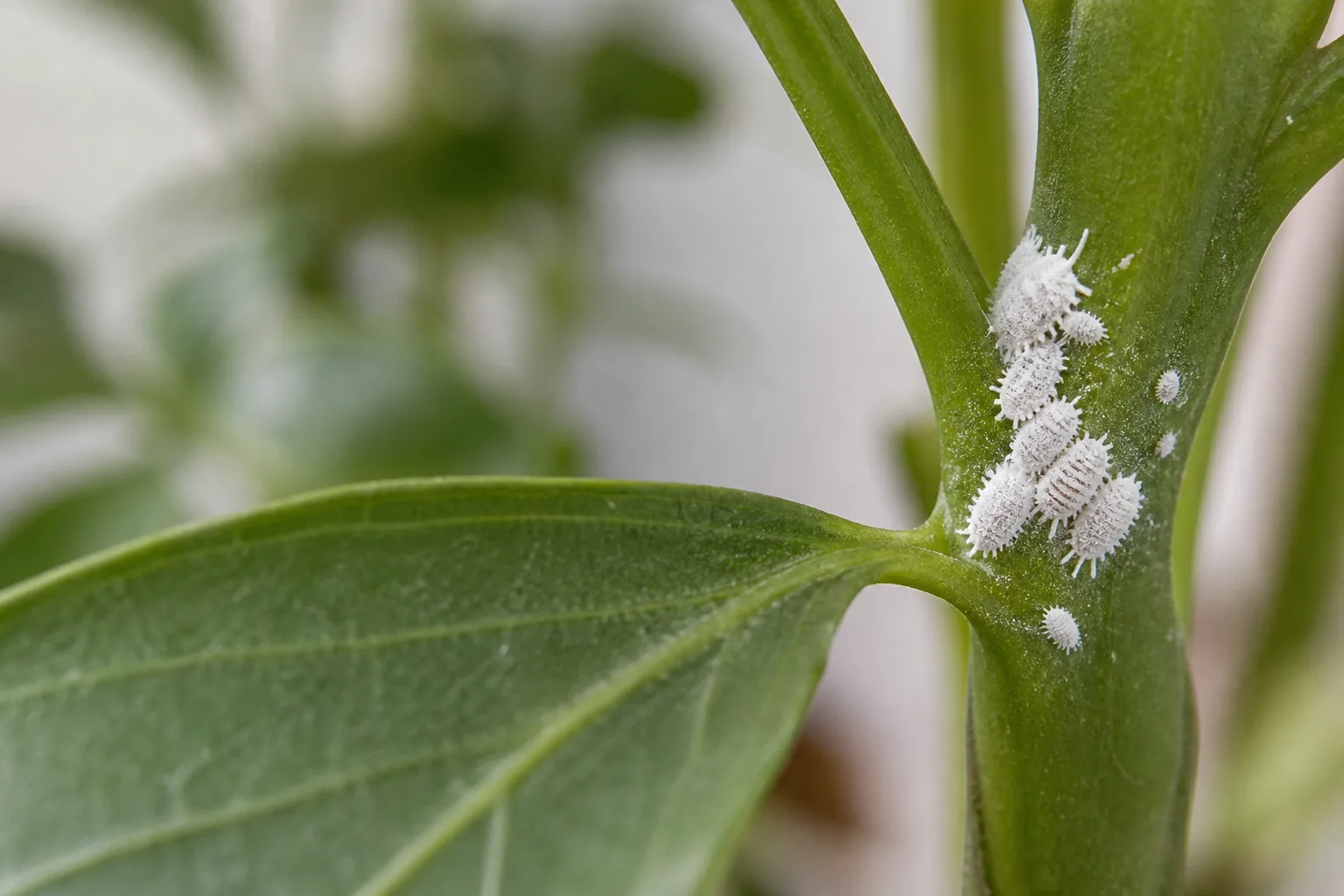
What Are Mealybugs?
Mealybugs are soft-bodied scale insects. Adults and immature insects can be found on plant stems, leaf joints, leaves or roots, depending on the species. A white waxy covering and sticky honeydew may be clues, but use a regional Extension diagnostic resource if the pest is unclear.
UMN Extension’s indoor-plant pest guide provides identification and treatment context for houseplants.
How to Identify a Mealybug Infestation
Inspect stems, leaf joints, leaf undersides, pot rims and—if the plant declines without a clear cause—roots. Look for clustered soft insects, white waxy material, sticky honeydew or sooty growth. White residue alone does not confirm mealybugs; compare with a trusted pest guide or ask a local Extension office.
Types of Mealybugs Most Common in US Gardens
Species-level identification is difficult from a casual inspection and may require magnification or a diagnostic service. For home care, first determine whether the insects are on foliage or roots, note the host plant and document a close-up photograph. Avoid treating a plant based on a species name guessed from color alone.
Why Mealybugs Appear: Risk Factors
Mealybugs can arrive on new plants or move between nearby plants. Check purchases before placing them with a collection, and inspect plants periodically for clusters or honeydew. Crowded foliage can make inspection and removal harder; improve access when practical.
How to respond to suspected mealybugs
First confirm the pest: mealybugs are small, soft-bodied insects with white, waxy material, commonly along stems, leaf joints or roots. Isolate the plant and inspect nearby plants. If diagnosis is uncertain or the plant is valuable, ask a local Extension service or nursery diagnostician.
- Reduce the population physically. On a small infestation, remove visible insects with a damp cloth or a directed rinse if the plant tolerates it.
- Recheck hidden areas. Inspect leaf axils, stems, pot rims and drainage holes. Root mealybugs need a different diagnosis from insects on foliage.
- Use a pesticide only if needed. Choose a product whose label explicitly covers the plant, site and mealybug. Contact products must reach the insect; follow the label for repeat applications, protective equipment and indoor use.
- Monitor over time. Reinspect new growth and leaf joints. Repeat only at the labeled interval; no schedule applies to every product or plant.
UMN Extension notes that contact insecticidal products need direct coverage and that homemade soap mixtures may injure plants. See its indoor-plant pest guidance and EPA label guidance.
Preventing Mealybugs: Quarantine and Plant Health
Inspect new and nearby plants before grouping them together. Keep foliage accessible for checks, remove dead material, clean tools after handling an infested plant and monitor the plant after any intervention. If using a pesticide, use only a product labeled for that plant, pest and indoor or outdoor site, and follow the complete directions.
Check for mealybug lookalikes before treating
Several problems can leave white or sticky material on a plant. A mistaken diagnosis can delay the right response or expose the plant to an unnecessary pesticide. Look for the insect itself and note where the residue appears.
| Observation | Why it may be confusing | How to check |
|---|---|---|
| White cottony clusters in leaf joints or along stems | Consistent with mealybugs, but wax or lint may also collect in crevices | Use a hand lens, gently move the material, and look for segmented insects beneath it |
| Small brown or tan bumps fixed to stems | Some scale insects are mistaken for plant growth or mealybugs | Check whether the bump is attached and whether sticky honeydew or other signs are present |
| White flecks or powder without visible insects | Mineral residue, dust, or fungal growth can resemble wax | Photograph the affected area and compare with a reliable plant-health diagnostic guide |
| White insects that fly when foliage is disturbed | Adult whiteflies may be mistaken for mealybugs at a distance | Observe whether insects fly from the undersides of leaves; collect a clear close-up for identification |
| Plant decline with no visible foliage pests | Root mealybugs, root injury, overwatering, or disease may all affect roots | Inspect the root ball carefully or seek a diagnostic service before discarding the plant |
These clues narrow the possibilities; they do not replace an identification. Save a photo of the full plant and one close-up with scale, note the host species, and ask a county Extension service or qualified nursery diagnostician when the pest remains uncertain. Root-infesting species may require specialist confirmation, especially when the plant is valuable or the collection is large.
A measured treatment plan for houseplants
Houseplant infestations are easier to manage when the affected plant is separated and inspected in good light. Keep it away from shared saucers, foliage, and handling tools where practical. Check plants that touched it or were watered beside it, including the undersides of leaves and growing tips. Isolation reduces contact but does not prove that every other plant is pest-free.
- Decide whether the plant is worth treating. Consider plant value, infestation extent, treatment access, and whether other plants are at risk. A severely weakened plant may not recover even after pests are removed.
- Remove accessible insects first. Wipe or rinse visible clusters if the plant tolerates it. Protect the potting area from runoff and inspect leaf joints, petioles, stems, and pot rims where insects can remain hidden.
- Use a labeled product only if needed. Read the full label for the named pest, plant, indoor site, application method, precautions, and retreatment interval. Contact products must reach the insect, so hidden colonies can be missed.
- Test plant tolerance where directed. Some foliage is sensitive to sprays. Follow label instructions for a small-area test if provided, and do not use homemade detergent mixtures as a substitute for a registered product.
- Keep the plant separated while you monitor. Follow the product directions for re-entry and handling, and clean tools after working on the infestation.
A single application may not reach every life stage or hidden insect. Do not repeat more often than the label permits or mix products to accelerate results. If the infestation persists, confirm the identification and reassess coverage, plant tolerance, and the treatment choice with Extension guidance. The UMN Extension indoor-plant pest guide discusses inspection and contact coverage; the EPA explains why pesticide labels must be followed.
Respond to mealybugs outdoors
On an outdoor plant, identify the host and inspect nearby plants before deciding whether treatment is necessary. Check stems and leaf joints, but also observe ants, honeydew, predators, and whether damage is spreading. Ants may protect honeydew-producing insects in some settings, yet their presence alone does not identify the pest or justify an insecticide.
Remove heavily infested plant parts only when doing so will not damage the plant beyond recovery. Bag and dispose of material according to local rules; do not place live pests on the compost pile. Avoid moving infested pots, cuttings, or tools between garden areas. If the plant is valuable, large, or in a production setting, seek local Extension advice before pruning or applying a pesticide.
Outdoor pesticide choices require particular care around flowering plants, pollinators, beneficial insects, water, and neighboring gardens. Use only a product labeled for the plant, mealybug, and outdoor site, and follow any restrictions on bloom, weather, drift, and application equipment. “Natural” or “organic” on a package does not mean harmless to non-target organisms.
Monitor recovery and prevent reinfestation
Choose a repeatable inspection route: examine the same stems, leaf joints, and new growth each time, and record the date, visible insects, plant condition, and any action taken. The exact follow-up interval depends on the product label and local guidance; do not create a generic weekly pesticide schedule.
New growth is a better sign of recovery than the appearance of old leaves, which may remain marked or distorted. Continue to watch nearby plants, especially those that shared space or tools. If insects keep returning, consider whether the source is an untreated nearby host, root infestation, or an incorrect initial diagnosis.
For future purchases, inspect both leaf surfaces and stem joints before bringing the plant into a collection. Keep nursery tags so you can identify the host and ask a precise diagnostic question if symptoms recur. Good inspection and separation lower the chance of spreading a pest, but no quarantine period guarantees that every hidden insect has been found.
Know when to request a plant diagnosis
Ask for help when the insect cannot be confirmed, roots may be involved, symptoms continue after a correctly followed treatment, or the plant is rare or valuable. A nursery or Extension diagnostician can often help more quickly when you bring useful details rather than only a verbal description.
- Identify the plant as precisely as possible, including a nursery tag or cultivar name if available.
- Photograph the full plant, the affected area, and a close-up of suspected insects in good light. Include a coin or ruler for scale when appropriate.
- Describe where the pests appear, when you first noticed them, and whether nearby plants show similar signs.
- List recent changes such as a new plant, repotting, watering changes, or pesticide use, including the product label if one was applied.
Do not ship or carry live infested material unless the receiving diagnostic service asks you to. Local rules may restrict moving plant pests, and a photograph or sealed sample may be safer. Follow the instructions of the service that will examine it.
Decide whether to keep treating an infested plant
Some plants recover after a small, confirmed infestation; others may be too weakened or difficult to inspect. Compare the likely benefit of treatment with the effort and risk of keeping the plant near a collection. There is no single pest count that determines the right choice for every species or household.
- Consider continued care when: the plant is otherwise healthy, the infestation is limited and accessible, and you can keep it separated while monitoring new growth.
- Consider removal when: the plant is severely declining, insects are repeatedly returning from hidden areas, you cannot isolate it, or protecting nearby valuable plants is a higher priority.
- Before disposing of it: check whether the suspected pest has been correctly identified and follow local waste rules. Do not give away or move an infested plant to another home or garden.
If you keep treating, document what you see and follow the product label exactly; do not continue a pesticide simply because the plant still looks damaged. Old leaves can remain discolored after pests are controlled, so judge recovery by the presence of live insects and the condition of new growth. UMN Extension’s houseplant insect guidance can help with identification and response, while the EPA label guidance remains essential if a pesticide is used.
Use a small-scale treatment check before treating the whole plant. Isolate the affected plant, inspect leaf joints and stem crevices, and remove a few visible insects with water or by hand. If using a pesticide, use only a product labeled for that plant and site; test the directions on a small area and repeat only as the label allows. UMN Extension notes that contact insecticidal soaps need to reach the pest and that homemade soap mixtures can injure plants. Read its indoor-plant pest guide and the EPA label guidance.