

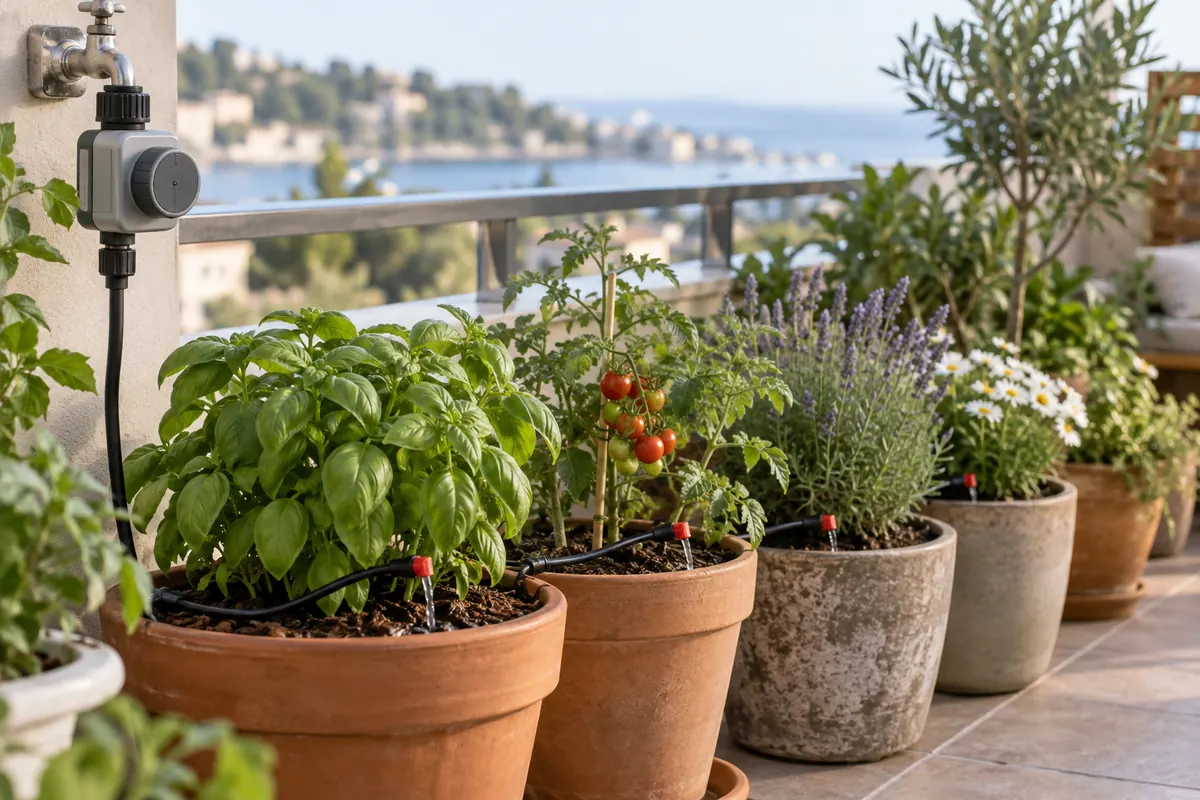
Irrigation for pots depends on container size, plant, growing medium, exposure and access to water. A small grouping may be manageable by hand; a larger collection may benefit from emitters, a timer or reservoir devices. Test the system at each pot before relying on it.
This guide explains how to compare faucet-connected drip, reservoir-fed devices and terracotta spikes. It is not a hands-on product test: match each system’s fittings, pressure, included parts and instructions to your setup, and do not assume a device can maintain every plant unattended.
Choose an irrigation approach by site and water source
First decide what problem the system should solve. A few easy-to-reach pots may be simplest to water by hand; a long row of containers may justify a connected line; a balcony without an outdoor tap may need a pump and reservoir. Count the pots and note where the water source, power outlet and drain are located before choosing. A kit that is convenient in a greenhouse may be impractical on an exposed balcony.
Then group plants by water demand and exposure. Pots in direct sun and wind can dry at a different rate from shaded containers. A cactus and a thirsty vegetable should not be placed on the same timed zone merely because they are nearby. Keep a separate schedule or hand-water plants with different needs. Check building rules before routing hoses or electrical cords across a shared walkway.
Compare the complete setup rather than one component: water source, filter, regulator, timer or pump, tubing, emitters, reservoir capacity, refill access and maintenance. Read the exact instructions for the selected parts. For faucet-fed drip, Utah State University Extension’s backyard drip guide explains why flow, filtration and pressure need to be checked together.
Monitor each container before relying on automation
After installation, run the system while present and measure outlet flow into a marked container for the same interval. Check the first and farthest outlets, then inspect the growing medium in every pot after water has had time to spread. A nominal emitter rate does not tell you whether the entire root ball is moist. Wide planters, coarse mixes and uneven root balls may need a different placement from small nursery pots.
Record the setup, runtime, weather and moisture result. Recheck after moving a pot, changing the medium, repotting or replacing an emitter. A timer schedule that worked in mild weather may overwater during cool rain or leave plants dry during a hot, windy spell. Inspect reservoir levels and battery or pump operation as part of the routine.
Before using an automated system during a trip, observe multiple full cycles and arrange someone to check plants if they cannot tolerate a failure. Test overflow and drainage, not only the supply line. No reservoir, spike or timer can guarantee a fixed number of days for every plant and container.
Comparison: drip kits, timers & spikes
| Feature | MIXC 82pcs Drip Kit | Reservoir-fed devices | Terracotta Spikes |
|---|---|---|---|
| Automation | Timer may be added if compatible | Varies by model | None (passive) |
| Number of pots | Check exact kit documentation | Check exact model documentation | 1 spike per pot |
| Setup complexity | Depends on layout and kit | Depends on layout and kit | Test setup and instructions |
| Tap connection needed | Yes | Yes | No ★ |
| Duration per fill | Continuous (tap) | Continuous (tap) | Measure and monitor |
| Check before choosing | Fittings, filter, pressure and included outlets | Reservoir size, pump, power and instructions | Connector fit, output and monitoring need |
MIXC micro-drip kit: verify the exact parts
The Amazon.com listing is a reference to a MIXC micro-drip kit, not evidence that it fits every faucet or pot collection. Check the exact listing for included tubing, fittings, filter, pressure control and emitter count. Compare those parts with your layout before purchase; a separate compatible timer may be needed if you want scheduling.
Do not infer output from the kit name. Read the flow rate and pressure range printed for each emitter and test flow into a measuring cup. Adjust the layout only after checking moisture and drainage in the pots; plant needs vary by species and conditions.
Confirm whether the selected kit includes a timer, what connector it uses and whether the timer can supply the required pressure and flow. Never assume universal faucet compatibility; check the actual thread and adapter specifications.
MIXC Drip Irrigation Kit — Automatic Watering System for Pots
- ✓ Check the listing for the exact tubing, fittings and emitter count
- ✓ Verify faucet connection, pressure and filtration requirements
- ✓ Measure emitter output and test the layout before use
Check current price and availability on Amazon.com.
Terracotta spikes: test before relying on them
Some terracotta spikes draw water from an attached reservoir, but operation depends on the device, potting medium, soil contact, plant demand and exposure. Follow the exact product directions, test one pot and check it frequently before using the device during an absence.
Do not assume a spike provides self-regulation or prevents overwatering. Check whether the reservoir drains into the pot as expected and compare the medium’s moisture before and after use. Replace or reposition a device if the pot becomes saturated or remains dry.
Reservoir capacity and run time vary with the model and conditions. Do not use an untested device as sole protection while away. Test it under the same exposure and potting mix, and arrange a check-in when plants cannot tolerate drying.
Terracotta Self-Watering Spikes — Plant Watering Stakes (10-pack)
- ✓ Check reservoir and connector fit in the exact listing
- ✓ Follow the maker’s placement and use directions
- ✓ Test moisture and output in each pot before relying on it
Check current price and availability on Amazon.com.
How to set up drip irrigation for pots
- Count pots and draw the route from water source to each container.
- Check the kit’s faucet connection, included tubing, emitter count, filter and pressure limits against the actual layout.
- Keep tubing out of walkways and route it so pots can still be moved and maintained.
- Install parts according to the exact manual; do not force incompatible fittings.
- Catch output from each emitter in a measuring cup for the same interval, inspect connections for leaks and check the potting medium after a full cycle.
- Adjust the schedule only after observing plant and soil response. Repeat checks after weather or seasonal changes.
USU Extension’s backyard drip guide covers filtration and pressure considerations.
Set a schedule from pot conditions
There is no universal run time for tomatoes, herbs, flowering plants or succulents. A timer’s schedule must fit the crop, container volume, growing medium, exposure, emitter output, pressure, rainfall and season.
- Check the plant’s care guidance and group only containers with similar water needs.
- Measure emitter output and record the runtime and weather.
- Check moisture in the root zone and drainage after watering; do not judge from the surface alone.
- Adjust the schedule gradually, then recheck during hotter, cooler or wetter conditions.
Keep cacti and other moisture-sensitive plants on a separate schedule or water them by hand if they do not share the same requirements as nearby containers.
Troubleshoot uneven flow, clogs and leaks
- One emitter has little or no flow: check kinks, blocked tubing, filter condition and the manufacturer’s cleaning instructions.
- Flow differs along the line: verify source pressure, tubing length and emitter requirements; do not add components beyond the manual’s limits.
- Connections leak: shut off water, inspect whether the correct fitting is fully seated and replace damaged parts with the specified component.
- Pots stay too wet or dry: measure output, check drainage and adjust the schedule based on the medium and plant, not just timer settings.
Flush lines and winterize only as the system maker directs. Avoid improvised cleaning chemicals that could damage the parts or affect plants.
Calibrate emitter output and watering duration
Use the flow rate and operating pressure listed for the exact emitter, then measure actual output under the installed conditions. Collect water from representative outlets for a consistent interval and compare the results. If the first and last emitters differ substantially, check pressure, tubing length, elevation, filter condition and the kit’s permitted number of outlets before extending the runtime.
Check moisture in each pot at root depth after a full cycle. If water collects in a saucer or the medium stays wet, inspect drainage and reduce irrigation only after ruling out a blocked outlet or root problem. If the root ball remains dry, observe whether water is running down the side of the pot or missing the roots. Move or add an emitter only if the manufacturer’s layout and flow limits allow it.
Make small schedule changes and note the plant response. This is more reliable than copying a timer duration from another balcony, since container size, plant, medium, exposure and emitter output vary. For general moisture checks and plant symptoms, see our guide to watering plants.
Maintain the equipment and prepare for cold weather
Inspect tubing, connectors, filters, reservoir seams, pump intake, timer and emitters at the start of the season and after moving pots. Clean filters and flush lines only as the product manual directs. Do not use acids, bleach, needles or improvised air pressure unless the manufacturer says that method is safe. Replace cracked tubing or damaged seals with compatible parts.
Before freezing weather, follow the exact instructions for draining, disconnecting or storing the timer, pump, filter and tubing. Keep electrical parts dry and within their documented outdoor rating. When plants are moved or the system is disconnected, close unused outlets with the specified cap so the next run does not leak.
Frequently asked questions
Test a container system before leaving it unattended. Run every emitter into a measuring cup for the same interval, compare outputs, then check each pot’s moisture after a full cycle. A kit’s listed emitter flow is not a watering schedule: plant size, sun, potting mix, container size and pressure all change the result. For drip design, USU Extension describes filtration and pressure reduction as core considerations; see its backyard drip guide.