

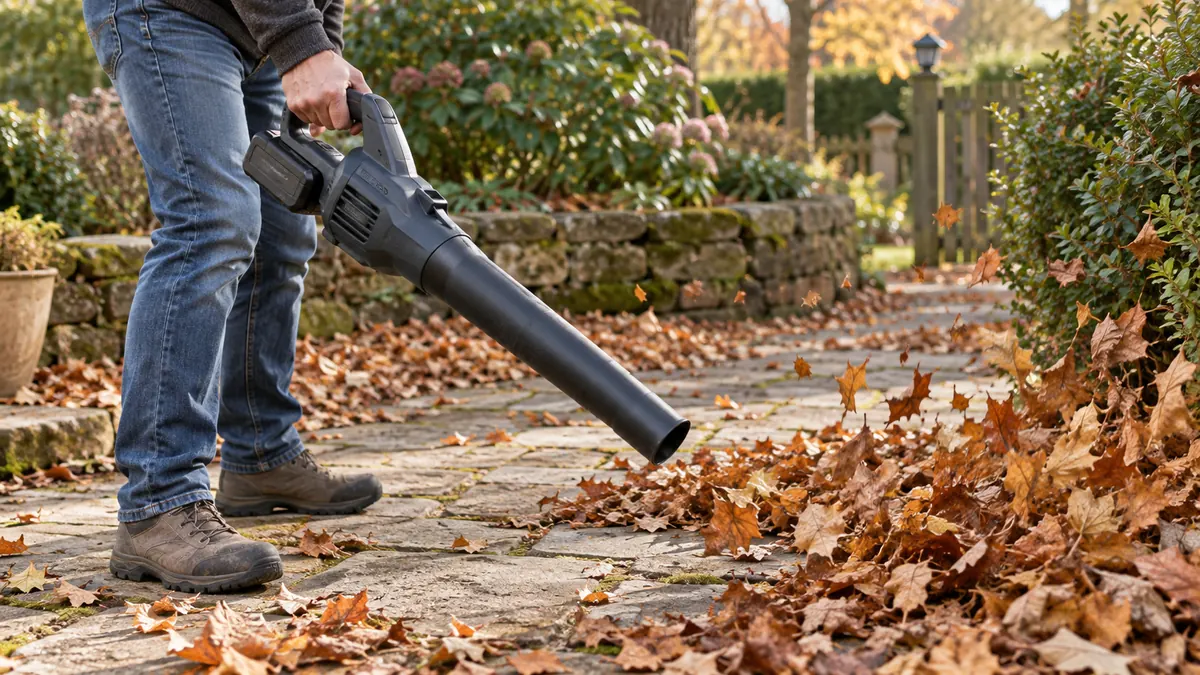
EGO battery-blower configurations
| Manufacturer example | Published configuration | What the package check changes |
|---|---|---|
| EGO LB5800 | 56V blower, 225–580 CFM, variable speed, flat and tapered nozzles | Bare tool; EGO lists the 5.0 Ah battery/charger kit separately as LB5804 |
| WORX WG584 | 40V max from two 20V Power Share batteries; 300–470 CFM and 60/69/80/95 mph speed settings | US WG584 kit page lists two 2.0 Ah batteries and a charger; WG584.9 is tool-only in its manual |
These are manufacturer facts for US configurations, not a measured head-to-head test. The Amazon.com LB5800 listing was identified as the exact bare tool, but the page snapshot reviewed showed no featured offer. An old EGO ASIN in the page history was an accessory, not the blower kit; it has been removed. Do not infer that a similar model suffix includes batteries or a charger.
Amazon.com identifies ASIN B07BFK7G5N as the EGO Power+ LB5800 56V, 580-CFM bare-tool blower, with two nozzle attachments. The page snapshot reviewed showed 4.7/5 from 987 ratings but no featured offer. Treat this as a model-identity reference; check live availability and the exact battery/charger package before buying.
Compare airflow, battery and nozzle
Estimate the material and area: dry leaves on a hard path need different airflow than wet leaf mats or gravel borders. A higher CFM figure does not show how long a battery lasts at that setting. Check the included battery Ah, compatible platform, tool-only status, nozzle, stated sound data and charger before comparing total cost. Include the cost of the battery and charger when comparing a bare tool with a kit.
Choose airflow and battery setup
- Compare air volume and air speed together, checking the nozzle and measurement condition used by the manufacturer.
- Confirm whether compatible batteries and charger are included and how the model fits your existing platform.
- Check the supplied nozzle, variable-speed control, trigger lock, harness and operating restrictions.
- Consider the debris type, noise, storage and service needs for the exact model.
Choose a battery setup for your yard
For a small courtyard, narrow side path or patio, prioritize low-speed control, a balanced handle, simple tube storage and a battery that is already part of your tool collection. A high-output backpack blower may be unnecessary if the job is to sweep dry leaves from a few hard surfaces. Choose a nozzle that directs air where it is needed and test the lowest setting that moves the debris without scattering gravel or mulch.
For a larger yard with seasonal leaf fall, consider whether the blower will need to shift damp leaves from grass, move piles across a wide lawn or clear long paths. Compare the tool's maximum air volume and speed alongside its battery platform, body weight, runtime claim and charge time. If the battery needs to be replaced mid-task, account for the cost of a spare pack and the time to charge it. EGO lists all of its 56V ARC Lithium packs as compatible with the LB5800; other manufacturers' battery ecosystems are not cross-compatible merely because their voltage labels look similar.
For garden beds, gravel and new plantings, controllability may matter more than maximum output. Variable-speed triggers allow the operator to reduce airflow near fragile material. Work leaves toward a collection edge or tarp rather than blowing them repeatedly across the garden. If debris is wet or matted, a rake or leaf vacuum may be more practical than pushing the machine to turbo. The blower-vacuum guide covers collection limits.
For large properties or long professional sessions, a compact handheld may cause more arm fatigue than a backpack battery system. Check whether the same battery can power a compatible backpack link, whether one is approved for the exact model and whether the added harness fits. The EGO page lists a separate backpack link accessory and model-specific strap; that does not prove the same attachment fits another brand or every blower.
Estimate runtime from the actual workload
A runtime figure is conditional, not a promise for every leaf-clearing job. EGO's page says its 5.0 Ah battery can run the LB5800 for up to 75 minutes, while also explaining that Turbo uses more energy and that lower settings extend work time. Treat “up to” as a best-case manufacturer claim under its stated conditions, not as 75 minutes of continuous turbo use or a direct estimate for a damp yard.
For a useful estimate, record the area, material, weather, number of passes, throttle setting and battery size used. If the manufacturer has a runtime chart, match its test setting and pack size. A 2.0 Ah battery is not automatically half as useful as a 4.0 Ah battery in every task: airflow demand changes, battery temperature and age matter, and a short burst of turbo draws more energy than steady low-speed work.
Compare charging setup as well as runtime. Check whether the kit includes a charger, how long the official manual gives for the supplied battery, whether the charger is compatible with other packs you own and how quickly you can rotate a spare battery. Store and charge packs in the temperature conditions in the manual; do not use a damaged or swollen battery.
Check platform, charging and storage
Battery platforms reduce duplicate purchases only when the pack, charger and tool are actually compatible. EGO states the LB5800 works with its ARC Lithium batteries. WORX identifies WG584 as a two-pack 20V system; its 40V MAX label is a combined nominal/maximum description, not a promise that one 20V battery can run the blower. The manual says the tool-only WG584.9 version lacks batteries and charger. Always compare exact model suffixes and regional kits.
Look at the full package list: blower body, upper and lower tubes, round or tapered nozzles, battery, charger, shoulder strap and manual. Product photos may show accessories that are sold separately. Confirm which tube and battery system match the yard's work, and keep the box or receipt with the serial/model code for service requests.
Clean cooling openings and the tube after use, remove grass or leaf fragments with the tool stopped and inspect the battery contacts for dirt or damage. Follow the manual for battery charging and seasonal storage. Keep packs out of direct sun, rain and extreme heat; do not leave a pack charging unattended where the maker advises against it. Recycle worn packs through an appropriate collection program instead of household trash.
EGO and WORX examples have different limits
No hands-on comparison or runtime test is presented. EGO's page gives variable airflow from 225–580 CFM, recommends its 5.0 Ah pack for an “up to 75 minutes” runtime claim and distinguishes the LB5800 bare tool from the LB5804 kit. WORX gives multiple speed/volume settings for WG584 and separately lists the `.9` tool-only variant. These package differences matter; the numbers are not evidence that one blower performs better on the same yard.
Protect people, hearing and batteries
Follow the blower manual for eye protection, safe operating distance, debris direction and battery charging/storage. Check local rules on blower noise and use. Do not aim airflow at people, animals, roads or open windows; keep bystanders away from stones and sharp debris that can be moved by the stream. Stop the motor before clearing a blocked tube or removing the battery for service. Do not use a blower to disperse dust or material that should be collected safely.
Compare complete kits, not bare-tool specifications. A listing may include one 5 Ah pack, two 2.0 Ah packs or no battery at all; this changes runtime, carried weight and purchase cost. Use the battery capacity recommended by the manufacturer when comparing runtime claims and confirm the charger is compatible with that pack. Do not assume a 40 V tool uses one 40 V battery: WORX WG584 is a 40 V maximum system built from two 20 V packs.
Battery performance also depends on the task. Wet leaves, acorns and compacted debris require more sustained airflow than dry leaves on pavement. High mode drains a pack faster; a wide-open intake or blocked tube can change output and heat. Work in short zones, lower power where it is enough and let the motor stop before clearing an intake. Manufacturer runtime figures should be treated as conditions, not a guaranteed full-throttle duration.
For storage, remove the battery, allow it to cool and follow its charger manual. Keep contacts clean and dry; do not store a damaged, swollen or wet pack. A battery that belongs to the same brand may not be compatible with every tool generation, so compare exact platform and model numbers. If you already own a compatible battery ecosystem, a bare tool can be economical; otherwise compare the full kit cost.