

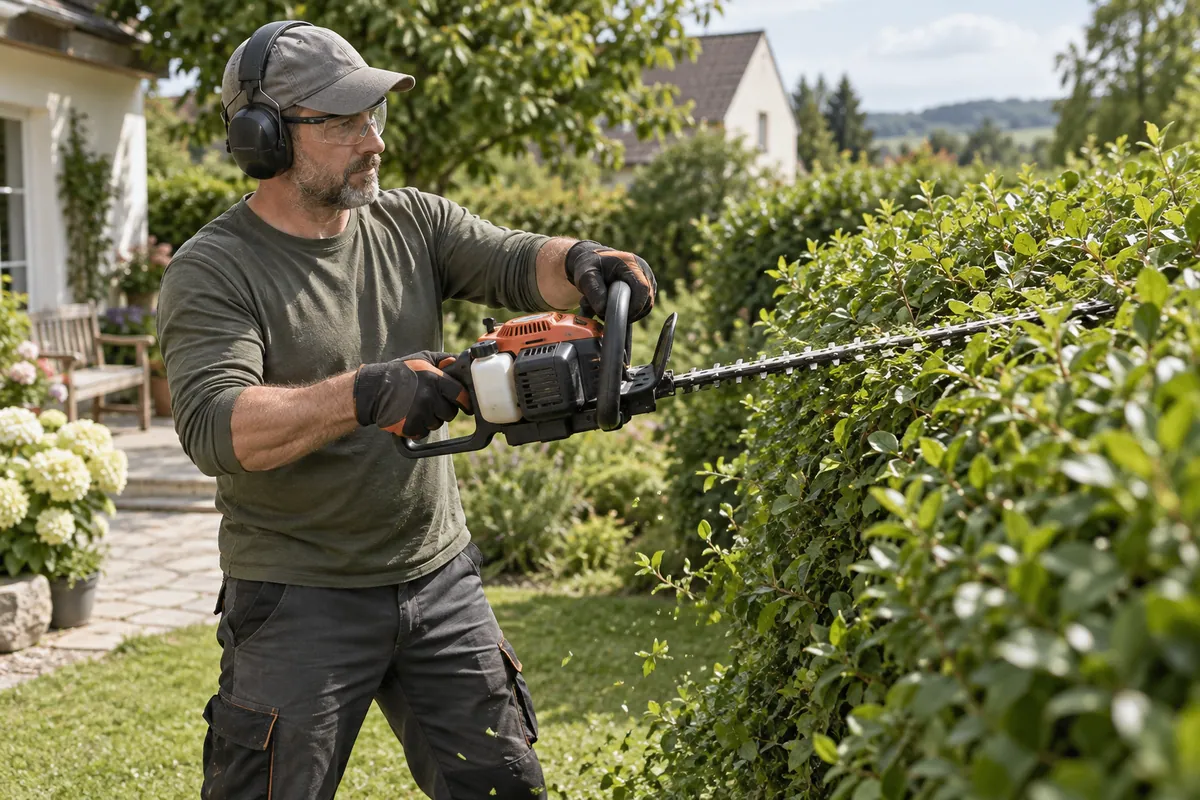
Which exact Husqvarna and STIHL models are compared?
The comparison is between the Husqvarna 122HD60 and the STIHL HS 45, not every hedge trimmer from either company. Model names and versions can vary by country, so confirm the nameplate, manual, emissions label and included equipment with a local dealer before buying. The STIHL US page also states that the HS 45 is not available in California; regional restrictions can change which option is practical.
Both are gasoline tools intended for hedge maintenance. Their published figures are useful for narrowing a shortlist, but they do not replace an inspection of the hedge, a manual check or advice from a service dealer.
Husqvarna 122HD60 vs STIHL HS 45 specifications
| Published specification | Husqvarna 122HD60 | STIHL HS 45 |
|---|---|---|
| Power source | Gasoline | Gasoline |
| Engine displacement | 22.5 cc | 1.7 cu. in. (manufacturer listing) |
| Published engine output | 0.8 hp | 1 bhp |
| Knife / blade length | 23.2 in. | 18 in. |
| Published weight | 10.8 lb | 10.5 lb with knife, without fuel |
| Other published detail | 4,050 cuts per minute; 1.1 in. tooth opening | Double-sided blade |
These numbers are manufacturer specifications, not independent measurements. The two pages describe weight differently, and engine output ratings can use different conventions. Avoid treating small numerical differences as a controlled performance test. For the HS 45, see the STIHL USA product page; Husqvarna publishes the 122HD60 specifications on its US product page.
Blade length and hedge access
The 122HD60 has a 5.2-inch longer knife on the published figures. On a broad, straight hedge face, a longer blade may cover more width per pass. It can also feel less nimble around corners, narrow gaps and shaped topiary. The HS 45’s shorter 18-inch blade may be easier to place in tighter sections, but may require more passes on a wide hedge.
Before selecting either, measure the hedge height and depth and consider where you can stand safely. Do not reach above shoulder level or climb while operating a handheld hedge trimmer. A longer blade does not make it safe to cut beyond a stable stance; use a suitable pole tool or get qualified help when the hedge cannot be reached from firm ground.
Engine figures and cutting limits
Husqvarna lists a 22.5 cc engine, 0.8 hp, 4,050 cuts per minute and a 1.1-inch tooth opening for the 122HD60. STIHL lists 1.7 cubic inches and 1 bhp for the HS 45, along with an 18-inch double-sided blade. These ratings do not establish which machine cuts faster through a particular hedge: branch species, dryness, density, blade sharpness and operator technique all affect the result.
Tooth opening should not be read as a promise that every branch of that diameter is appropriate to cut. Check the operator manual for the specific tool and use hand pruners or a pruning saw for woody branches outside the hedge trimmer’s guidance. For large, old hedges, remove larger limbs separately instead of forcing them between the teeth.
Weight, servicing and ownership
The published weights are close, but they are not a reliable comfort comparison because the STIHL figure explicitly excludes fuel and includes the knife while the listings do not describe identical weighing conditions. Fuel, guards, attachments and the way the machine is held affect the weight in use. If fatigue or overhead cutting matters, handle the complete tool before purchase and ask the dealer whether a demonstration is possible.
Gas tools need fuel handling, engine maintenance, storage and access to replacement parts. Compare the required fuel mix and service schedule in each manual; do not infer that they are the same because both use gasoline. Check local emissions rules, warranty coverage, dealer distance and parts availability. The STIHL US listing notes that the HS 45 is not sold in California, which is a material availability limitation for some readers.
For either model, wear eye, hearing, hand and foot protection specified by the manual. Keep bystanders clear, inspect the hedge for wire or debris, and stop the engine before clearing a jam or carrying out maintenance.
How to choose between the two
- Consider the 122HD60 if its longer 23.2-inch knife fits your hedge layout, the model is supported locally and its manual’s limits match the work.
- Consider the HS 45 if the 18-inch blade suits your hedge and a local STIHL dealer can confirm the correct version, service and parts for your location.
- Choose neither on the brand name alone. If the hedge is small, near neighbors or frequently shaped, compare a battery or manual alternative for noise, maintenance and control.
There is no sourced basis here to declare one the overall winner. Compare the hedge you actually maintain, the exact regional model and the complete tool in hand. For a broader category overview, see the gas hedge trimmer guide.
Match each specification to the hedge
Before visiting a dealer, describe the hedge in practical terms: its length, height, depth, plant species, branch thickness, how often it is trimmed and where you can stand. A 23.2-inch blade may cover a wider face in a pass than an 18-inch blade, but that does not mean it is easier to control around a corner or beside a narrow gate. Compare blade length with the geometry you actually need to cut.
| Your constraint | What the listed figures can tell you | What still needs checking |
|---|---|---|
| Broad, straight hedge face | The longer published blade may cover more width per pass. | Handling, balance and safe reach at the working height. |
| Corners, gaps or shaped sections | A shorter blade may be easier to place in confined spaces. | Clearance, blade control and branch type for the species. |
| Frequent trimming | Engine and cutting-rate specs describe the maker’s stated configuration. | Service schedule, vibration, sound, fuel handling and dealer support. |
| One-off or light shaping | Neither engine size nor brand establishes the best value. | Whether manual shears, rental or a professional service is more suitable. |
Do not interpret the listed tooth opening as a safe branch diameter or guaranteed cut limit. Branch species, hardness, moisture, blade condition and technique affect whether a cut is possible; use the maker’s instructions for the tool’s intended work. If the branches exceed that guidance, switch to an appropriate pruning tool rather than forcing the hedge trimmer.
These products are presented on US manufacturer sites. If you are buying elsewhere, verify the local model name, emissions approval, warranty, manual language and authorized repair network. A product page can describe an item that is unavailable or restricted in a particular state or country. Ask the dealer to confirm the exact SKU and the included blade before comparing the delivered price.
For a fair in-person comparison, hold each complete machine in the position you would use on your hedge, with the safety guards fitted. Ask the dealer to explain the published weight basis and whether fuel, blade cover or other equipment is included. Do not start or operate a display tool without permission and the required protective setup. If neither model feels controllable from a stable stance, compare a pole tool, manual shears or a professional hedge service instead.