

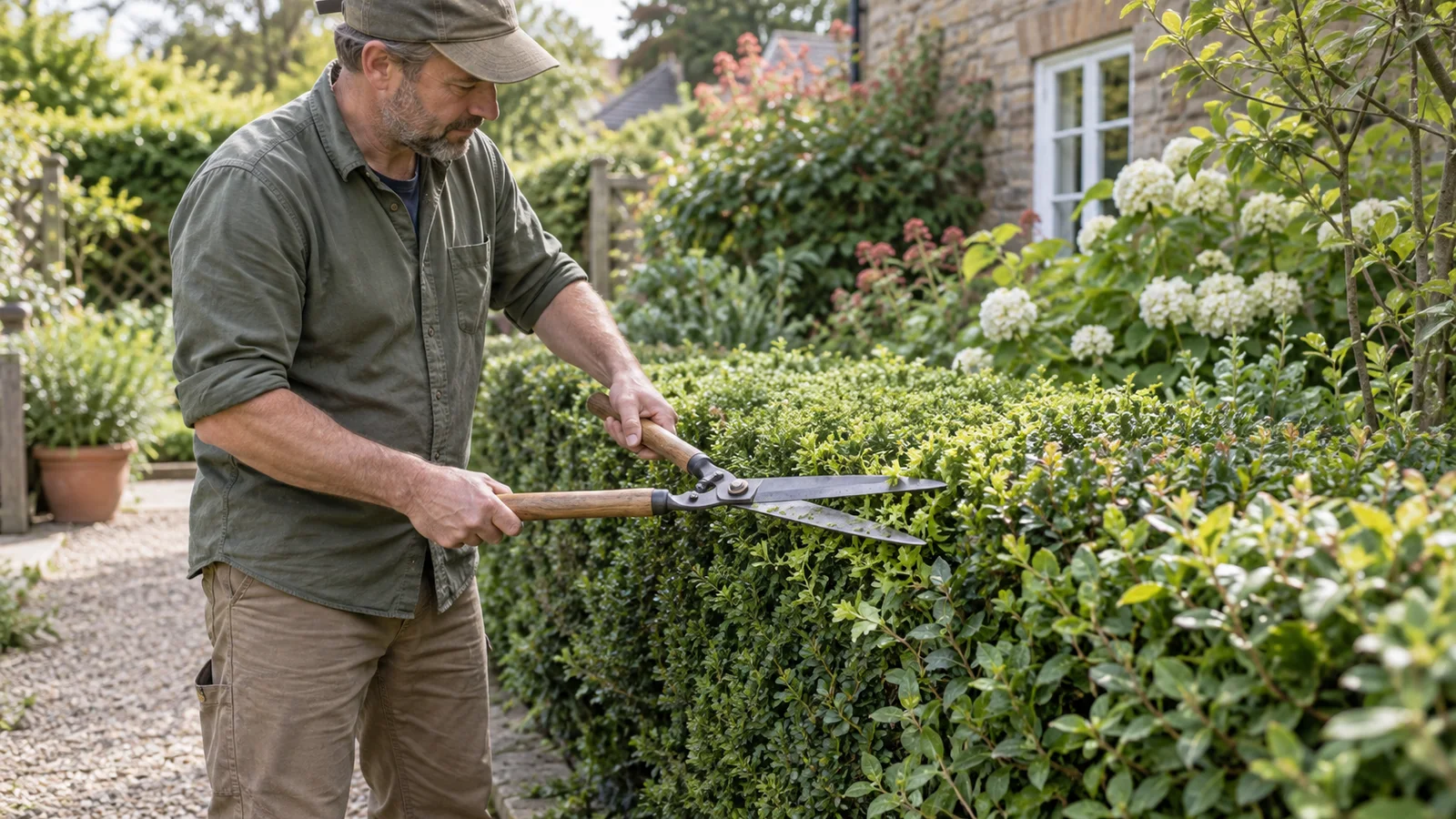
When manual hedge shears are the right tool
The Royal Horticultural Society recommends hand shears for small hedges and soft growth. Their two-blade action is useful for light shaping where you want to see and control each cut. They need no cord or battery and are quiet, but a long hedge can require substantial repeated effort.
For large hedges, a powered trimmer may make the job easier. Large-leaved evergreen hedges can be damaged cosmetically by shearing; RHS suggests using secateurs or loppers when time allows. The right method depends on hedge species and the finish you want, so check plant-specific pruning guidance before cutting.
Choose the tool for the hedge and growth
| Hedge condition | Useful starting point | Why |
|---|---|---|
| Small hedge with soft new growth | Manual hedge shears | Controlled light trimming without powered equipment |
| Long, regularly maintained hedge | A suitable powered hedge trimmer | Can cover more length, subject to tool capacity and safe reach |
| Thick individual branches | Pruners, loppers, or a pruning saw | Hedge shears are for light trimming, not large branch cuts |
| Large-leaved evergreen hedge | Secateurs or loppers where practical | Shearing may leave cut leaf surfaces visible |
University of Minnesota Extension distinguishes hedge shears from pruners, loppers, and saws by the size and type of growth they cut. Use a tool within its capacity; do not twist the blades or force them through branches that bind.
Compare blades, handles, weight, and reach
Manual hedge shears may have straight or wavy blades, different handle shapes, and varied lengths. A wavy edge may help retain light growth between the blades, while a straight edge can suit a clean, controlled pass. Blade shape alone does not establish cutting performance; compare the maker’s intended use and care instructions.
Check how far the handles open, how the pivot feels, and whether the grips fit your hands. A lighter pair can be easier to lift repeatedly, but balance also matters. Try a few strokes before buying if possible, and check whether the model has replacement blades, bumpers, or other service parts. Fiskars’ PowerLever HS52, for example, is listed by the manufacturer at 58.8 cm high and 0.61 kg; those are product specifications, not a claim that it is the right fit for every user.
Do not choose a longer tool simply to reach higher. Keep both feet on stable ground and trim only within a position you can control. Use a suitable platform only when it is stable and intended for the task; avoid standing on a chair or overreaching with shears.
Trim a hedge with a steady, controlled cut
Inspect the hedge and work area before trimming. Check for obstacles and wildlife, identify the plant species, and decide how much new growth to remove. For a formal hedge, RHS suggests using a string line to guide a straight top, starting lightly, and stepping back regularly to check the shape. Keeping a hedge slightly narrower at the top than at the base helps light reach lower growth.
Use short, controlled strokes rather than trying to cut a thick section in one pass. Hold the shears at a comfortable height and keep the blades away from your body and other people. Stop when the blades bind, the handle slips, or fatigue affects your control. Clean the tools after trimming diseased or pest-affected plants and follow local horticultural guidance.
For a small formal hedge, work along a section you can reach from stable ground. Set the line at the intended top height and trim only a little below the new growth. Step back to compare both sides and avoid widening the hedge toward the top. If the sides are uneven, adjust them gradually rather than removing a large amount from one face.
Collect the clippings as you go so they do not hide paths or create a trip hazard. Rake or sweep the area after trimming and check that no branches are caught in the shears. If a task requires reaching overhead, leaning over a wall, or standing on unstable ground, stop and choose a safer method or a qualified service.
Check timing, plant type, and wildlife
The right time and amount to trim depends on the hedge species, flowering or fruiting habit, climate, and the amount of reduction needed. A light trim of soft growth is different from rejuvenating an overgrown hedge. Check plant-specific advice before cutting; some conifers and other evergreens may not regrow from old wood, so removing too much can leave permanent bare patches.
Before trimming, inspect the hedge for nests and other wildlife, and check local guidance where protected species or seasonal rules may apply. If you find an active nest, postpone the work until it is safe to continue. The RHS also advises checking hedges thoroughly before starting and notes that trimming frequency affects flowers, berries, and habitat.
Know when to switch to pruners, loppers, or a saw
Hedge shears are intended to trim many small shoots at once, not to cut every woody branch. Use hand pruners for smaller individual stems, loppers for larger branches within their rated capacity, and a pruning saw for branches that exceed the other tools. Check the maker’s capacity for the exact tool; branch species and condition change how difficult a cut feels.
For a neglected hedge that needs substantial reduction, do not try to remove thick wood with repeated shearing. Identify the species and the right season, then use a pruning method appropriate to that plant. Some evergreens do not regrow from old wood, so a severe cut may leave permanent gaps.
When you are unsure what species you have, how old the wood is, or how much can be removed, take a clear photo or a small sample to a local horticultural service before making a major cut. The time spent checking can prevent a hedge from being permanently misshaped by an unsuitable tool or pruning season.
Clean and maintain manual hedge shears
Wipe off sap and plant debris, dry the blades, and check the pivot, fasteners, handles, and blade edges. Sharpen using the method recommended for the model; the RHS notes that some shears require a brand-specific sharpener. Store the blades closed or covered, away from children and moisture. A clean, maintained tool is easier to control and less likely to tear soft growth.
Sharpen and store shears without damaging the edge
Start maintenance by identifying the blade design and finding the maker’s sharpening instructions. A bypass hedge shear has two cutting edges that pass one another; changing the bevel or sharpening the wrong face can prevent the blades from meeting cleanly. Some models use coatings, replaceable parts or a particular sharpener. Follow the product instructions and do not grind away material to compensate for a bent blade or damaged pivot.
For routine cleaning, remove sap with a suitable cleaner, dry the blades and apply the lubricant specified by the maker. Inspect the pivot bolt and lock nut, but do not overtighten them: the blades should close smoothly without excessive side play. Keep a protective cover on the blades during storage and transport, and hang the shears where children cannot reach them.
Use a simple inspection before each trim: open and close the shears, check that the handles are secure, and look for chips, rust, a loose stop or a blade that catches. Test the tool on a small soft stem. If it crushes or tears rather than cuts, stop and service it before trimming a whole hedge. Replace a tool or get professional repair if the blade is cracked, the handle is damaged or the pivot cannot be adjusted safely.
Good maintenance cannot make hedge shears suitable for branches outside their capacity. The RHS guidance on sharpening and pruning supports using the correct tool and keeping its cutting edge in working condition; select pruners or loppers when a single woody stem is too large for a controlled shearing cut.
Use a steady sequence for an even finish
Begin by checking the whole hedge rather than starting at the nearest end. Look for gaps, damaged growth, overhanging branches and places where the hedge touches a path or fence. Decide how much growth to remove before you cut; hand shears make it easy to keep nibbling at an uneven section until more is removed than the plant can replace.
For a formal hedge, set a string line only after confirming the intended height and natural shape. Trim the top lightly, then step back and check it from more than one angle. Work along short sections so you can keep the cutting plane consistent. When shaping the sides, keep the base slightly wider than the top where the hedge form allows it, so lower foliage is not shaded out.
Use the full length of the blades for light shoots, with smooth controlled strokes. Do not twist the handles to widen a cut or close the shears around a branch that is too large. If the blades stop, ease them open without pulling against the branch, then choose a tool designed for that stem. A crisp finish comes from many small, controlled cuts, not from forcing one heavy cut through dense growth.
Take short breaks before your arms or hands become tired. Fatigue makes it harder to keep both blades aligned and increases the chance of an uneven cut or loss of control. Clear clippings from paths as you go, keep other people outside the working area, and put blade covers back on before carrying the shears to another part of the garden.
Before each session, make a quick fit check: identify the hedge species, decide whether you are shaping soft growth or removing woody stems, and check that the blades meet cleanly along their length. Set aside any section that needs a lopper or saw so you do not try to force the shears through it once you are underway.
Plan a sequence that keeps your stance stable. Work on a short section from a firm path, avoid cutting across your body, and move your feet when the angle changes. If the hedge is taller than you can reach comfortably with both feet planted, stop and use an appropriate platform or a qualified service rather than stretching the handles overhead.
For a formal hedge, check the top and both faces from several steps back before making the next pass. Small corrections are easier to control than removing a large amount at once. If the hedge has an uneven shape, use a guide line only after checking the plant’s natural form and the amount of live growth that can safely be removed.