

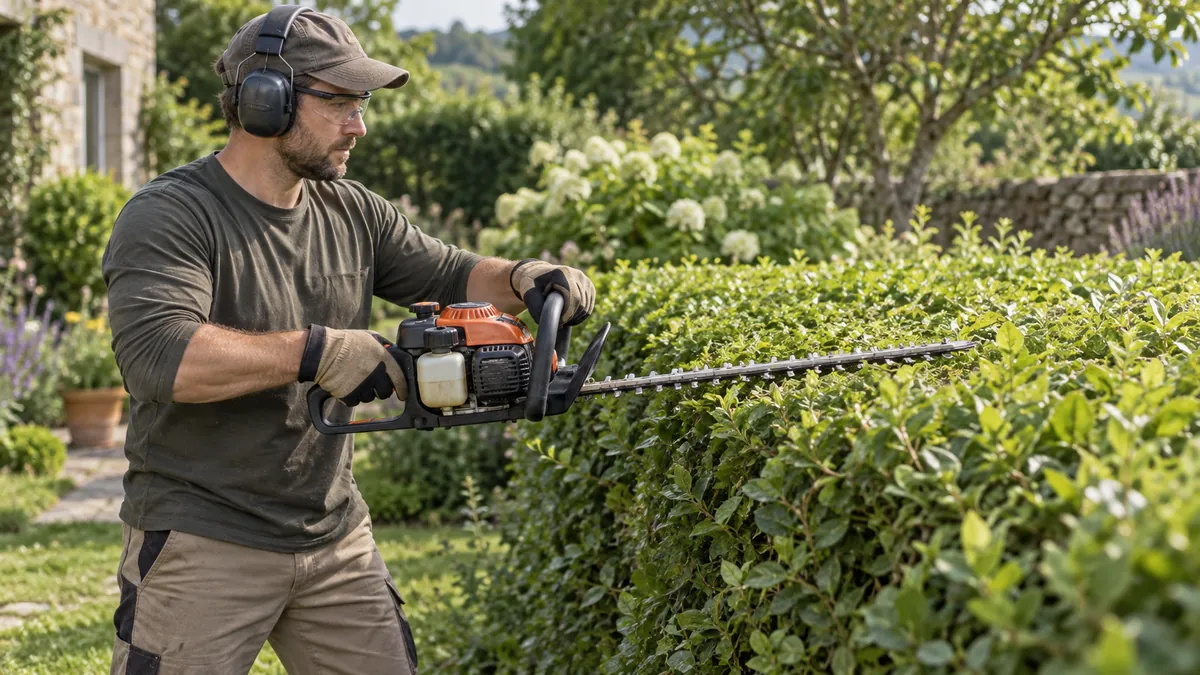
When gas power fits the job
Start with the layout and the work session. A gas model may be worth comparing if a long hedge is beyond the practical reach of a cord, charging access is limited, or the tool will be used across several separated areas. That does not make gas the automatic choice for a large property: compare the specific model’s weight, noise rating, cutting capacity and operating instructions with the person who will use it.
A corded electric model can be simpler where a suitable outdoor outlet is close and the cord can stay clear of the cutting path. A battery model avoids a trailing cord and fuel mixing, but requires a compatible battery, charging plan and realistic runtime for the job. Compare the actual tool and battery system rather than assuming all models in one power category perform alike.
Gas also brings a combustion engine and fuel system. The U.S. Environmental Protection Agency sets exhaust and evaporative-emission standards for small spark-ignition equipment. For an owner, the practical comparison is the complete routine: fuel specified by the manufacturer, safe refueling, engine maintenance, storage, and whether the work area is outdoors and well ventilated.
Specifications to compare
Published cutting capacity: Use the figure from the manufacturer for the exact model and SKU. It is a stated limit, not a guarantee that every branch of that diameter will cut cleanly. Hard, dry or irregular woody growth may bind. Move to loppers or a pruning saw for branches that exceed the trimmer’s stated capacity.
Blade length and knife length: Product pages may show a rounded commercial bar size and a different measured knife length. Confirm which measurement is being reported. A longer bar covers more length per pass but can be harder to control in tight corners; it does not extend safe working reach enough to justify climbing or leaning.
Weight, balance and handles: Compare the stated weight and handle arrangement, then consider how long you can keep a secure two-handed grip. Weight published by a manufacturer may exclude fuel or accessories, so check what is included before comparing models.
Noise and vibration: Check the stated sound pressure at the operator’s ear, sound power, and vibration figures where provided. These are measured values under stated methods, not a promise of what every user will experience. Wear the protective equipment specified in the manual and take breaks if fatigue affects control.
Fuel and maintenance: Read the manual before buying. Confirm the required fuel, oil and mixing ratio, fuel storage guidance, starting procedure, filter care and service intervals. Do not infer a ratio from engine displacement or copy instructions from another brand or model.
One model checked against its manufacturer
The Husqvarna 122HD60 is one example of why model-level verification matters. For SKU 966 53 24-02, the U.S. support page lists a nominal 22-inch bar, 23.2-inch knife length, 1.1-inch tooth opening and 10.8-pound product weight; it lists 4,050 cuts per minute and 94 dB(A) sound pressure at the operator’s ear. There is a displacement conflict: that support page says 22.5 cc, while the 2026 operator’s manual lists 21.7 cc for the 122HD60. Confirm the exact SKU with Husqvarna before relying on engine displacement.
| Husqvarna 122HD60 specification | Manufacturer listing for SKU 966 53 24-02 |
|---|---|
| Cylinder displacement | Conflicting manufacturer sources: 22.5 cc on U.S. support page; 21.7 cc in 2026 manual |
| Bar / knife length | 22 in nominal bar / 23.2 in knife length |
| Teeth opening | 1.1 in |
| Weight listed | 10.8 lb |
| Cutting speed | 4,050 cuts/min |
| Sound pressure at operator’s ear | 94 dB(A) |
These are specifications, not test results or a claim that this is the best choice. Product details can vary by market and SKU; the engine-displacement conflict is left visible instead of choosing one number. Confirm the product code and current manual before purchase or use. Specifications were checked against the manufacturer’s U.S. support page and 2026 operator’s manual on 10 October 2026.
Match the cutting method to the hedge
A powered hedge trimmer is intended for repeated shaping of suitable growth, not every pruning task. Penn State Extension advises reserving hedge shears for formal hedges; many flowering shrubs are healthier when allowed to keep their natural form. Large leaves can also look ragged after powered shearing. Identify the plant and learn whether it flowers on old or new wood before deciding when to trim.
For spring-flowering shrubs that set buds on older growth, pruning at the wrong time can remove next season’s flowers. Penn State’s guidance recommends pruning many spring bloomers after they finish flowering, while many summer bloomers are pruned in late winter or early spring. These are broad patterns with species-specific exceptions, so check a reliable plant guide for the hedge in front of you.
Look through the hedge before starting. Remove or separately cut thick branches the trimmer is not rated to handle, check for wire or hidden objects, and pause if you find active wildlife nesting. Do not use the tool to force an overgrown hedge back to size in one pass.
Safe setup, operation and refueling
- Read the manual for the exact model and wear the eye, hearing, hand and foot protection it specifies.
- Inspect guards, handles, fasteners, controls and blades before starting. Do not use a damaged tool or one with a safety feature that does not work.
- Keep both hands on the handles, keep hands clear of the cutting bar and maintain firm footing. Do not cut from a ladder or overreach.
- Keep bystanders away and run the engine only outdoors. Never start or operate a gasoline trimmer inside a garage, shed or other enclosed space.
- Stop the engine and wait for the blades to stop before clearing debris, adjusting, cleaning or inspecting the machine.
- Refuel only as directed in the manual, away from ignition sources, with the engine stopped and cool. Wipe up spills and move away from the refueling spot before restarting.
Virginia Cooperative Extension’s powered-hand-tool guidance also says to check that safety features work, keep the machine under two-handed control, and stop it before inspection or maintenance. Follow the product manual if it sets stricter requirements.
Cleaning, maintenance and storage
After use, shut the engine off and let moving parts stop before cleaning. Remove plant debris and inspect the blades using the method in the manual. Use only the lubricant and sharpening approach specified for that model; do not put hands near the teeth while the engine can run.
At the intervals in the manual, check the air filter, spark plug, fasteners, blade condition and drive components. Use the specified fuel mix and storage procedure. Some manufacturers advise draining the tank; others give different steps for their fuel system. A generic “run it dry” or stabilizer rule may conflict with the instructions for a particular machine.
Store the trimmer with the engine off, cool and protected from accidental contact, with the blade cover fitted. If it is hard to start, leaks fuel, vibrates unusually or has damaged blades, stop using it and contact the manufacturer or a qualified service provider.
Check ownership and service before buying
Compare the complete cost of owning the tool, not only its purchase price. The manual may require specific fuel, oil, spark plugs, air-filter cleaning and blade service; ask whether the correct consumables and replacement parts are available nearby. A nearby authorized dealer can matter when an engine needs adjustment or a safety part must be replaced.
Consider who will carry, start and operate the hedge trimmer. A gasoline engine and fuel tank add weight, heat, sound and vibration. If the user has limited grip strength, shoulder mobility or stamina, handle the complete machine at a dealer before choosing it. A shorter session or a lighter battery or manual tool may be easier to control even if it means more frequent stops.
Also check the local rules that apply to small-engine equipment and the property where you will work. Noise restrictions, emissions rules, storage requirements and access to service vary by location. EPA information in the sources below covers U.S. emissions standards; it does not replace local rules or establish requirements in other countries.
A practical decision is to write down the hedge length and height, the thickest branches you expect to trim, how often you will use the tool and where it will be stored. Compare those needs against the manual for the exact model and SKU. If a model’s product page and manual disagree, contact the manufacturer or dealer before treating either number as definitive.
Plan fuel handling and the work session
Before the first use, practise the starting and stopping procedure from the manual in an open outdoor area, following its required protective equipment. Check whether the machine has a stop switch, blade brake or other controls that are specific to its design. Do not assume the starting sequence or fuel mixture is the same as another tool you own.
Plan refueling before the engine is hot or the tank is nearly empty. Follow the manual for the approved fuel, container, cooling time and restart location; keep fuel away from flames, sparks, smoking and children. If fuel spills, follow the manufacturer’s cleanup instructions and do not restart until the area is safe. These steps are model-specific, so a generic checklist cannot replace the manual.
Break the hedge into sections that can be trimmed while maintaining a steady two-handed grip. Stop before fatigue, noise or vibration affects your attention, and avoid scheduling work when neighbors or local rules make engine noise a problem. Keep the engine off while carrying the tool between sections, clearing clippings or inspecting the blades. A gas trimmer’s freedom from a power lead is useful only when the tool remains controllable throughout the job.