

Identify the model and its limits
The G suffix identifies the dual-fuel version of this range: gasoline and liquefied petroleum gas (LPG). The manufacturer’s manual also lists a gasoline-only KS 3000. Both have the same published 3.0 kW maximum and 2.6 kW nominal output, while the KS 3000G weighs 45.4 kg net compared with 41.53 kg for the KS 3000.
The KS 3000G uses AVR voltage regulation. The manufacturer does not classify it as an inverter model. AVR and inverter describe different technologies; the presence of AVR alone does not establish that a generator meets the electrical requirements of every sensitive device. Check the connected device’s manual and the generator’s specifications if a particular output type or waveform is required.
Official KS 3000G specifications
| Specification | KS 3000G | What to consider |
|---|---|---|
| Voltage and frequency | 230 V · 50 Hz | Single-phase; check the ratings of the devices you plan to connect. |
| Maximum / nominal power | 3.0 kW / 2.6 kW | Maximum output is for short peaks, not continuous use. |
| Voltage regulation | AVR | This is not inverter technology. |
| Fuel and engine | Gasoline/LPG · four-stroke · 208 cm³ | The manual specifies a separate procedure for each fuel. |
| Tank and published runtime | 15 L · up to 15 h at 50% load | Manufacturer figure, not a guaranteed runtime at every load. |
| Outlets | 2 × Schuko 230 V · 12 V/8.3 A output | The manual limits simultaneous use of 12 V and 230 V outputs. |
| Published noise | 68 dB(A) LpA at 7 m · 93 dB(A) LwA | Consider its surroundings and local noise rules. |
| Net weight and dimensions | 45.4 kg · 580 × 430 × 440 mm | Plan where it will sit and how it will be transported. |
These figures come from the manufacturer’s specifications and Spanish-language manual. The manual states a nominal-voltage deviation limit of 5% under its stated conditions. We do not treat that as proof of compatibility with every electronic device.
How to size your loads
Start with the devices that must run at the same time. Add their normal operating loads, then check the startup demand for pumps, refrigerators, compressors and other motors. The 3.0 kW maximum does not describe a load the generator can sustain for hours; its nominal output is 2.6 kW.
Könner & Söhnen’s manual advises against continuous loads above 80% of nominal output to help extend service life. Applied to 2.6 kW, that is about 2.08 kW continuous. Before running an irrigation pump and a power tool together, check both ratings and their startup surges; adding their running watts alone may not be enough if both motors start at once.
- List each device’s normal operating power.
- Find its starting demand or initial current in the device manual or on its rating plate.
- Decide which loads will start together and which can be connected one at a time.
- Leave room below the continuous-load guidance and stop if the breaker trips or the generator indicates a fault.
If you plan to connect a generator to a building’s electrical system, the manufacturer’s manual says that installation must be carried out by a qualified electrician. Do not plug a generator into a household outlet to energize the home wiring.
Use a pre-connection load checklist
Before connecting appliances, compare the demand with the KS 3000G’s nominal output and the manual’s continuous-load guidance. The 3.0 kW maximum is not a target for sustained use. The manual advises staying below 80% of the 2.6 kW nominal rating; that calculation is about 2.08 kW. It is a planning ceiling from the manual, not a guarantee that every combination below that number will start or run correctly.
| Check | Write down | Decision |
|---|---|---|
| Each appliance | Voltage, running demand and connection type from its label/manual | Use only equipment compatible with 230 V / 50 Hz output and the available socket. |
| Motor or compressor | Manufacturer-stated starting current or surge requirement | Plan starts separately; the maximum rating alone does not prove a particular motor will start. |
| Simultaneous use | Which devices must run together | Keep sustained demand within the manual’s continuous guidance and respect outlet limits. |
| Fuel and changeover | Gasoline or LPG, correct hose/reducers and manual procedure | Use one fuel at a time and follow the model-specific instructions. |
For a small workshop, list the equipment that is essential and identify which tool can wait until a pump or other motor has started. For backup use, record the loads needed for safety and communication separately from convenience loads. If the combined running demand or a motor's startup requirement is missing from the appliance documentation, ask the equipment maker rather than estimating it. Do not use an adapter or extension lead to bypass a voltage, socket or protection mismatch.
The manual also limits simultaneous use of the 12 V and 230 V outputs. Confirm the intended connection from the exact manual and generator panel before using the DC socket alongside AC equipment. If the setup involves house wiring, transfer equipment or an unclear neutral/earth arrangement, stop and have a qualified electrician assess it. These checks help decide whether the KS 3000G fits a specific load; they are not a substitute for installation approval or a supervised test.
Keep the appliance list with the generator's manual and update it when the setup changes. A replacement pump, refrigerator or power tool can have a different starting requirement even if it performs the same job. Record which fuel was selected, which outlet serves each device and what must be switched off before a motor starts. If another person may operate the set, show them the exact manual sections for the fuel procedure, shutdown and emergency stop rather than relying on a verbal summary.
For a buying decision, compare the KS 3000G with an alternative by its continuous rating, fuel options, electrical system, weight and support in your country. Do not compare a North American watt figure or an inverter generator's claims directly with this European 230 V / 50 Hz AVR model. The inverter generator guide explains the technology distinction, while the dual-fuel guide compares fuel-specific ratings without treating them as interchangeable.
Gasoline and LPG operation
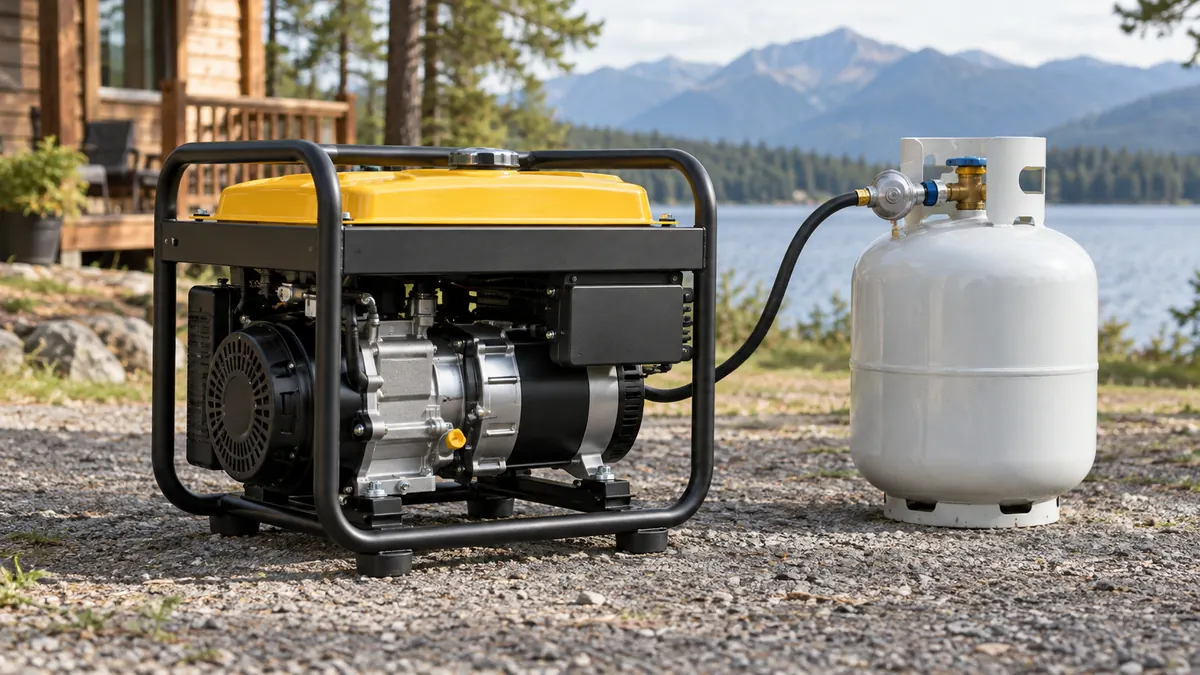
The manufacturer describes a kit with a 1.5 m bottle hose, an additional reducer and a built-in reducer. The gas bottle must remain upright. Könner & Söhnen says the generator is not designed for connection to a gas main; a fixed gas installation needs a qualified professional and must comply with local rules.
The manual prohibits using gasoline and gas at the same time. It describes changing fuels while the generator runs, but requires disconnecting connected devices before the change. When switching from gasoline to LPG, leftover fuel in the carburetor can make operation uneven for a few minutes. To start directly on LPG, follow the model-specific manual and check for leaks. Do not improvise adapters or use another model’s procedure.
Choose fuel based on what you can store and replenish safely. The specifications do not give a comparable runtime for every LPG type and load, nor do they establish a universal cost saving. Use local fuel prices and your actual load when estimating operating costs.
Placement, safety and maintenance
The manual warns that exhaust contains carbon monoxide and prohibits placing the generator in homes, spaces connected through shared ventilation, or locations from which exhaust could enter a home. Operate it outdoors, on a flat and dry surface, with sufficient ventilation and away from flammable materials. Do not use it in rain, snow or high humidity. The U.S. Consumer Product Safety Commission also advises using generators outdoors and away from doors, windows and vents; follow the manufacturer’s instructions and local requirements.
The manual says the generator is supplied without engine oil or gasoline. Prepare the engine before the first start as described in the documentation, and check the oil level before each use. For the initial break-in, the manual calls for an oil change after the first 20 hours and limits the load during that period; review the complete maintenance schedule before operating the unit.
At 45.4 kg net, it is important to plan how the unit will be moved and positioned. Könner & Söhnen offers the KS 3 KIT transport accessory with wheels and handles separately. Do not assume a seller includes it. Published LpA is 68 dB(A) at 7 m; it may be disruptive in a small plot or near neighbours, so check local noise rules.
Who it may suit
The KS 3000G may suit someone who needs to choose between gasoline and LPG, has compatible single-phase loads and can keep those loads within the generator’s power guidance. The standard Schuko outlets may fit common equipment, but every connected device still needs to meet its voltage and power requirements. If you do not need LPG, compare the gasoline-only KS 3000: it has similar published power and weighs less.
Look elsewhere if you require an inverter generator, need a continuous load close to 3 kW, want a quiet unit, or expect to move the generator often without a transport accessory. Compare the specification and manual for each alternative against your actual load rather than the “3,000 W” label alone.