

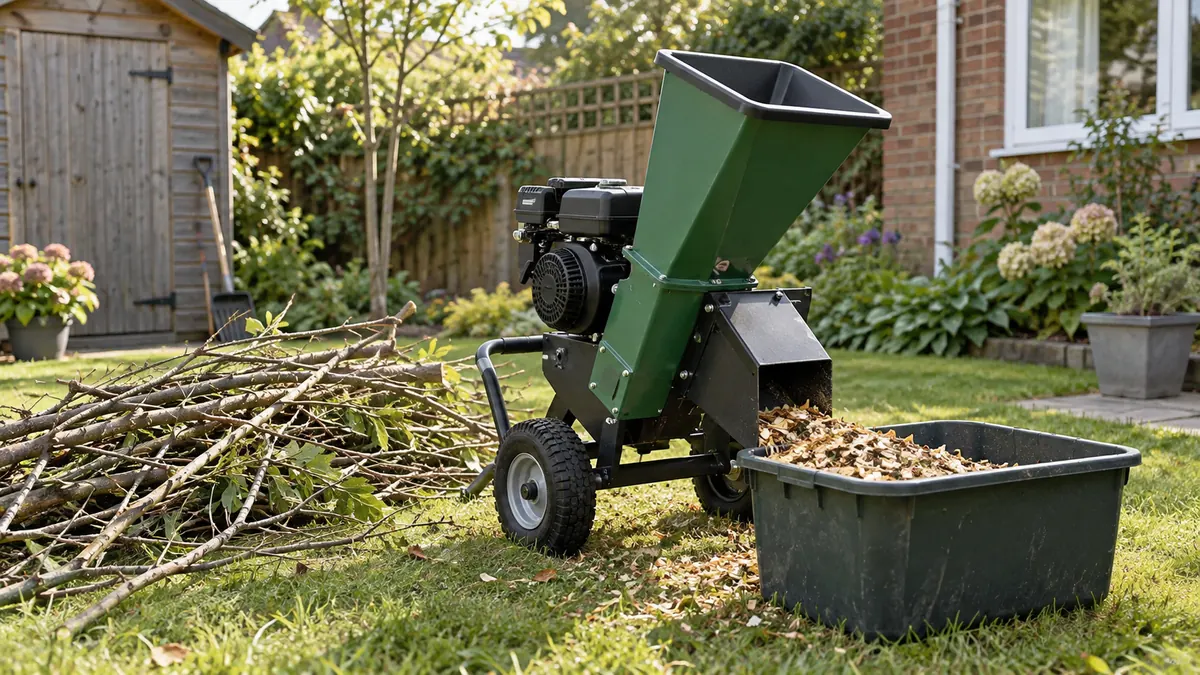
Identify the garden waste before shopping
Separate the last season’s waste into three groups: loose foliage and soft green material, woody branches within a compact machine’s stated limit, and larger branches that need a saw, rental chipper or green-waste collection. A leaf mulcher may use flexible line to reduce dry leaves; a branch chipper has a wood-feed and cutting mechanism; a combination chipper-shredder can add a separate hopper for softer material. Similar names do not make the feed openings interchangeable.
Make a short inventory from an ordinary pruning season. Note how often you prune, the longest and thickest branches, whether the wood is green or dry, and how many bags or bins the waste fills. Measure actual branches near the point that would enter the machine. Knots, forks, bends and clusters can take more space than a straight stem and may not pass through a hopper even when the diameter is below the headline limit.
Garden area alone is a weak sizing measure. A small orchard can produce more wood than a large lawn, while a hedge garden may create many fine clippings and very few thick branches. Buy around the recurring task rather than the largest branch that appears once in several years. If occasional large limbs dominate your estimate, manual pruning plus collection or renting may be more practical than storing and maintaining a larger chipper year-round.
When a compact home chipper fits
A compact electric machine can suit modest, predictable woody prunings when an appropriate outlet is close, the work area is level and the manual names the material and diameter. It is less suitable if branches routinely exceed its limit, if access requires lifting the machine up steps, or if the neighbors and local rules make its operating noise impractical. “Compact” and “domestic” do not guarantee light weight or quiet use.
| Garden situation | First option to assess | Check before buying |
|---|---|---|
| Mostly dry leaves, few branches | Leaf mulcher, rake or collection bags | Confirm it is designed for leaves; check voltage, cutting line, bag and storage |
| Occasional thin hedge prunings | Compact electric branch shredder | Accepted wood type, branch limit, jam procedure and outlet setup |
| Regular woody fruit-tree pruning | Machine sized to the actual branch range or a scheduled rental | Feed opening, material limits, knife/roller service, collection and transport |
| Thick limbs only once or twice a year | Pruning saw, municipal collection or chipper rental | Whether storage and maintenance cost more than occasional access |
The highest published diameter is not automatically the right selection target. If the garden’s regular branches are well below that limit, a smaller machine may be easier to move and store. If you intend to feed near the maximum, verify how the manufacturer defines that figure, what type of wood it describes and whether the unit needs short pauses between branches.
Compare documented machine types
These examples illustrate different purposes and regional markets; they are not current buying recommendations or a performance ranking. Bosch UK describes the AXT Rapid 2200 as a 2,200 W blade shredder rated for branches up to 40 mm and weighing 12.1 kg. DR lists its US-market PREMIER 320 gas chipper-shredder for 3-inch branches and separate garden waste up to 0.5 inch; its published specifications include a 6.6 hp / 233 cc engine and 129 lb weight. WORX Canada calls the WG430 a leaf mulcher, not a branch chipper; it is a 120 V, 13 A device with flexible-line cutting and an 11:1 leaf-mulching ratio.
| Documented example | Published category and limit | Implication for a home garden |
|---|---|---|
| Bosch AXT Rapid 2200 | EU/UK corded blade shredder; 2,200 W; max. 40 mm; 12.1 kg | Check manual, outlet and the physical route from storage to work area |
| DR PREMIER 320 | US gas chipper-shredder; 3 in chipping and 0.5 in shredding; 129 lb | Higher capacity brings engine service, transport and storage demands |
| WORX WG430 | Canada 120 V leaf mulcher; 13 A; line head; 11:1 leaf ratio | Not a branch shredder; verify regional voltage and leaf-only material |
Never transfer a regional listing’s voltage, warranty, package contents, parts support or availability to another country. A manufacturer’s maximum capacity is also specific to its machine and test conditions. It does not establish that a compact unit will process every branch at that diameter or outperform a different cutting system.
Blade, roller, turbine and leaf-mulching systems
Blade shredders cut branches against a blade or anvil. The result may be finer than a roller’s output, but feed technique, blade condition and supported wood type matter. The owner will need to inspect the cutting edge and use the maker’s replacement part and service procedure. Do not open a cutting chamber while powered or bypass a guard interlock.
A roller system draws and crushes material against an adjustment plate. It may produce coarser fragments and can feed a branch into the mechanism, but soft leaves or long stems can bundle together if the manual does not permit them. Follow the loading direction and adjustment instructions. A turbine system is a different design again; the label alone does not tell you how it handles wet leaves or wood.
Leaf mulchers can use flexible line rather than a metal blade. WORX WG430’s 13-inch cutting diameter describes its line head, not a 13-inch branch capacity. WORX lists leaves, yard debris and an 11:1 leaf-mulching ratio, and specifically names the product as a leaf mulcher. The maker’s manual and product page do not support treating it as a woody branch chipper. Keep sticks, brush and branch pieces out unless the exact manual expressly allows them.
Before choosing a system, check replacement blades or line, access to the adjustment plate, jam-clearing procedure, motor protection and the availability of service. These features help plan ownership; they do not guarantee that the shredder will never clog. A model without a published branch limit should not be sized by guessing from the width of the feed opening.
Plan power, storage, service and disposal
Measure the route from the shed to the operating area, including door widths, steps, gravel and turning space. Include the hopper, handles, wheels, collection bin and room to feed long branches in the machine’s working footprint. A wheeled unit can still be awkward on a slope or uneven lawn. Check the machine weight and whether you can reposition it without lifting near the cutting opening.
For corded tools, confirm voltage and outlet requirements in the local manual. Use only an outdoor-rated extension lead with the specified length and conductor size, keep plugs dry and route the cable away from the feed path. Battery models require a compatible pack, charge time and safe storage. Gas engines add fuel and oil handling, air-filter, spark-plug and knife service, exhaust and transportation concerns. Include these tasks in the ownership decision rather than comparing purchase prices alone.
Noise limits and permitted hours depend on local rules and the property. A quiet product claim or a manufacturer sound figure does not mean a chipper is silent at a neighbor’s window. If the garden is attached to other homes, check community requirements, position the machine away from open windows and consider rental or collection instead.
Think about where the output will go. A small collection box may need frequent emptying, while a large box fills with weight and takes storage space. Fresh wood chips may be coarse and are not automatically finished compost. Diseased or invasive plant material may need separate disposal. If there is no safe place to accumulate or use the output, a shredder may shift the waste problem rather than solve it.
Set up the work and feed material carefully
- Read the manual for material, diameter, pauses, protective gear and start-up; identify the exact model and revision.
- Sort leaves, soft stems, straight branches and oversized limbs. Remove rocks, wire, ties, soil, plastic and metal.
- Set the machine on stable, dry ground with a clear discharge path and room to move around it safely.
- Feed one suitable branch at a time, without pushing a hand into the hopper. If the motor slows, stop adding material and use only the maker’s procedure.
- To clear a jam, stop the engine, disconnect mains power or remove the battery and wait for all moving parts to stop. Use the manual’s tools and access points.
Curved branches and forks can catch or turn in a hopper. Shorten pieces only when it can be done safely with a suitable cutting tool. Never steady a branch close to the feed opening or push it with a hand, foot or improvised stick. If vibration, sound or discharge changes unexpectedly, stop and inspect only after isolating power.
Safety and maintenance in a home garden
OSHA’s chipper safety guidance highlights hazards from cutters, ejected material and entanglement. Keep children and bystanders outside the work zone, tie back hair, avoid loose clothing and use eye and hearing protection recommended by the equipment manual. Keep hands away from feed and discharge areas, and never operate with a missing cover, damaged switch or bypassed guard.
Before storage, isolate all power and wait for moving parts to stop. Clean and inspect only as directed; avoid water near motor, electrical connections or bearings unless the manual permits it. Check bolts, cutting parts, wheels, hopper, collection container and cable or fuel system. Replace worn parts with the model-specific parts listed by the manufacturer. Stop using the machine if the housing cracks, it vibrates abnormally or a safety device fails.
Decide where chips and mulch will go
Wood chips, shredded leaves and compost are not interchangeable materials. For compost, mix suitable clean woody fragments with greener material and manage moisture and aeration. A coarse layer can take longer to break down than leaf litter. For ornamental mulch, check that the plant species, chip size and placement are appropriate and avoid burying stems or the crown. Do not spread material from diseased plants or invasive species without checking local horticultural guidance.
For a small amount of waste, manual pruning and municipal green-waste collection may have lower cost and less maintenance than a machine. If the volume is seasonal, rental can offer a larger chipper without year-round storage. If a shredder will be used repeatedly, keep the exact model manual and service schedule with the machine, and verify replacement parts before the first busy pruning season.
For a broader overview, see the complete branch shredder guide, the guide to electric branch shredders and our page on gas branch shredders. Match the type to your actual waste and check the local manual before use.