

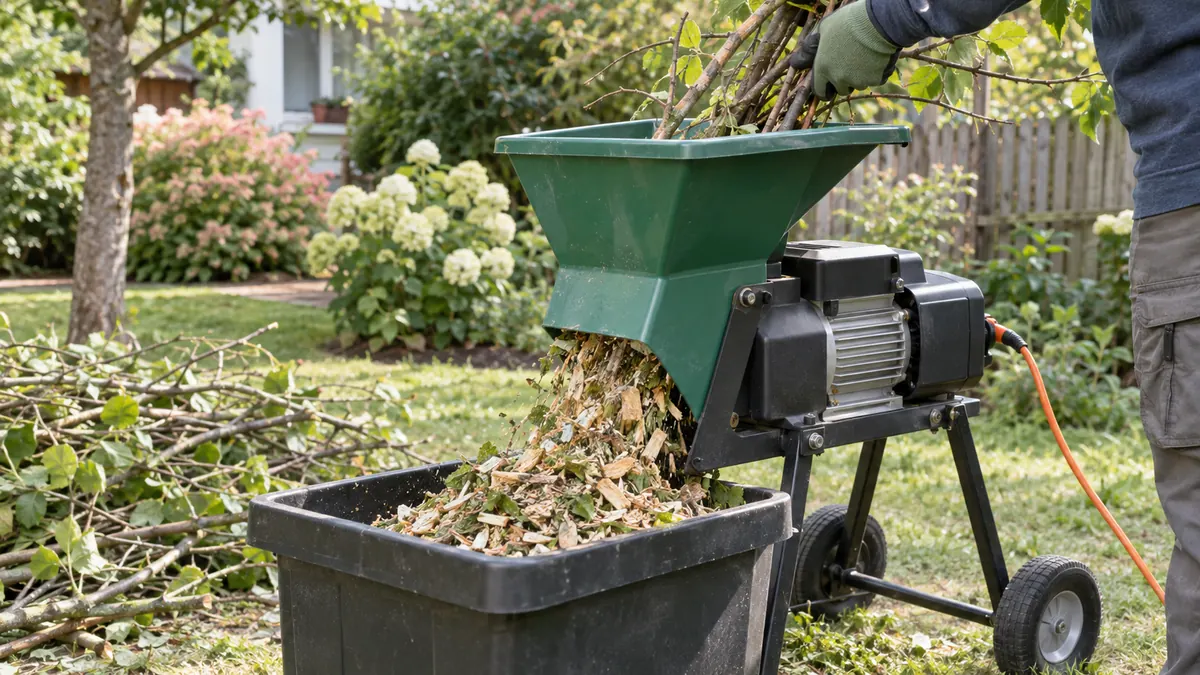
Can a leaf mulcher process branches?
- Read the maximum branch diameter in the exact model manual; do not treat a marketing label or motor amperage as proof that it can process every branch of that size.
- Check the cutter description and accepted materials. The WORX WG430, for example, is an electric leaf mulcher using a bladeless Flex-a-Line system; its published 13-inch cutting diameter is not a branch-diameter rating.
- Confirm voltage, extension-cord requirements, collection method, replacement cutting parts and the model's jam-clearing procedure before buying.
Compare documented electric branch-shredder examples
For a corded branch shredder, Bosch lists the AXT Rapid 2200 at 2,200 W and a maximum branch diameter of 40 mm; its manual says the model is intended for fibrous and woody garden waste and specifies periodic working cycles. Patriot's US CSV-2515 is a 120 V, 1.5 hp electric chipper-shredder rated by its manufacturer for branches up to 2.5 inches. They are different regional tools and should not be treated as direct performance equivalents.
WORX's WG430 is another useful distinction: the maker calls it a 13 A electric leaf mulcher and explicitly says it is designed for leaves, grass clippings and pine needles, not branches, sticks or brush. Its cutting line and advertised opening do not create a branch-chipping rating. The model family and material must be checked before interpreting any diameter measurement.
| Example | Power and material | Documented limit | Market note |
|---|---|---|---|
| Bosch AXT Rapid 2200 | 2,200 W blade shredder for woody garden waste | 40 mm maximum branch diameter; 12.1 kg | Manufacturer page is UK/EU configuration |
| Patriot CSV-2515 | 1.5 hp, 120 V corded branch chipper and leaf shredder | Up to 2.5 in per US manufacturer page | US electrical configuration; retailer status can change |
| WORX WG430 | 13 A leaf mulcher using cutting line | Not rated for branches, sticks or brush | Do not classify it as a branch chipper |
Check branch limits and power access
For woody branches, the practical decision is whether the manufacturer's manual explicitly lists that material and diameter. A leaf mulcher may reduce leaves but is not a substitute for a branch chipper. If your pruning produces limbs above the documented limit, use a suitable saw first or arrange green-waste collection rather than forcing them into the hopper.
Match woody waste to the machine
- Confirm the manual accepts woody branches and states a maximum diameter for the wood you process.
- Check feed opening, branch length, reverse or jam controls, and whether the rating differs for fresh and dry wood.
- Verify voltage, outdoor extension-cord gauge and length, outlet protection and safe cable routing.
- Compare discharge direction, collection setup, machine weight, blade availability and storage.
Choose blade, roller or string-based reduction
Cutting-system names point to different material paths. A fast blade machine slices eligible branches into chips; a roller or turbine-style system draws woody pieces through a slower cutting chamber; a string-based leaf mulcher shreds leaves and soft debris without a branch knife. The accepted material, maximum diameter, feed opening and jam procedure must come from the exact manual—not from the general label “electric shredder.”
Blade systems need sharp, correctly fitted blades and a way to inspect or reverse them as directed. Their cutting action can be loud, and the feed must not be forced. A roller system may be quieter and can pull suitable branches inward, but it still has a stated maximum and can jam on leafy, flexible material. Leaf mulchers can reduce seasonal leaf volume but cannot safely replace a chipper for woody pruning.
Also check whether the unit produces chips of a useful size, how material exits, whether a collection bag or bin is included and how often blades, lines or wear parts need replacement. Make sure the part number is available in your market before investing in a model that is discontinued or imported.
Plan the outlet, cord and discharge area
Electric machines avoid gasoline engine maintenance but still need the correct circuit, cord and working area. Read the manual for voltage, current, extension-cord gauge and maximum length. Keep the cable away from the feed chute, sharp branches, wheels and wet ground. If the circuit breaker trips, stop and investigate rather than repeatedly restarting into an overload.
Place the machine on level, stable ground and orient its discharge so chips cannot strike a person, window or vehicle. Use a bin that does not block the outlet. Feed only one piece at a time where the manual directs, and do not push hands or feet into a hopper. Keep a suitable pusher tool nearby if the maker supplies one. Shut off, unplug and wait for all motion to stop before clearing a jam or opening the housing.
What the safety sources do and do not establish
OSHA identifies contact with moving cutting components and ejected material as serious chipper hazards. Its guidance is written for work settings, but the core user lesson is clear: keep hands and loose clothing away from the feed opening, never defeat guards, and isolate power before clearing a jam. The appliance-specific manual remains the authority for feed direction and allowed material.
Feed material and clear jams safely
Before every session, set the machine on stable ground, inspect the housing and guard, and keep other people out of the discharge area. Stop and disconnect power before inspection or maintenance; wait for all moving parts to stop. OSHA's chipper guidance also calls for eye, hearing and hand protection and following the manufacturer's safety instructions.
Manufacturer capacity is a selection ceiling, not an instruction to feed every branch at that diameter. Hard or dry wood, knots and forks can exceed the practical load of a motor even when a branch appears within the nominal limit. Cut long limbs into straight sections, remove side branches, feed slowly and stop if the mechanism labors. Never force material into the intake or use a stick unless the manufacturer supplies an approved pusher.
Electric machines need a suitable outdoor outlet and cable route. Confirm voltage, current draw, extension length and wire gauge in the exact manual. Keep plugs and connections away from wet grass and discharge; do not leave a cable where the machine can drive over it. Wear eye and hearing protection because chips and fragments can escape, and keep the discharge area clear of people.
Roller shredders and blade chippers process material differently. A roller may pull branches through a crushing mechanism, while a blade model cuts at speed. Compare the specified branch range, adjustment and noise guidance, not just the wattage. A clogged or jammed machine must be switched off, unplugged and fully stopped before opening the chamber. Remove debris with the supplied tool, never by hand.
The Bosch AXT Rapid 2200 is documented at 2,200 W and up to 40 mm in the European source. The Patriot CSV-2515 is a US 120 V, 1.5 hp example with a different rated branch capacity. These specifications are not a head-to-head test and their regional electrical systems differ. Check local parts and service before importing a model.
Noise, discharge and cleanout affect where a home machine can be used. Place it on stable ground, point the outlet into a suitable bin and avoid running it beside an open window or neighbor’s outdoor seating. Do not block cooling vents or cover a motor to reduce noise. The manual’s safety zone and hearing protection guidance take precedence over a retailer’s “quiet” label.
When a machine stops under load, turn it off, unplug and wait for all moving parts to stop before clearing the chamber. Use the supplied tool and avoid touching cutter edges. If it trips repeatedly, check that the branch size and feed rate are within the manual’s limits and that the power circuit is suitable. Do not replace a fuse with a higher rating or bypass an overload protector.
Measure the largest limb and sort branches before shredding. A straight fresh limb is different from a knotty dry branch of the same diameter. If the machine stalls or the feed becomes intermittent, stop and check size, orientation and moisture against the manual. Do not increase the stated limit or use a longer pusher; a jam can release stored mechanical energy.
When choosing between a blade chipper and crushing roller, also compare the type and cost of replacement parts. Confirm how the gap or blade is adjusted, whether service can supply it locally and what tools are required. A low purchase price can be offset by unavailable blades or a design that is difficult to clear safely.
Do not use an electric shredder in rain or leave its connection where water can pool. Protect the outlet and cable from the cutting area and use the circuit protection prescribed by the manual. When feeding, stand at the intended operator position, keep a safe grip on branches and let the machine pull material only as designed. Do not look into the hopper or discharge while cutters are moving.