

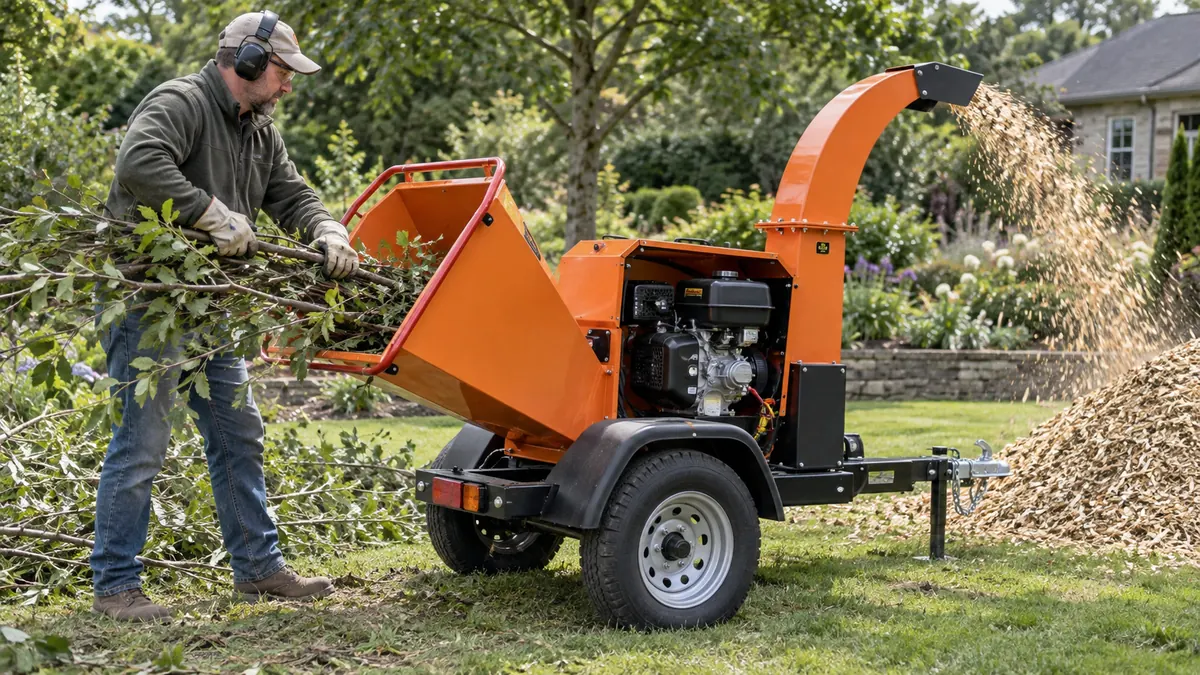
When gas power solves a real constraint
- Use the manufacturer's rated feed diameter and material limits, and distinguish that maximum from a recommendation for continuous heavy feeding.
- Check machine mass, wheel or trailer design, hitch requirements, storage footprint and how the unit will be loaded and secured.
- Compare the manual's engine oil, fuel, blade inspection and service requirements with your expected seasonal use.
Compare documented gas chipper capacities
Manufacturer examples show why a gas rating must be checked by model. DR lists a current Premier 320 with a maximum 3-inch branch chipping capacity, 6.6 hp/233 cc engine and separate 0.5-inch shredding limit for yard waste. Its Pro 420 is listed at a maximum 4-inch branch capacity, 9.2 hp/301 cc and a 0.75-inch shredding limit. Patriot lists the CSV-3065B as a 6.5 hp gasoline chipper-shredder rated for branches up to 3 inches. These are product-page specifications, not independent performance results; maker and manual limits take precedence over this summary.
| Manufacturer example | Branch capacity | Separate shredding limit | Published engine |
|---|---|---|---|
| DR Premier 320 | Up to 3 in | Yard waste up to 0.5 in thick | 6.6 hp, 233 cc |
| DR Pro 420 | Up to 4 in | Woody garden waste up to 0.75 in | 9.2 hp, 301 cc |
| Patriot CSV-3065B | Up to 3 in | Maker describes leaves and vegetation; check exact manual | 6.5 hp gas engine |
The terms “chipping capacity” and “shredding capacity” are not synonyms. A machine may accept a branch through a dedicated chute while its shredder hopper is intended for leaves or smaller prunings. Never use the largest diameter from a product card to feed material into a different hopper.
Check feed capacity, transport and service
For occasional small-yard pruning, hauling a gas chipper, maintaining an engine and storing fuel can outweigh the benefit. For repeated large-branch work, compare the capacity and service instructions of the exact chipper rather than relying on generic horsepower-to-diameter rules. If a retailer listing does not give the full model number and manual, treat the specification as unconfirmed.
Compare site access, workload and upkeep
- Confirm the manual accepts woody branches and states a maximum diameter for the wood you process.
- Check feed opening, branch length, reverse or jam controls, and whether the rating differs for fresh and dry wood.
- Review engine service intervals, fuel and oil requirements, blade inspection and replacement parts.
- Plan the route for moving and securing the machine, discharge area, noise and outdoor storage.
Separate chipping from shredding
Before comparing engine size, sort the waste into branches, leaves, soft green growth and material that must be hauled away. A chipper knife cuts woody limbs; a hammer or shredder section reduces smaller garden material. A leaf vacuum or mulcher is generally not a chipper, and a chipper's branch rating does not mean it can process a load of wet leaves in the same manner.
Measure branches after pruning and sort them near the machine. Include knots and forks in the decision, not only the straight stem diameter. A thick fork, curved branch or dry hardwood can feed differently from straight green wood. The rated maximum is a limit, not a target for constant production. If the manual states a lower continuous or material-specific limit, use the more conservative figure.
Chip size and final use also matter. Chips can be used for paths or mulch only if the type and size suit the intended bed; they should not be placed against plant stems. If the yard produces very little wood, hauling or a municipal green-waste service may be simpler than buying and storing a heavy engine-powered chipper.
Estimate maintenance and transport needs
A gas chipper-shredder is a substantial machine, not a handheld garden tool. Compare weight, wheel spacing, handle height, turning clearance, loading height, storage footprint and whether it needs a trailer. The DR Pro 420 product page lists 188 lb for the manual-start version, which illustrates why moving equipment between a shed and work area can be a deciding factor. Use an appropriate ramp and rated tie-downs; do not lift a loaded machine by an unapproved handle.
Budget for the engine's specified fuel and oil, filters, belts, knives, hammer inspection, spark plug and seasonal storage. Sharpening or replacing knives requires the exact manual and safe isolation procedure. Keep receipts and record hours so service intervals are not guessed from elapsed seasons. If the machine has a reverse-feed control, follow its use only as designed; it is not a substitute for power-off jam clearing.
Gas equipment must run outdoors, away from enclosed areas and openings where exhaust can enter. Plan where noise and flying chips will travel before starting, especially near homes, roads, pets and neighboring work areas. Clear a safe discharge zone and use the guarding and PPE specified by the manual.
Before buying or renting, measure the narrowest gate, turning space and ground slope on the route to the work area. Compare them with the machine's operating width, total length, weight, ramp needs and approved lifting points. Check whether a local dealer or rental company can deliver and service the model. A chipper whose capacity fits the branches but cannot reach the site safely is not a practical choice.
What the safety sources do and do not establish
Commercial chipper guidance from OSHA highlights hazards from being pulled toward the feed system and from material thrown by the machine. A residential portable chipper may have different controls, but it still requires the exact manual, guards in place, a clear discharge area and power-off maintenance.
Fuel and feed-system precautions
Run gasoline equipment outdoors only, away from enclosed spaces and air intakes; keep fuel away from heat and allow the engine to cool before refueling. Keep hands out of the hopper, stand where the manual directs, and never clear an obstruction with the machine powered. Stop if a guard, emergency control or interlock is damaged.
Choose a gas chipper by the largest branch you actually generate, not by the largest number printed on a brochure. DR lists a Premier 320 for branches up to 3 inches and a Pro 420 for up to 4 inches; the manufacturer also gives different shredding capacities for leaves and small material. Those are maker-rated limits, not independent throughput measurements. Check species, dryness, forked shape and condition because a limb can bind even when its nominal diameter is below the stated limit.
Feed straight, trimmed branches gradually and use the machine’s approved feed chute. Never push material with a hand or foot, reach into a hopper or clear a jam while the engine can start. Keep the discharge pointed away from people, vehicles and windows. Use eye, hearing and hand protection listed by the manual, tie back hair and avoid loose clothing. Stop the engine, wait for all cutters to stop and isolate the ignition before inspecting the chamber.
Gas power makes sense when branches are too large for a domestic electric shredder or the work area has no suitable outlet. It also adds engine service, fuel handling, exhaust, vibration, storage and transport. Verify machine width, weight, loading points and ground conditions before moving it; never lift by a chute or guard. Operate outdoors because of exhaust and keep fuel away from hot parts.
Compare warranty and replacement blades with the intended annual workload. If pruning produces only a few small branches, hiring a chipper or using a collection service may be more practical than maintaining a gas machine. A branch shredder is not a leaf vacuum or a compost machine; decide in advance how the chips will be stored, composted or removed.
Branch capacity also depends on feed geometry. A straight branch may pass more easily than a forked or bent one of the same measured diameter. Cut off side forks, feed butt-end first where the maker instructs and do not hold a branch once the feed mechanism engages. Use a supplied pusher for leaf material only if it is listed for that chute; never reach inside the machine.
Before each use, check that guards, discharge chute, feed hopper and emergency stop work as intended. Make sure the ground is level and the machine cannot roll. Keep children and observers outside the specified exclusion zone. When finished, wait for the flywheel to stop completely and isolate the ignition before opening the chamber or moving a jammed branch.
Measure branch diameter at the thickest point and note whether the wood is green or dry. The chipper’s advertised maximum cannot represent every species or fork shape. Keep only the amount of feed material that can be handled without lifting or twisting. If a branch jams, do not pull it back while the rollers or flywheel are moving; follow the maker’s reverse or jam-clear procedure after isolating the machine.
Transport a chipper with the engine off and cool, using its designed handles and wheels. Secure it on a trailer with rated tie-down points and keep fuel container separate from hot components. A machine that cannot be safely delivered to the work area may not be a suitable purchase even when its capacity matches the branches.