

Before you buy cloves: make three local checks
A useful container plan starts with local information, not a generic planting date. Before buying seed garlic, write down three things: the expected timing of the first killing frost in your area, where the pot will spend winter, and whether that spot receives full sun once spring growth begins. These answers determine whether the project fits the space better than any product list or universal calendar.
| Check | Why it changes the plan | Practical next step |
|---|---|---|
| Local fall timing | Garlic needs time to root before winter, but a date suited to one state may be wrong for another. | Use your county or state Extension calendar before ordering. |
| Winter exposure | A raised, exposed pot changes temperature and dries differently from a bed in the ground. | Choose a place you can inspect after wind, rain and freezes. |
| Sun and water access | Garlic needs a sunny site and containers can need closer moisture checks in dry weather. | Confirm the pot can stay there through the following summer. |
Know your local garlic season
Garlic timing is regional. University of Minnesota and Illinois Extension both describe fall planting in cold-winter regions, after or near the first killing frost, so roots can develop before winter. In a mild climate, that exact date may be unsuitable. Check the advice from your state or county Extension office before ordering seed garlic, especially if winter temperatures, snow cover or rain patterns differ from the Midwest or Northeast.
Garlic needs a long growing season and is generally harvested in summer. That makes it useful to label the container and leave it in place rather than treating it as a quick gap-filler. If you need the same pot for spring tomatoes or annual flowers, use another container for garlic.
Choose planting stock for your climate and kitchen
Start with firm, healthy seed garlic from a reputable supplier and choose a variety recommended for your region. Grocery-store bulbs can sprout, but Extension guidance cautions that their variety and storage history may not suit local bulb formation. Keep the cultivar name with your planting notes; it is the information that makes next season’s decisions more useful.
The hardneck/softneck label is useful, but it is not a substitute for local variety advice. Illinois Extension notes that hardneck types produce a scape, while softneck types are generally longer keeping; climate can affect how those traits appear. Decide whether you value scapes and larger individual cloves, or longer storage, then check which locally recommended varieties match that goal.
Set up a container for a long crop
Choose a stable, food-safe container with drainage holes and enough depth for a developing root system. Larger containers buffer rapid drying and temperature swings better than small pots. Use a clean potting mix that drains well; native garden soil often compacts in containers and can make watering difficult to judge.
Position the container in full sun where you can access it in winter. A pot against a wall may be easier to inspect and shelter from wind, but do not assume a protected spot stays warm enough in every climate. In areas with hard freezes, group containers or use an appropriate insulating mulch according to local Extension advice. The objective is to protect the root zone, not to keep the crop warm like a houseplant.
Plant healthy cloves correctly
- Choose planting stock: buy firm, disease-free seed garlic suited to the region rather than relying on a grocery-store bulb with unknown storage and climate history.
- Separate close to planting: break the bulb into individual cloves without stripping their papery skins. Save soft, damaged or diseased cloves for the kitchen, not the planter.
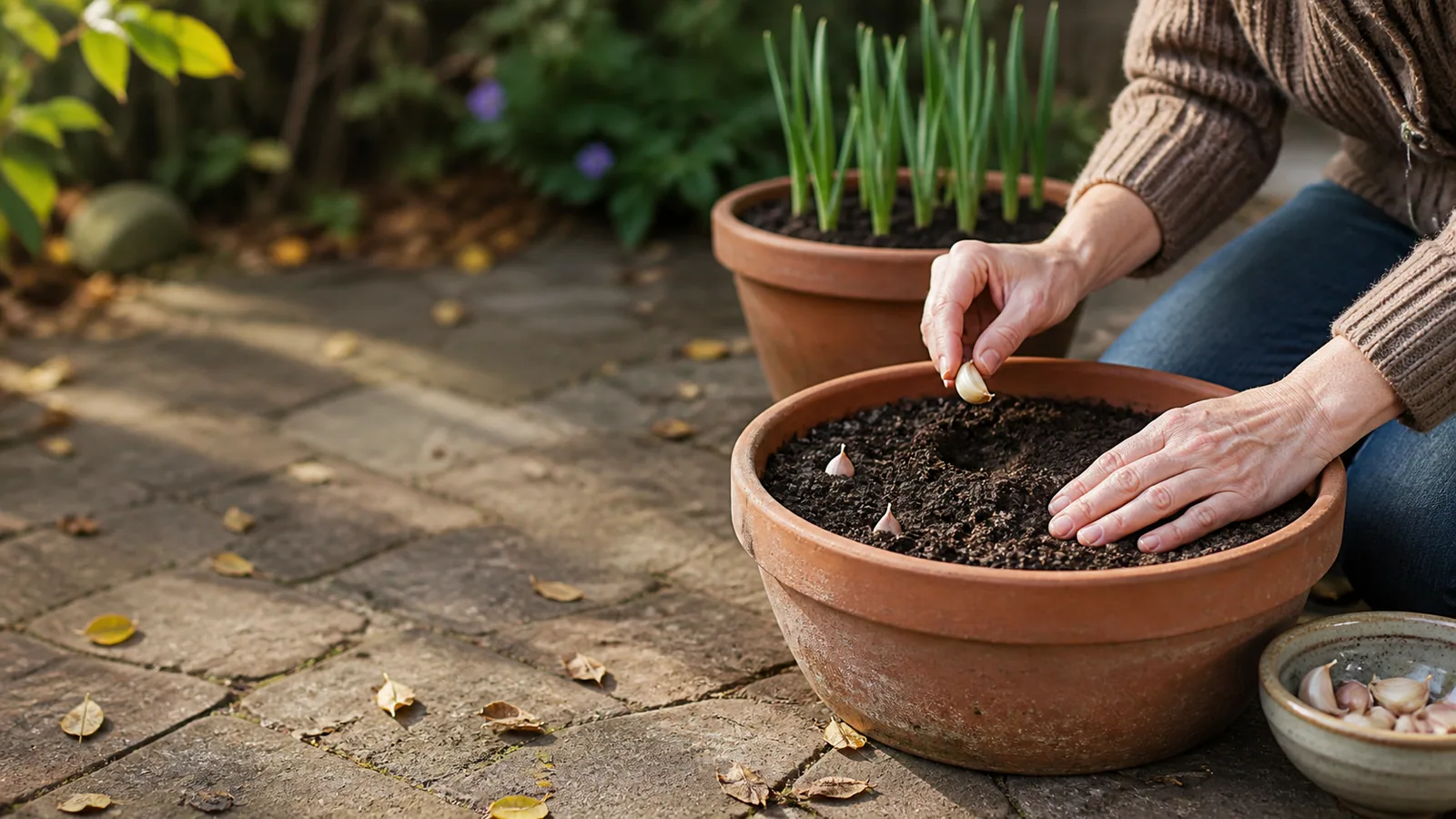
- Place the clove correctly: set the flatter basal plate down and the pointed tip up. Illinois Extension describes planting cloves about 1–3 inches deep in the ground; use the lower end of that range only when your container and local conditions make it appropriate.
- Allow room: do not crowd cloves just because a container has open surface area. Garlic needs space for each bulb and enough growing medium to remain manageable through the season.
- Water in: moisten the mix thoroughly and confirm water can drain. A saturated container is not a well-watered container.
Care through winter and spring
Garlic is shallow rooted and suffers when the growing medium stays dry for too long, but a container should never remain waterlogged. Check below the surface before watering. University of Maryland Extension recommends judging container moisture from the growing medium, container weight and plant needs rather than following a rigid schedule. Rain, wind, container material and the size of the plant all change the answer.
In spring, resume regular observation as growth accelerates. Keep weeds out of the container and use a local soil-test or Extension recommendation before adding fertilizer. Hardneck garlic may produce a flower stalk called a scape; Extension guidance notes that removing it can direct more growth toward the bulb. The decision is not urgent on day one, but it is worth learning to recognize the stalk if you choose a hardneck variety.
Harvest and cure without rushing
Harvest timing depends on variety and season. Rather than pulling a bulb when the first leaf yellows, watch the plant and consult a local guide. Illinois Extension advises harvesting when lower leaves brown while a substantial portion of leaves remains green. Lift bulbs carefully so the wrappers stay intact; do not rinse them clean for storage.
Cure garlic in a dry, shaded place with good air circulation. The aim is to let the outer layers and tops dry before trimming and storing. The storage life differs by garlic type, so label the variety and use the bulbs that do not keep as long first. For food-safety guidance on preserved garlic, follow a tested Extension recipe rather than improvising garlic in oil.
Observe before trying to fix a problem
Container growing makes it easy to react too quickly: a pale leaf can prompt extra fertilizer, while a dry-looking surface can prompt watering even when the root zone is wet. Instead, check the mix below the surface, the drainage holes and the recent weather first. Record the planting date, variety, watering changes and any mulch or feed used. A short record turns a vague problem into something you can compare next season.
If plants repeatedly wilt, yellow or decline, do not assume one cause or apply a pesticide based only on a photo. University of Minnesota Extension notes that environmental conditions, diseases, insects and wildlife can produce similar symptoms. Remove obviously damaged plant material, avoid moving suspect soil or cloves to another planter, and ask a local Extension office or diagnostic service when the cause is unclear. Correct diagnosis is more useful than a fast, generic remedy.
What containers change — and what they do not
The core garlic requirements do not change in a container: sun, drainage, healthy planting stock, suitable timing and ongoing attention still matter. What changes is the speed at which the root zone responds. A small or porous pot can dry quickly; an exposed pot can experience sharper cold or heat swings; and a planter with poor drainage can stay wet long after a bed would have drained.
This is why container garlic should be treated as a small, observable crop. Check the growing medium, make adjustments based on the actual weather and keep notes on planting date, variety and harvest. Those notes are more useful next year than a universal pot-size or watering rule.
Sources and editorial method
This is an evidence-led instructional guide, not a product review. The garlic-growing guidance is based on university Extension sources reviewed for this update in September 2026. Its container-care section adapts Extension recommendations for growing vegetables in containers; it does not claim that Tu Jardín Pro has tested container varieties or winter setups. Local Extension advice takes priority where climate or cultivar guidance differs.
- Growing garlic in home gardens — University of Minnesota Extension
- Garlic — Illinois Extension
- Growing Vegetables in Containers and Salad Tables — University of Maryland Extension
- Preserving garlic — Oregon State University Extension