

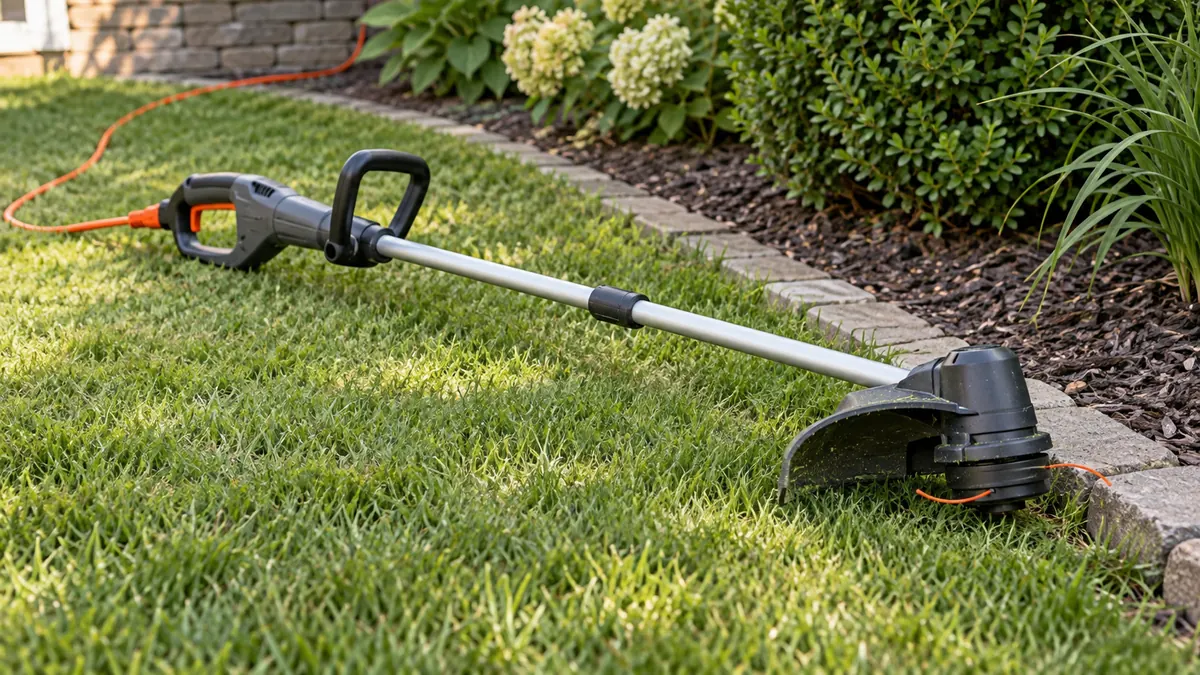
Greenworks 21142 / STA808 published specifications
The product page and manual use model identifiers 21142 and STA808. The Canadian listing describes 10 A, 120 V AC and 60 Hz; an 18-inch swath; 0.080-inch line; a dual-line bump-feed head; and approximately 6,000 no-load RPM with a ±10% tolerance. It lists a bare-tool weight of 9.9 lb. These are manufacturer specifications for that regional version, not measurements of an individual used unit.
| Published detail | Greenworks Canada STA808 / SKU 21142 | Owner check |
|---|---|---|
| Power | 10 A, 120 V AC, 60 Hz | Read the unit nameplate before connection |
| Cutting path | 18 in (about 45.7 cm) | Confirm guard and head are original type |
| Line | 0.080 in (about 2 mm), dual line | Use the line size and winding direction in the manual |
| Feed | Bump feed | Follow the prescribed advance method |
| No-load speed | 6,000 RPM ±10% | Not a cutting-speed measurement under load |
| Weight | 9.9 lb as listed by the manufacturer | Verify the complete configuration and guard |
The wide path may clear an open strip in fewer passes than a smaller head, but the manufacturer figure does not tell you how close to cut around trunks or paving. A wide head also needs room to swing, so take care among shrubs, garden edging and irrigation lines. Do not remove the guard to increase the exposed line or extend the cutting path.
What the 18-inch path and 10-amp rating mean
The 18-inch cutting swath is a nominal maximum for the specified configuration. It is not a recommendation to sweep at full width through dense or tall growth. Start with short controlled arcs and let the motor recover between passes. If it slows, reduce the amount of grass being cut rather than pushing the head into the vegetation. A corded trimmer has continuous access to mains power only while the cable remains safely routed; it does not mean the motor can tolerate unlimited load.
The 10 A rating belongs to the 120 V, 60 Hz model listed in Canada. It cannot be used by itself to assess a circuit, extension lead or transformer. Check the tool nameplate, manual and the power supply in the country where it will be used. Do not use a plug adapter to resolve a voltage or frequency mismatch. If a seller cannot show the label clearly, treat the supply requirements as unverified.
This is a line trimmer for lawn edges, grass around posts and finishing work beyond a mower’s reach. It is not a brush cutter just because Greenworks calls the shaft attachment-capable. Thick woody stems, brush and branches need a tool designed and guarded for those materials. Keep this model within the line and vegetation range described in its manual.
Dual line, bump feed and replacement head
Greenworks specifies two lines of 0.080-inch diameter. A bump-feed head releases a controlled length of line using the method in the manual; it is different from an automatic-feed system. If the line stops advancing, switch off and unplug the tool before examining the spool. Check that the line is wound in the marked direction, the spool cover is latched and both exposed ends are balanced. Unequal line length can cause vibration and may make the head cut unevenly.
The manufacturer’s replacement-head page names model 21142 compatibility for a T-type head. That is useful fitment evidence, but it does not prove that every revision, spool or accessory listed under “Greenworks trimmer” fits. Compare exact part number, shaft interface, head attachment and guard instructions against the tool’s model label and manual. Do not substitute thicker line, metal wire or fishing line; an incompatible diameter or material can overload the motor or break into dangerous pieces.
Before ordering a spool, record the model and serial number and compare them with the parts diagram. Do not rely only on photographs of a similar head: covers and locking tabs can differ even when two spools look alike. If line feeds continuously, the cutting ends differ, or the head wobbles after a refill, unplug the trimmer and inspect the spool seating and head. Replace cracked components rather than continuing to use them.
Attachment compatibility: check the exact part
Greenworks describes the STA808 as attachment-capable. The word “capable” means the shaft was designed for compatible attachments; it is not universal approval for every split-shaft accessory. Use the official fitment list for the precise model and any serial or type range it names. Confirm the drive connection, shaft dimensions, attachment guard, rotation direction and any power limitations. A tool that physically slides onto the shaft may still be mechanically unsafe or unsupported.
In particular, do not mount a metal blade, brush-cutter head or hedge-trimmer attachment unless Greenworks explicitly approves that exact combination and the required guard. A line trimmer motor and shaft are engineered for specific loads. If you need a true brush cutter, compare a model sold and documented for that use rather than inferring capability from an interchangeable shaft.
North American power supply and local fit
The 21142/STA808 listing consulted is Canadian-market and specifies 120 V, 60 Hz. That differs from the 230 V, 50 Hz domestic supply used in Spain and much of Europe. The model code alone does not confirm that a particular used tool is the Canadian configuration, but no European equivalent was identified in the sources used here. Before buying an import, obtain a legible photograph of the rating plate and the manual for its exact type number.
Also ask about local warranty, return rights, parts and repair support. A model can be technically documented and still be a poor purchase for a gardener who cannot safely power or service it. The product page's unavailable status does not establish whether another retailer has stock, but this review did not verify a current regional offer. The guide is most useful to an existing owner or someone checking a specific used listing, rather than as a current buying recommendation.
Setup, safe edging and maintenance
Before use, inspect the full cable, strain relief, plug, housing, guard and handle. Do not operate with a nicked insulation jacket, loose plug or missing guard. Use only an outdoor extension lead that meets the exact manual’s gauge and length instructions. Keep the cord behind the operator and outside the cutting path; plan the route before starting so that you do not step over it or pull it around sharp edging. Use a protected outlet suitable for exterior work and keep connectors away from wet ground.
Clear wire, stones, toys and other objects from the work zone. Wear eye protection, closed shoes and hearing protection when the manual or the setting requires it. Keep children, animals and other people well away from the line’s projection area. Work along one edge at a time and stop before reaching across a path or opening. When edging, use the guide and head position specified by the manufacturer; do not twist the shaft or drag the line over hard surfaces.
Disconnect power before replacing line, clearing wrapped grass or cleaning the head. Remove loose debris with a brush; avoid spraying water at the motor or switching assembly. After work, check for a damaged guard, line-cutter blade or loose fastener. Store the tool dry, with the cable loosely coiled and away from sharp hooks. If it overheats, vibrates unexpectedly or smells of burning, unplug it and arrange service rather than repeatedly restarting.
Listing and parts checks
For a listing or used tool, verify the 21142 or STA808 label, 120 V/60 Hz plate, dual-line head, guard, cord retention feature and included accessories. Ask for the serial/type number and a photograph of the exact unit, not a generic catalog image. Compare the line and head references with Greenworks’ manual and supported parts page. Inspect the cable, trigger return, shaft, handle adjustment and attachment coupling before use.
The published specifications make the model straightforward to identify, but they do not establish regional supply, condition or service in another country. We removed earlier marketplace references that did not identify the model. Use the manufacturer manual and parts page to identify consumables, and confirm the exact type number before ordering; the article contains no purchase card or live price.
For an overview of corded versus battery models, see the electric string trimmer guide. If you already have battery tools and need to avoid a cord, compare the battery string trimmer guide by platform and kit rather than by voltage alone.