

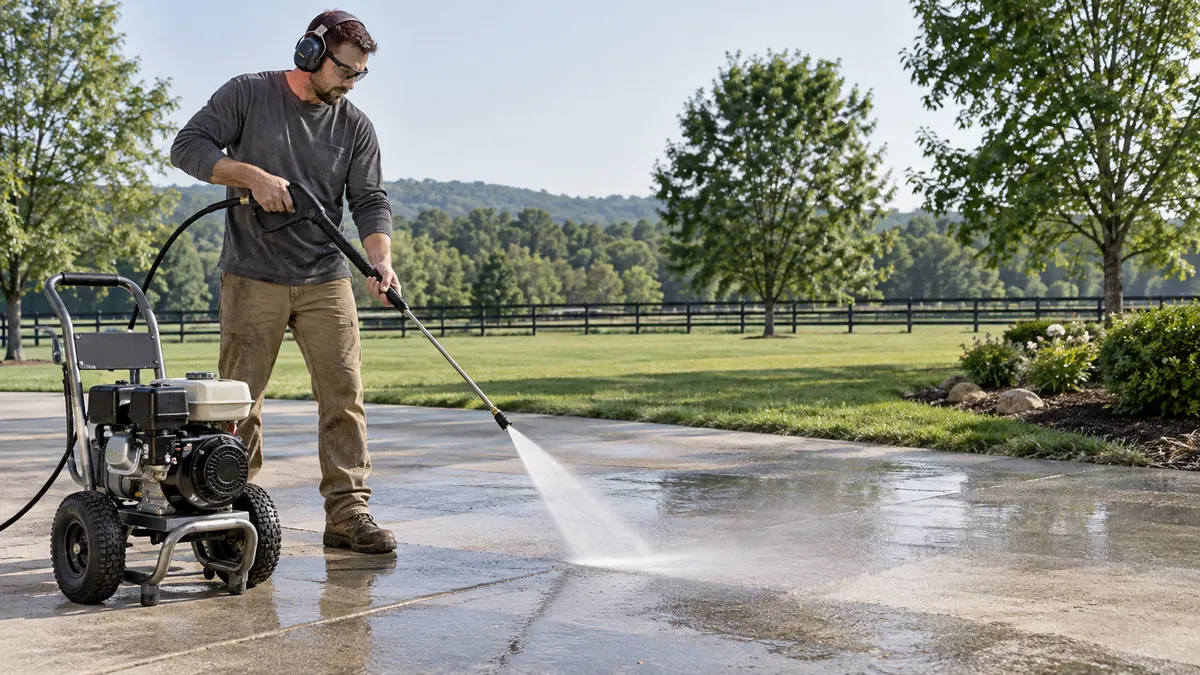
What Generac publishes for SpeedWash 3200
- Generac SpeedWash 3200 documentation lists 3,200 PSI, 2.7 GPM, a 196 cc engine and a brass-head axial cam pump for model 7122/G007900.
- Simpson MS60773-S was marked unavailable; Westinghouse WPX2700 could not ship to the selected location during the prior review.
- No gas-washer listing in the former set supported a current comparative ranking.
Read the pressure, flow and package together
Generac's product page lists the SpeedWash 3200 at 3,200 PSI and 2.7 GPM with a 196 cc OHV engine, recoil start and axial-cam pump. It also lists a 25-foot high-pressure hose, a PowerDial spray gun, a soap tank and four quick-change tips: 0°, 25°, 40° and soap. These are package details from the maker's page; inspect the manual and product number because a listing may describe a related kit or current revision.
PSI is pressure and GPM is the water flow rate. Maximum figures do not necessarily occur together on every machine or with every nozzle. Do not treat their product as a lab-tested cleaning score unless the manufacturer defines the test conditions. Pressure and flow must be matched to both the surface and the attachment, and the water source needs to supply the required flow without starving the pump.
| Check | Generac SpeedWash example | Why it matters |
|---|---|---|
| Maximum pressure and flow | 3,200 PSI; 2.7 GPM (maker specification) | Compare both values and the test configuration |
| Engine | 196 cc OHV; recoil start | Fuel, oil, service and noise are part of ownership |
| Pump and hose | Axial cam; 25 ft high-pressure hose | Check hose rating, wear parts and replacement availability |
| Included tips | 0°, 25°, 40° and soap | Use the correct nozzle and distance for the material |
Match flow, pump and surface
Choose from the surfaces and area you clean, then confirm nozzle types, hose rating, pump parts, water supply and service schedule. Pressure and flow are manufacturer maximums under stated setups, not a guarantee of faster cleaning on every surface. Check local noise restrictions and the exact model number before comparing purchase offers.
Plan outdoor use and pump service
- Compare pressure and flow together, checking whether the figures are maximum or operating ratings.
- Verify the engine, pump, fuel, detergent system, nozzle set and maintenance instructions by model code.
- Match the nozzle and distance to the surface; test first on a small inconspicuous area.
- Run gasoline pressure washers outdoors only and keep exhaust well away from openings.
Plan fuel, noise and routine service
A gasoline washer frees the operator from an electrical cord, but it requires fuel handling, engine oil checks, air-filter and spark-plug service, and a storage plan that follows the engine manual. The Generac page lists a 0.8-gallon tank and 0.6 L oil capacity for the current SpeedWash specification; do not convert those capacity figures into runtime without a duty-cycle and load test.
Gas engines are noisy, produce exhaust and are unsuitable for enclosed spaces. Consider neighbors, work hours and the distance between the machine and the cleaned area. Use the maker's hose length to plan where the unit can stand outdoors so exhaust is directed away from people, windows and air intakes. Do not extend the high-pressure hose with a garden-hose fitting or substitute an unrated connector.
Before an extended storage period, use the exact manual for fuel stabilization or draining, pump protection, oil service and frost precautions. Never store fuel beside ignition sources. If the machine has been unused for a season, inspect hoses and seals for damage and ensure that the water inlet filter and nozzle are clear before starting.
Prepare the work area and water source
Place the washer on a firm, level outdoor surface and chock wheels if the model can roll. Connect the garden hose and water supply before starting the engine, then purge air from the pump using the manual's priming sequence. Running a pump without enough water can damage it. Keep the inlet hose free of kinks and confirm that the source supplies the volume the pump needs.
Remove trip hazards and fragile objects, protect nearby plants and direct runoff away from storm drains where detergents or contaminants could enter. Set the spray direction before pulling the trigger. A pressure washer can inject fluid under skin; treat a suspected injection injury as an emergency even if the puncture looks small. Never make a leaking connection safe by putting a hand near the jet.
Choose nozzle, distance and detergent carefully
A narrow spray can cut soft wood, strip coating and force water behind siding. Begin with the widest compatible tip at a greater distance, then test on an inconspicuous area. Keep the wand moving and let the nozzle do the work; do not hold a concentrated jet on one spot. Use a surface cleaner only when the washer's manual lists the accessory and enough flow is available.
The Generac SpeedWash page lists 0°, 25°, 40° and soap tips. These angles serve different purposes; the 0° tip concentrates the jet and is not a general-purpose default. Follow the manual for the recommended tip and minimum distance. If a tip is clogged, stop the engine and relieve pressure before cleaning it with the supplied tool.
Detergent selection depends on the surface, cleaning target and product label. Use only the washer's intended soap-injection method and rinse thoroughly. Do not draw acids, solvents, bleach or other chemicals unless the machine and chemical manufacturer explicitly approve them. Keep runoff away from plants and storm drains where local rules require it.
For a fair comparison with an electric washer, compare a complete setup rather than engine displacement alone: pressure and flow ratings, hose length, included tips, detergent method, pump service, noise, exhaust separation and transport. A gas model may work where no outlet is available but may be too noisy or large for close residential settings.
No verified current offers or ranking
Generac's spec source for SpeedWash is manufacturer documentation. The page no longer repeats “most powerful” or “best value” labels that were not substantiated by a common test or current offer.
CO placement and high-pressure hazards
CDC says never run a gasoline pressure washer in an enclosed space or within 20 feet of a window, door or vent. High-pressure spray can cause serious injury; never point it at a person, test the GFCI on electric accessories and follow the operator manual.
A gas pressure washer needs an outdoor work plan. Place the engine outside and away from doors, windows, vents and enclosed garages because exhaust can cause carbon-monoxide poisoning. Keep fuel away from ignition sources, refuel only after shutdown and cooling, and use the fuel grade and oil specified by the engine manual. Do not store gasoline in an unapproved container or leave fuel where children can reach it.
Before starting, connect and purge the water supply as instructed so the pump is not run dry. Inspect the high-pressure hose, fittings and gun for damage, leaks or abrasion. Route the hose so it cannot catch under wheels or create a trip hazard. Use stable footing and the correct nozzle; never point the spray at a person, animal, electrical equipment or a pressurized container.
The Generac SpeedWash 3200 is listed by its manufacturer at 3,200 PSI and 2.7 GPM with a 196 cc engine, 25-foot hose and four tips. Those figures describe the product specification; they do not guarantee cleaning time or suitability for every surface. The engine’s maintenance schedule, pump care, oil level and winterization procedure come from the applicable manual. A different SpeedWash model or retailer package may include other parts.
Consider transport before buying a gas unit. A 62-pound machine plus fuel, hose and accessories is not equivalent to the weight listed for an empty frame. Check wheel size, handle, lifting points and where it can be stored. Noise and exhaust may make it unsuitable for dense neighborhoods or early morning work. For a small paved area, an electric washer may be quieter and easier to store; for long sessions away from power, gas can address a real access constraint.
Flow rate helps estimate how much water the machine can move, but it does not describe the force at the surface by itself. Generac publishes 2.7 GPM with the SpeedWash 3200’s maximum pressure; nozzle size, distance and water supply affect the result. A restricted garden hose, clogged inlet filter or kinked high-pressure hose can reduce performance. Do not run the pump without water or try to compensate for poor flow by holding the nozzle closer.
The 196 cc engine, 0.8-gallon fuel tank and 0.6-litre oil specification belong to the cited SpeedWash package. Verify the exact product and manual before maintenance because replacement engines, model years and regional packages may differ. Keep the air intake clear, inspect oil and fuel only with the engine off, and follow the schedule for pump and engine service.