

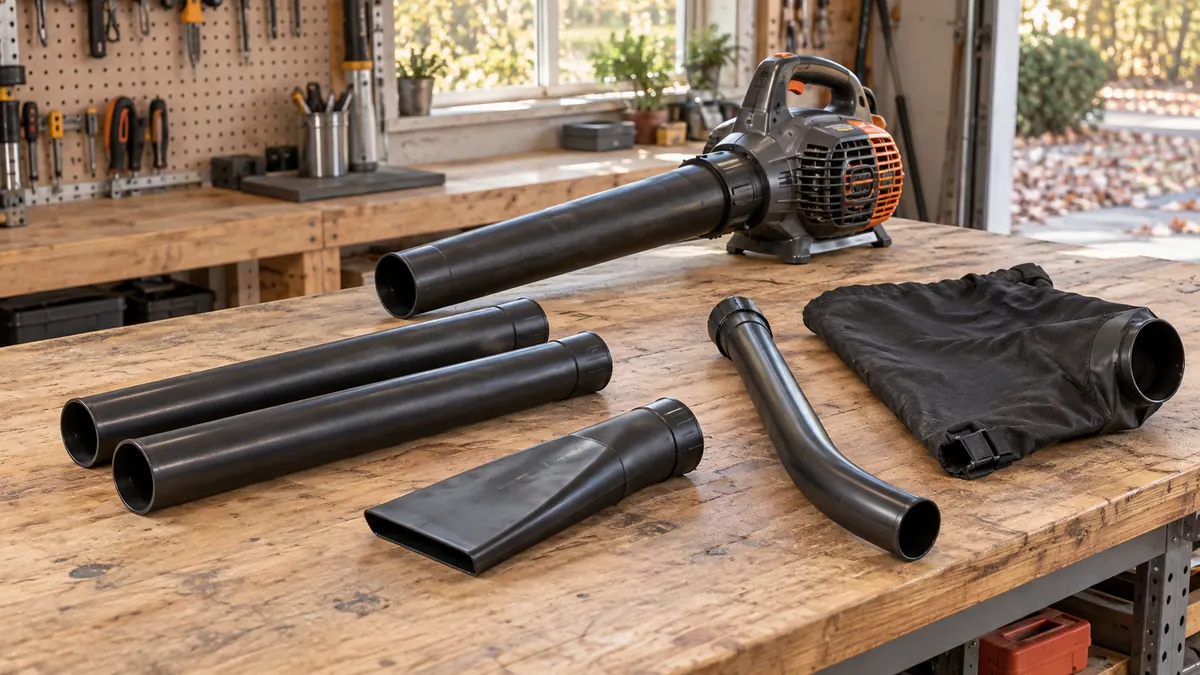
Identify the blower before searching for parts
Start with the machine’s identification plate. Record the brand, complete model name, type or product number, serial range if shown, and market. A product family can include a handheld blower, backpack blower or blower-vac, and tube shapes and locking features may differ between generations or kits.
Find the manual and parts diagram for that exact version. Look for approved accessories, their part numbers, installation steps and any use limits. If the documentation does not list a vacuum bag, extension or nozzle, do not infer fit from the outlet’s apparent diameter. Ask the manufacturer’s service channel or retailer to confirm against a clear photo of the plate and connector.
Check what the blower already includes. One package may contain a nozzle, tube, strap, battery or charger while another is sold as a bare tool. Buying by family name alone can duplicate a part, omit a necessary adapter or mix accessories from a regional variant.
Compatibility checks by accessory type
| Accessory | What to confirm | Mistake to avoid |
|---|---|---|
| Flat or concentrator nozzle | Model and part code, connector, latch and orientation in the manual | Assuming every tube in a brand family uses the same fitting |
| Extension tube or gutter kit | Compatible blower list, connector and approved working position | Adding improvised pipes or assuming a ladder setup is safe |
| Vacuum tube and collection bag | Vacuum-mode support and the correct tube, cover, impeller and bag | Fitting a generic bag to a blower-only tool |
| Harness or shoulder strap | Model-specific anchor points, load and approved installation | Tying a strap to a handle not designed to carry it |
| Battery and charger | Platform, voltage, part number, generation and kit configuration | Treating all batteries with the same voltage as interchangeable |
A nozzle may change airflow direction or concentration, but it does not turn a blower into a vacuum, shredder or safe elevated-work tool. Use an attachment only when the maker lists it for the machine and explains how to install and operate it. If the accessory table names several models, check that your complete suffix is included.
Connector shape is only one part of the check. An extension or concentrator changes the tool’s balance and may change how air exits the tube; a bag and vacuum tube change how the machine handles and how debris reaches the impeller. The maker’s instructions are the source for allowable combinations, not a universal tube-diameter rule. If two product photos look alike but their part numbers differ, treat them as separate until the manufacturer confirms a replacement or adapter.
Verify the part number and package
- Record the label. Photograph the model, type or product number and serial information; do not rely on the family name alone.
- Find the accessory code. Check the manual, parts diagram and official catalogue; distinguish a single replacement part from a complete kit or adapter.
- Compare the connector. Check locks, orientation and fit. Do not force, cut or modify a tube to make it attach.
- Read the package contents. Confirm the kit includes every part shown in the diagram and that the blower supports the operating mode.
- Check market and returns. Imported accessories can use a different part number or fitting. Ask for written confirmation if compatibility is unclear.
For a discontinued part, ask the manufacturer whether it has an official successor. Do not infer that a newer code replaces an older one because the names or photographs look similar. Keep the old accessory until the replacement has been identified and checked as the manual directs. If compatibility cannot be confirmed, treat it as unknown.
When buying from a third-party seller, compare the listing’s full contents with the maker’s diagram and ask for a photo of the molded part number if it is missing. Check the seller’s return conditions before opening a sealed package. A return policy does not make an unverified fitting safe, but it can help if the delivered part does not match the documented code. For equipment imported from another country, also confirm electrical or battery version, warranty territory and local service access.
What manufacturer examples show
Product documents for the BLACK+DECKER BV6600 and WORX WG430 illustrate why a complete model matters. The BV6600 is a blower-vacuum configuration with its own collection components; the WG430 is a dedicated leaf mulcher with a separate design. Those are different machines and accessories are not interchangeable just because both products collect or reduce leaves. Consult the maker’s manual and parts list for the exact version rather than adapting one system to the other.
Husqvarna’s official parts and accessories lookup likewise asks owners to identify their product before choosing a part. The same principle applies to other brands and regions: use the machine’s order code and serial information, compare the official accessory number, and verify the package contents. These examples document the fitment process; they are not a ranking or a recommendation to buy a particular accessory.
No current offer was verified for a complete, exact blower-and-accessory combination, so this page provides no purchase box and does not present an unverified adapter as a substitute. If the manufacturer does not publish a current part reference, obtain written compatibility confirmation from its service channel before ordering.
Choose for the job, not a generic claim
Moving leaves on a path or lawn: use the nozzle and position recommended for the blower. Aim the stream toward the ground and work in passes that gather debris; avoid directing air at loose gravel, bark, people, vehicles or windows. A higher air-speed figure is not automatically better if it also lifts soil or mulch.
Vacuuming leaves: choose a machine and kit designed for that mode. Empty the bag when the manual calls for it, confirm the closure is latched and stop the tool before changing tubes. Do not feed branches or material the manual excludes; use a chipper designed for woody debris instead.
Cleaning gutters: confirm the manufacturer lists a kit for the exact blower and describes the operating position. An extension changes balance and can direct debris back toward the operator. Do not use it from a ladder or reach over a roof edge without a safe work procedure. If you cannot keep stable footing and clear visibility, choose another method or hire a professional.
Before choosing among these options, clear loose items from the work area and decide where the leaves will go. A blower attachment can move debris into a pile, but it does not collect or compost it; a vacuum bag adds carrying weight and needs regular emptying. For a small path, a rake may be quicker and quieter than fitting an attachment. For a large volume of woody prunings, select a chipper designed for those materials rather than pushing them through a leaf impeller.
Installation, safety and care
Switch the tool off before fitting an attachment and wait for motion to stop. Disconnect the cord or remove the battery; for a gasoline engine, follow the manual’s shutdown procedure to prevent accidental starting. Use the protective equipment specified by the maker for the task, and keep people and pets away. Eye and hearing protection may be necessary depending on the model, environment and exposure time; the same legal claim should not be applied to every tool and situation.
After fitting the accessory, check that each latch is engaged, the tube cannot rotate loose and the air inlet or outlet is clear. Make the first check in a clear area and stop if you feel vibration, air leakage, looseness or an unfamiliar noise. Never open the housing or reach into an impeller while the tool can start.
Remove dust and plant debris as the manufacturer directs. Dry a collection bag fully before storage, inspect its seams and fasteners, and replace damaged parts with the approved reference. Do not use solvents unless the manual permits them; they can damage plastics, adhesives or fabric. Label stored nozzles and adapters with the model they fit to prevent mix-ups next season.