

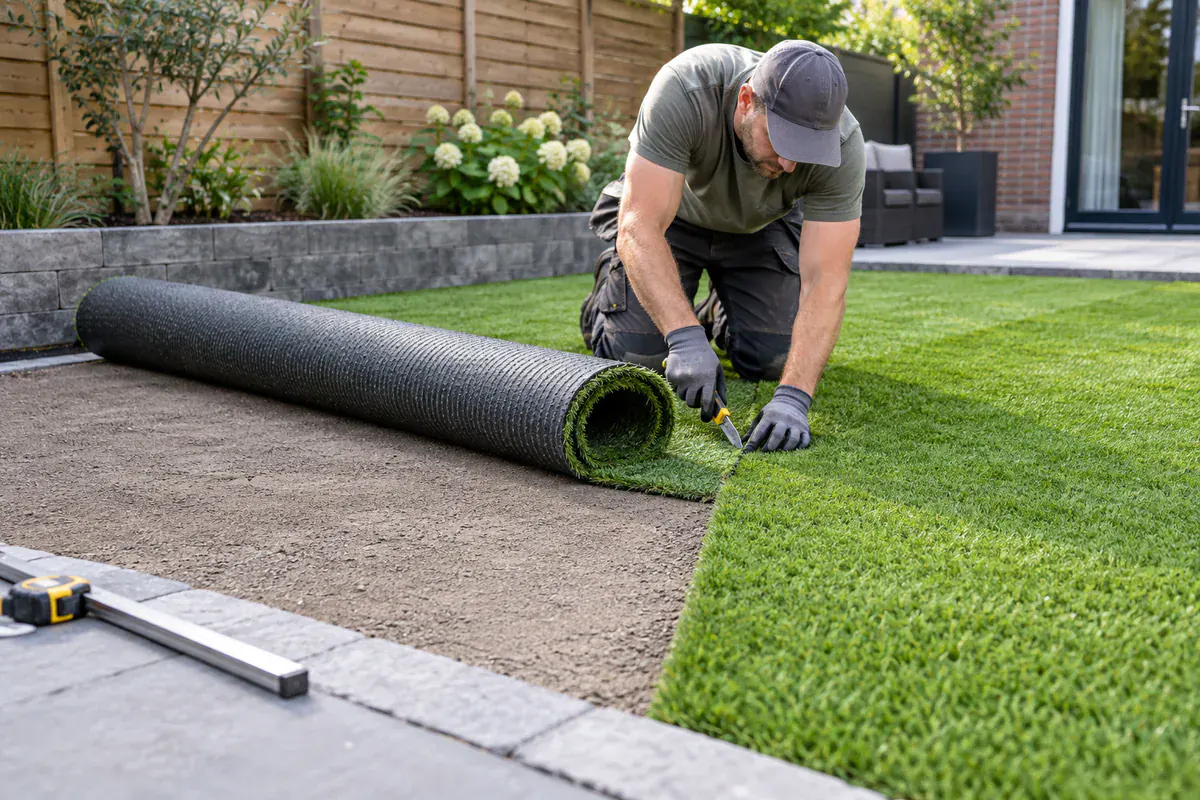
Decide whether synthetic turf fits the site
This page does not contain a verified product test or current model ranking. Before buying, define the use (pets, play, seating or appearance), measure the area, and compare complete installed-system specifications rather than roll height alone.
Ask the seller for exact fiber and backing materials, stated permeability and test conditions, UV warranty terms, infill requirements, cleaning instructions, heat limitations, seam details and end-of-life disposal. Do not assume “eco-friendly,” “maintenance-free” or “pet-safe” without evidence for the specific product and installation.
Compare turf by documented specifications
Pile height, face weight or density, yarn shape, backing and drainage are different attributes. A tall pile is not automatically more durable or realistic. Compare products only when the seller defines the measurement and provides a model-specific specification or test.
For an outdoor area, also ask how the full installed system handles runoff, heat, infill, seams and edge restraint. Request written cleaning and warranty conditions before purchase.
Use a site checklist instead of an unverified ranking
| Question | Evidence to request |
|---|---|
| Will water drain through the installation? | Permeability test, sub-base design and local drainage plan |
| Will it suit the intended traffic? | Model-specific wear or warranty information and the stated test method |
| Can it tolerate local sun and heat? | UV warranty, temperature limitations and installation orientation |
| What is the real installed cost? | Written quote including removal, sub-base, seams, infill and disposal |
No model can be called “best” without current, comparable evidence for the site and use.
Compare synthetic and living lawn tradeoffs
Synthetic turf can provide a consistent surface without mowing, but it still needs cleaning and may require repairs or replacement. It changes how a site handles heat, water, habitat and material disposal. Living turf requires region-appropriate establishment and care but can support soil and habitat when managed appropriately.
Compare the whole life cycle, local water rules, stormwater requirements, surface temperature and maintenance—not only the purchase price. FTC guidance says broad environmental-benefit claims need substantiation; see its Green Guides summary.
Plan installation with a qualified site assessment
Installation depends on the existing soil, slope, drainage, intended use and local construction rules. Before excavation, locate utilities and confirm property or HOA requirements. Ask an installer to document sub-base depth and material, compaction, runoff, seam and edge details, infill, and how repairs will be handled.
Do not use a generic step list as a substitute for site engineering or manufacturer instructions. Poor grading or drainage can create problems even when the turf itself is permeable.
Follow the exact product care instructions
Maintenance varies by product and use. Ask the manufacturer for instructions on debris removal, pet waste, cleaning products, heat exposure, infill and repair. Keep sharp tools, open flames and high heat away unless the product instructions say otherwise.
Do not describe a product as maintenance-free. Check the warranty for exclusions and retain the care document after installation.
Read product specifications with their test conditions
Request the product data sheet, warranty and test method for every measurement. Compare pile height only with the same measurement convention; check fiber material, backing, UV terms, water permeability and infill requirements. Confirm whether a test applies to the turf roll alone or to the installed assembly.
Without comparable documentation, a table of numeric specifications does not establish relative quality.
Use a written installation scope
For a professional quote, ask the installer to specify site preparation, base material, compaction, slope, drainage, edge restraint, seams, infill and waste disposal. Clarify who is responsible for locating utilities and obtaining permissions. Review manufacturer installation instructions and warranty conditions before approving the work.
One U.S. example is SYNLawn’s installation guide, which covers measurement, site preparation, seams, edges and infill; it recommends professional installation for areas over 200 sq. ft. SYNLawn’s U.S. residential warranty also conditions coverage on following its installation and maintenance guidance and excludes failures associated with improper sub-base preparation or drainage. These terms apply to SYNLawn products under that U.S. warranty, not to every turf system or market. Check the current instructions and warranty for the exact model and installation site.
Build a project-specific budget
There is no reliable installed price per square foot without current local quotes and a site assessment. Ask for separate costs for turf, removal, base preparation, drainage, seams, infill, labor, delivery and disposal. Compare warranty length and exclusions with expected maintenance and replacement costs.
Avoid projecting “lifetime savings” unless the assumptions and time period are clearly stated.
Survey drainage, shade and access before ordering
Measure the usable area in several places rather than multiplying one length by one width. Irregular lawns, curved borders, trees and posts create offcuts; roll direction also affects visible seams. Ask the supplier to show the proposed layout on a simple plan, including where each join will fall and how the pile direction will look from the house or main seating area. Keep the plan with the order so the delivered roll widths can be checked before cutting.
Record where rainwater currently travels after a heavy shower. A permeable turf backing cannot compensate for a compacted or poorly graded base, and routing runoff toward a neighbouring property can create a separate problem. Note low spots, drains, retaining walls, steps and door thresholds. If the surface borders a pool, paving or a play area, ask how the edge will be secured and whether the finished height changes access. For sloping ground, request the installer’s written approach to restraint and erosion rather than relying on a general DIY diagram.
Shade and reflected heat matter too. A wall or glazed façade can create a hotter patch than the rest of the lawn; trees can add leaf litter, sap and roots that complicate cleaning or repairs. Write down who will use the area, whether pets will relieve themselves there, how furniture will move across it and whether children will play barefoot. Those conditions should be considered against the exact product’s warranty and care sheet. Do not infer a safe surface temperature from a colour, pile height or marketing phrase.
Ask the installer to mark the roll direction and seam positions on the plan before cutting. Seams should not land where a gate, regular walking route or furniture leg will repeatedly pull at them; the maker's joining system and adhesive conditions govern the finished assembly. Include a small allowance for offcuts around curves and posts, but have the supplier calculate it from the actual roll width rather than applying an arbitrary percentage. This makes the order, quote and installation scope easier to compare.
Where the surface meets paving, a drain or a threshold, confirm the finished height and edge restraint in writing. A new base can raise the lawn and affect door clearance, steps or runoff paths. Do not cover existing drains or direct water toward a neighbouring plot. If the site has a retaining wall, steep slope, unstable subsoil or a recurring puddle, ask a qualified installer or drainage professional to assess it before choosing turf. The product data sheet cannot substitute for a design of the ground beneath it.
Compare artificial grass installation quotes line by line
Ask every installer to quote the same scope. A useful quote identifies the turf brand and model, roll width, pile and backing details, underlay or sub-base materials, excavation depth, compaction method, drainage provision, edging, seam method, infill type and quantity, disposal, labor and applicable taxes. It should also state who moves garden furniture, protects irrigation pipes and reinstates borders. Without those details, a lower total may simply omit work that another estimate includes.
Ask how variations are handled if the soil is unstable or the existing surface contains concrete, roots or buried services. Confirm the deposit, delivery responsibility, start and finish dates, workmanship warranty and the process for fixing a lifting edge or visible join. Obtain the product warranty separately and check whether the installer must be approved for it to apply. Keep a few spare offcuts and the product label after installation; they help identify the material later if a patch or warranty request is needed.
Finally, compare the proposed installation with local rules for surface water, trees and shared boundaries. A landscape professional can help where grading, drainage or retaining structures are involved. The aim of an artificial-grass installation checklist is not to make every garden use the same build-up; it is to make the assumptions visible before the existing surface is removed and covered.