

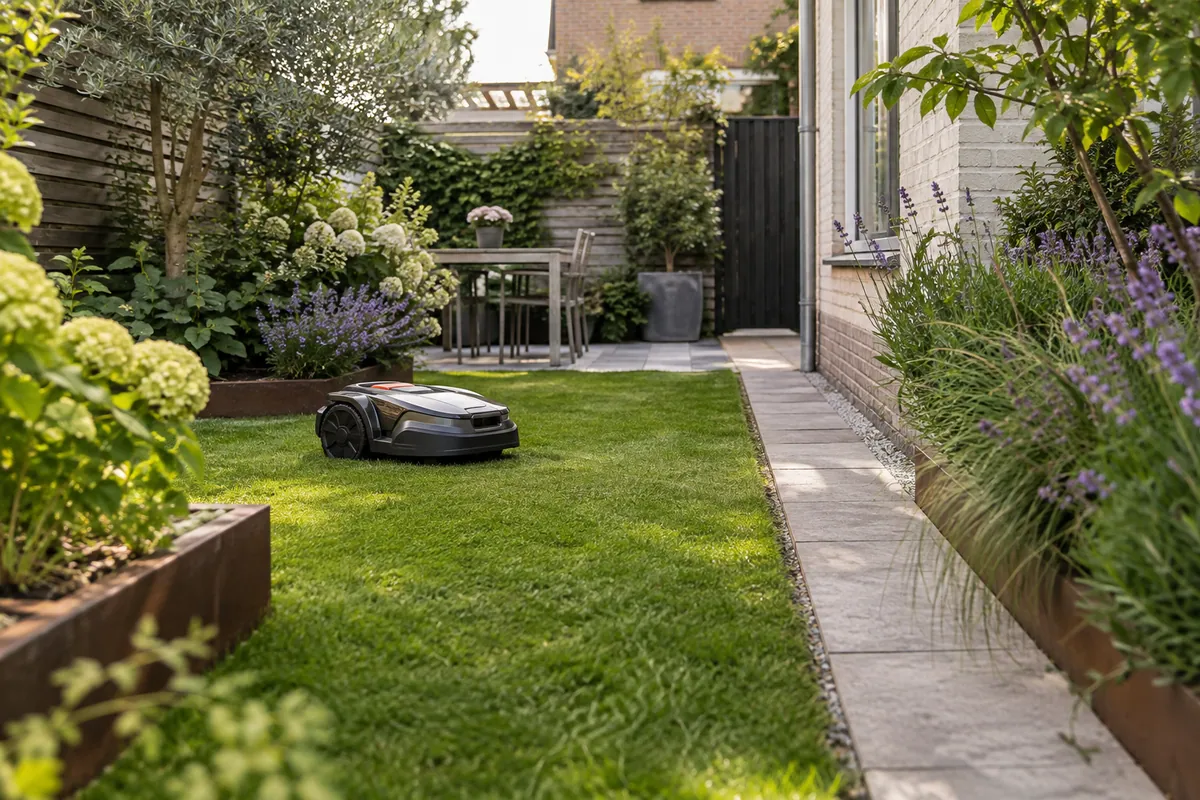
Measure the mowing area, not the property
Measure only the grass that the mower can safely access. Exclude paving, beds, ponds, play areas and steep sections that the model cannot handle. If the lawn is split into islands or separate strips, record each section and how the mower would travel between them.
Compare that map with the manufacturer’s minimum and maximum area guidance for the exact mower. The maximum number is not a guarantee of coverage for a complicated layout. The minimum can matter too: an oversized model may have a schedule and charging routine designed for a larger area. Ask the manufacturer how the product behaves on a very small patch if its documentation does not answer the question.
Check narrow passages and divided lawns
Measure gates, paths between buildings and the narrowest point between boundaries. Include turning space at each end. Some wire-based systems can use a guide wire through a passage, but the permitted width and installation method vary. Husqvarna, for example, publishes separate passage guidance for specific Automower models; those dimensions should not be treated as a standard for every robot mower.
For a lawn split by a path or patio, check whether the model supports a passage, a secondary area or a manual carry procedure. If you must lift the mower to another patch, follow the shutdown instructions and consider whether the extra work defeats the purpose of automation.
Compare wire, wire-free and charging setups
A physical boundary wire can be a straightforward fit for a simple, stable small lawn, but it requires installation around the work area and any excluded features. A wire-free system avoids that perimeter cable but may require satellite visibility, a reference station, cameras, internet or app mapping. Verify the exact requirements before deciding that a system is easier to install.
Mark the charging station on your lawn sketch. It needs the clearances and power connection in the manual and a route the mower can use to leave and return. Check that the cable can reach an outdoor outlet safely and that the station will not block a narrow path or be exposed to accidental damage.
Compare automation with a compact mower
For a very small patch, a compact walk-behind mower can take less time to use than installing, mapping and maintaining a robot. Compare the total effort, not just cutting time: boundary setup, cleaning, blade replacement, seasonal storage, software or connectivity needs, and troubleshooting all count.
A robot becomes more attractive when you value frequent automatic cutting, have a stable boundary and can place the charging station conveniently. If the lawn contains many tiny separated areas or substantial hardscape, include those interruptions in the decision rather than relying on the advertised square footage.
Run a small-garden site audit before choosing
Small lawns make installation details unusually visible: a single gate, step or narrow corridor can decide whether the mower reaches the whole grass area. Walk the garden with a tape measure and a sketch. Mark the grass perimeter, charging-station candidate, outlet, gate swing, beds, tree trunks, drains, play areas and the place where a person would carry the mower for cleaning or storage.
Next, trace the route from the station to the farthest patch and back. Record the narrowest clear width after accounting for edging, fence posts and plants that move in the wind. Measure the turning space at both ends of a corridor; the published mower width alone does not show whether it can make the turn. If a route crosses paving, note any raised lip or loose gravel and compare it with the mower’s manual.
| Site condition | Question to check | Decision signal |
|---|---|---|
| One open rectangle | Can the mower reach every edge and return to the dock? | Compare coverage and boundary setup for this area. |
| Narrow side passage | Does the exact model support the width and required guide system? | Check the manual or ask the manufacturer before buying. |
| Separate grass patches | Can a wire, mapped zone or secondary-area feature connect them? | Count manual carrying as recurring work if zones cannot connect. |
| Trees or tall walls | Will the navigation system work under cover or near the boundary? | Test coverage in shaded and signal-obstructed spots. |
| Steep or wet corner | Is the slope within the model limit on that surface? | Exclude it or choose another maintenance method if uncertain. |
Make a scale drawing or use a phone photo with dimensions written on it. Then check the installation guide for the exact model and market. For example, Husqvarna’s Automower instructions describe guide-wire arrangements for certain wire-based products and recommend different passage layouts depending on whether a guide wire is used. Those measurements are not universal specifications for every robot mower.
Finally, simulate a normal week. Ask who will empty debris, clean the mower, replace blades, move toys, supervise children and pets, and store the machine in winter. If the mower saves only a few minutes but requires repeated carrying between small sections, a compact push mower may be the simpler choice. If the lawn is connected and the station fits naturally, automation may be convenient even when the area itself is small. Choose based on the route and upkeep you can manage, rather than treating a low square-footage rating as proof of fit.
Use your sketch to estimate the installation effort too. A simple rectangular edge may be manageable as a DIY project if the instructions allow it, while several islands, a shared gate, a narrow passage and a remote station can require more careful wire or map planning. Ask for an installation quote when you cannot tell whether the route is supported. Compare that one-time cost with the time you would spend carrying and cleaning a compact mower over several seasons.
For a small lawn, finishing and edge work can take more time than the robot’s mowing cycle. Check whether the mower leaves a strip along walls or borders that still needs a trimmer, and whether its route avoids stepping stones, gravel or plant beds. Measure those edges on the site visit. A mower that maintains the center but leaves most perimeter trimming untouched may not reduce the weekly work enough to justify the setup.
Test the final plan with the furniture and gates in their normal positions, not only on an empty lawn. A chair, hose reel, children’s toy or open gate can change a tight route. Decide where such items will be stored during a mowing session and whether the boundary still keeps the mower away from a driveway, public path or water feature. If the safe route depends on remembering to move several objects every time, include that routine in the comparison.
Before ordering, confirm the mower’s minimum and maximum area range, supported passages and charging-station clearances in the same regional manual. Manufacturer pages may summarize the product differently across markets, so use the documentation that accompanies the local SKU.
Compare setup effort and recurring work
For a small lawn, one-time installation can be a larger share of the total effort than it is on a broad, open plot. Compare the entire first-season setup, then estimate the ongoing tasks for each option. A boundary-wire model may need careful perimeter placement around beds and paving. A wire-free system may avoid cable laying but can require a clear antenna position, app mapping and signal checks. A compact push mower avoids docking and navigation setup but needs to be pushed and stored after each use.
| Option | Up-front work to check | Recurring work |
|---|---|---|
| Boundary-wire robot | Cable route, joins, charging dock and exclusion zones. | Blade checks, cleaning, wire repairs and seasonal storage. |
| Wire-free robot | Signal/antenna position, digital map, dock and app setup. | Blade checks, map edits, connectivity troubleshooting and storage. |
| Compact walk-behind | Choose a mower that fits the gate and storage location. | Each mowing session, blade care and charging or fuel upkeep. |
Small gardens often have a high proportion of edging. Measure the border that will remain after automated mowing and include a string trimmer or manual edging pass in the comparison. A robot that maintains the central turf but leaves a narrow strip beside every wall may still save time, but the result depends on how much finishing work you are willing to do.
Think about the garden’s normal use, too. If children play on the grass, furniture moves frequently or the gate is often left open, the mowing schedule and access controls must fit that routine. Confirm the maker’s instructions for pausing, lifting and restarting the mower, and decide where it will be stored during a gathering or maintenance task.
Before ordering, convert the sketch into questions for the manufacturer or installer: What is the minimum supported grass area? How narrow can the passage be? Does the mower need a guide wire, a virtual-zone connection or manual carrying? What clearance does the dock require? Which edge strips will still need trimming? Recording the answers against the exact model number makes it easier to compare two systems with different maps and installation methods.
Check the complete kit and service route for your country. A bare unit may not include the power supply, antenna, wire, connectors or installation pegs shown in the product imagery. Ask what is included, whether the warranty requires approved installation, and how replacement blades and batteries can be obtained. On a small lawn, accessories and paid setup can account for a meaningful part of the total cost, even if the machine’s rated area is modest.
If possible, observe a similar model on a garden with the same access constraints. Watch how it turns at the end of a narrow passage, reaches corners and returns to its dock. A demonstration is not proof that the same model will work in your garden, but it can reveal practical questions that an area number cannot answer. Confirm those conditions with the manual and installer before purchase.
Manufacturer and safety sources
Passage dimensions and installation procedures differ by model. These references are examples for Husqvarna Automower wire installations, plus general mowing safety guidance; they are not universal specifications.
- How to create a passage in a boundary-wire installation — Husqvarna US Support
- How to lay a guide wire in a boundary-wire installation — Husqvarna US Support
- Install Automower with a physical boundary wire — Husqvarna US Support
- Mowers and mowing safety — University of Minnesota Extension
Small-garden site checklist
- Measure the mowable grass and draw every separate section.
- Measure the narrowest passage and space needed to turn.
- Record slopes, raised edges, trees, beds, drains and other obstacles.
- Choose a charging-station location that meets the manual’s requirements.
- Compare boundary wire and wire-free setup steps for the exact model.
- Check the minimum area, passage and slope guidance in the manufacturer documentation.
- Compare total setup and care with a compact walk-behind mower.