

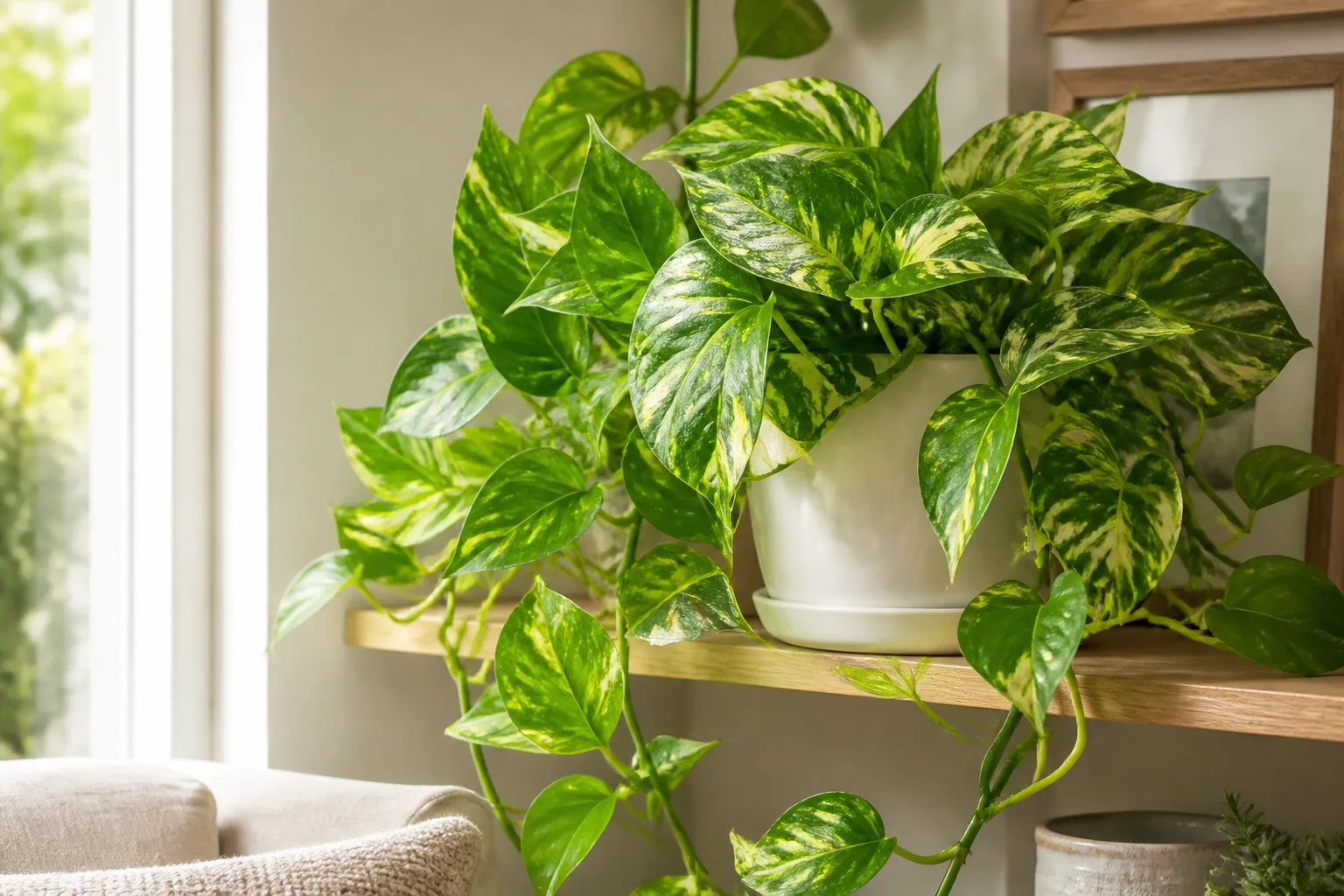
Light and variegation
Place pothos in medium to bright indirect light. It can persist in lower light, but growth slows and variegated leaves may become greener. Avoid prolonged, intense direct sun. If the vine has long bare sections, move it gradually to a brighter location and prune back to a healthy node rather than expecting leafless stems to fill in by themselves.
Water and potting mix
Use a free-draining mix and a container with drainage holes. Water when the upper mix has dried, then drain the saucer. Yellowing leaves and dark stems can follow excess moisture; very dry mix may cause droop. Check the root zone before changing fertilizer or watering habits. NC State Extension’s pothos profile notes the risk of root rot from overwatering and loss of variegation in low light.
Prune and propagate
Cut just below a node with clean scissors. A cutting that includes a node can be rooted in water or a suitable moist medium; a leaf without a node will not form a new vine. Train stems along a support if you want larger mature foliage, or let them trail from a stable shelf. Check that the support can hold the plant’s weight as it grows.
Keep it away from pets and children
Pothos contains insoluble calcium oxalates and can cause mouth irritation, drooling, vomiting, and other symptoms if chewed. Hang it where pets cannot reach dangling stems. Consult the ASPCA houseplant safety guidance or a veterinarian after a possible exposure.
Choose a growth style and train the vine
Pothos can trail from a hanging pot or shelf, or climb a support when stems are guided upward. A trailing arrangement is easy to display but should be placed where dangling stems are inaccessible to pets and young children. For a climbing form, use a stable support that can carry the plant as it matures. A support does not guarantee larger leaves; mature foliage depends on plant age, light, and growing conditions.
Variegated cultivars have patches or bands of lighter color, while more green-leaved forms often tolerate lower light better. If variegation fades, check whether the plant has been in a dim location for a long time. Move it gradually to brighter indirect light rather than placing it straight into harsh sun. Rotate the pot occasionally if growth leans strongly toward a window, but do not move the plant frequently while it is adjusting.
To make a fuller pot, prune long stems and root healthy cuttings back into the same container once they have developed roots. Cut back to a point with a node, where a leaf joins the stem; new growth can emerge from a node. Do not expect bare sections of stem to fill with leaves without a new growing point. If a vine is sparse along its length, repositioning it for better light and refreshing the planting with cuttings is more predictable than trying to force growth at every gap.
Keep shelves, hooks, and trellises securely fastened. A mature pothos can become heavy, and a falling pot can injure people or pets. Avoid placing the plant above food preparation surfaces or near heat sources. Use a removable inner pot with drainage if the display container has no holes, and empty runoff after watering.
Build a watering routine around the pot
Water pothos when the upper portion of the potting mix has dried, then water thoroughly and let the excess drain. The dry-down interval changes with pot size, light, room temperature, season, and root density. A small pot in a bright warm room may dry faster than a large pot in a cool corner. Use the mix and plant as your cue rather than copying a weekly schedule.
Check that drainage holes are open and that the pot is not sitting in water inside a decorative cachepot. If the soil is still wet several days after watering, examine the room, pot size, and medium. A heavy mix can hold water too long, while a root-bound plant may dry very quickly. Repot only when needed; increasing the pot size substantially can create a larger volume that dries slowly.
When the plant is very dry, water evenly until moisture reaches the root ball, then drain the saucer. If water rushes down the sides without soaking the center, rewet gradually in smaller passes. Avoid leaving a severely dry pot immersed for long periods unless you can monitor it, and do not let the plant remain in standing water afterward.
Feed only during active growth and according to a houseplant fertilizer label. A pothos in lower light or a cool room may grow slowly and need less input than a fast-growing vine in bright light. Yellow leaves are not proof of nutrient deficiency. Check watering, roots, pests, and changes in light before adding fertilizer.
Root a pothos cutting with a node
Choose a healthy stem with at least one visible node and use clean scissors. Make the cut below the node, keeping a leaf attached if possible. A leaf blade without a piece of node will not make a new vine. Remove any leaf that would sit below the waterline or in the propagation medium, because submerged foliage can decay.
Place the node in clean water or a lightly moist, airy propagation medium, and keep the leaf above the surface. Put the cutting in bright indirect light and check it regularly. Refresh water when it becomes cloudy; if using medium, keep it lightly moist but not saturated. Rooting speed depends on light, warmth, and the cutting itself, so avoid promising a fixed number of days.
When a cutting has established roots, transfer it carefully to a small pot with drainage and a free-draining houseplant mix. Keep the medium slightly moist during establishment, then return to the normal dry-down routine. If several rooted cuttings are added to the parent pot, place them evenly and avoid crowding the original root ball.
To propagate a longer vine, take several short cuttings rather than one long bare section. Label cultivars if you have more than one. Cuttings from a variegated plant may vary in pattern, especially if a stem has reverted to mostly green growth. Discard unhealthy cuttings and disinfect tools between plants if pests or disease are suspected.
Diagnose yellow leaves and sparse stems
| What you notice | Likely checks | What to try |
|---|---|---|
| One or two older leaves yellow | Normal leaf turnover, pot crowding, and recent changes | Remove fully yellow leaves and observe whether the pattern continues. |
| Several yellow leaves with wet mix | Overwatering, blocked drainage, or roots sitting in cachepot water | Empty standing water and inspect roots if decline persists. |
| Drooping leaves with dry mix | Dry root ball, heat, or a pot that dries quickly | Water thoroughly, drain, and monitor the next dry-down cycle. |
| Long gaps between leaves | Low light, older bare stem, or a growth habit stretched toward a window | Improve light gradually and prune or replant node-bearing cuttings. |
| Small leaves or fading variegation | Insufficient light, cultivar change, or a reverted stem | Check the plant identity and move to brighter indirect light if practical. |
Compare more than one leaf and inspect the root zone before changing care. If the mix is wet and roots are firm, allow it to dry; if roots are mushy or the pot smells sour, remove dead roots and repot into fresh medium. Do not fertilize a plant with damaged roots. For species details and overwatering risk, refer to NC State Extension’s pothos profile.
Inspect for pests and maintain a healthy plant
Check new pothos plants before placing them near an existing collection. Look under leaves and along stems for webbing, scale, mealybugs, or sticky residue. Wipe dust off leaves with a damp cloth and support each leaf as you clean. Do not use furniture polish or household cleaning products on the foliage.
If you find insects, isolate the plant and identify the pest. A rinse may remove some pests from a small plant, but it does not replace a diagnosis or a suitable treatment. Use only a product labeled for the pest and indoor ornamental plants, and follow directions for ventilation, protective equipment, and keeping pets away. Monitor new growth after treatment because eggs or hidden insects may remain.
Prune damaged or overly long stems with clean tools, and remove fallen leaves from the soil surface. Keep the plant in a spot where it can receive suitable indirect light without contacting cold glass or a heater. Pothos is toxic if chewed; its trailing stems are tempting to curious pets, so keep all parts inaccessible. If ingestion is suspected, contact a veterinarian promptly and bring the plant name or photo.
Manage a mature pothos without stripping the plant
As a pothos grows, long stems can become difficult to support and may shade leaves closer to the pot. Decide whether you want a compact tabletop plant, a trailing display, or a vine trained upward. Prune only the stems that no longer fit the arrangement, and keep enough healthy foliage for the plant to continue growing. A single severe cut can leave a sparse plant and will not guarantee that every bare section fills in.
To shape a fuller pot, shorten several stems at nodes and root the cuttings as described above. Once the cuttings have roots, plant them back around the edge of the original root ball, leaving space for each stem. Avoid crowding too many cuttings into one small pot; a dense root zone can dry unevenly and make watering harder to assess.
If you train the plant on a pole or trellis, secure the support in the pot before the vine becomes heavy. Use plant ties that hold the stem gently rather than cutting into it. Check wall anchors and hanging hooks, and keep the plant away from electrical cords and high-traffic areas. Mature vines can pull a light pot from a shelf or tug on a weak support.
Some pothos plants produce larger foliage when allowed to climb and receive suitable light, but that response depends on the plant’s maturity and growing conditions. A support alone does not guarantee giant leaves. If the plant is not thriving, verify light, roots, and watering before adding a more elaborate structure. Keep a support clean and inspect the vine for pests where leaves overlap.
When a mature plant becomes unwieldy, consider dividing or repotting only if roots fill the container or the medium has broken down. A pothos can remain in a relatively snug pot if it is otherwise healthy. Repot into fresh mix with drainage, move up modestly in size, and then monitor how quickly the new pot dries. The NC State Extension pothos profile notes its climbing and trailing habit and helps distinguish natural growth from stress.
Make pothos placement safe for the household
Choose a shelf, hanging basket, or support that keeps every stem and fallen leaf out of reach of pets and young children. A high location is not safe if a cat can jump onto the shelf or if trailing stems hang low enough to be pulled. Secure hooks and brackets to support the mature plant, and keep pots away from food preparation surfaces and aquariums.
Wear gloves if you are sensitive to plant sap and wash hands after pruning. Collect cuttings and dropped leaves immediately rather than leaving them on a table. Keep propagation jars out of reach too; water-rooted cuttings remain plant material and should not be treated as safe household décor for animals to chew.
If a pet or child may have chewed pothos, do not wait for symptoms or try to induce vomiting. Contact a veterinarian, poison-control service, or qualified medical professional and share the plant name or a photo. The ASPCA’s houseplant safety guidance provides context, while an exposure should be handled by the appropriate professional.