

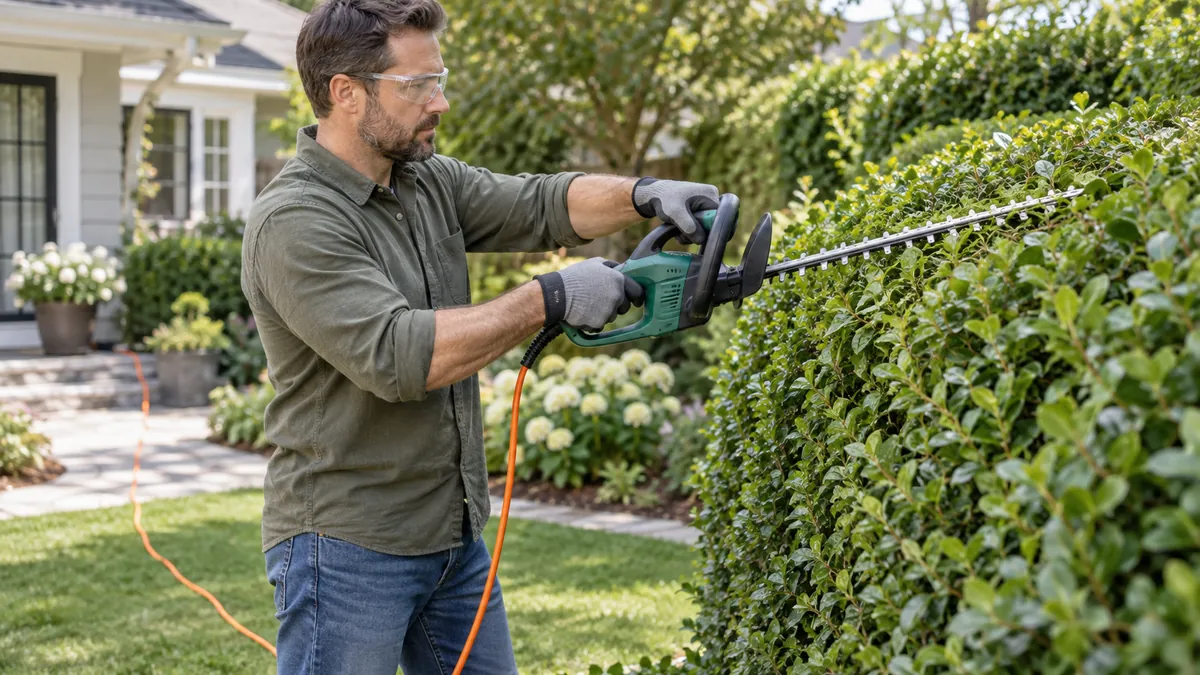
Corded or battery-powered?
Start by walking the route from the power outlet to every section of hedge. If the extension cord would need to cross a public path, pass through standing water, run where a vehicle could crush it or repeatedly enter the cutting area, a corded tool may be the wrong fit. A battery model removes that cord-management task but introduces battery runtime, charging and platform compatibility to consider.
A corded model can be practical when the hedge is close to the house, the route is clear and the work can be done from stable ground. It gives continuous power while connected, but that alone does not tell you how quickly it will cut or which branches fit between its teeth. Compare actual tool specifications and the condition of the hedge.
Specifications that help you choose
Published cutting capacity: Manufacturers state a maximum stem or branch thickness for some models. Treat it as a product-specific limit, not a promise that every branch of that diameter will cut cleanly. Older, dry or unusually dense stems may bind the blade. Use hand pruners, loppers or a pruning saw for branches outside the stated capacity rather than forcing the motor.
Blade length: A longer cutting bar can cover more hedge per pass, but reach is only helpful if you can keep the tool controlled. Shorter blades may be easier to position on small shrubs or in confined spaces. Handle shape, balance and the operator’s reach matter alongside the number of inches.
Tool weight and grip: Compare the stated weight and handle arrangement. You must keep both hands on the trimmer while operating it. If the hedge is too high or wide to reach from firm, level ground, choose a different way to manage it instead of leaning, climbing or overreaching with a running cutting tool.
Current draw and voltage: The amp rating helps identify the electrical requirements, but it is not a standard for cut quality or branch diameter. Do not use an amp comparison to infer that one trimmer is automatically more powerful or better for a particular hedge.
Two models checked against manufacturer sources
These examples show how specifications can inform a decision without establishing a “best” model. The BLACK+DECKER BEHT150 has a 17-inch dual-action blade, 3.2-amp motor, published cutting capacity up to 5/8 inch and a stated weight of 3.9 pounds. Those specifications describe a compact corded model; they do not establish how it performs on every hedge or branch type.
The Toro 51490 is listed by Toro with a 22-inch dual-action bar, a 4-amp motor, work-grip handles and a 9-pound weight. Toro’s product page gives two different cutting-capacity figures: one feature states 1/2 inch and another states 9/16 inch. Because the manufacturer page is inconsistent on this point, this guide does not use a single maximum-thickness claim for the model. Check the exact manual or ask Toro support before relying on a diameter limit.
| Published specification | BLACK+DECKER BEHT150 | Toro 51490 |
|---|---|---|
| Cutting bar | 17 inches; dual-action | 22 inches; dual-action |
| Motor | 3.2 A | 4 A |
| Weight stated by manufacturer | 3.9 lb | 9 lb |
| Cutting-capacity note | Up to 5/8 inch, per product page | Toro page conflicts: 1/2 inch and 9/16 inch |
Specifications are taken from manufacturer pages accessed 10 October 2026. Verify the exact model, manual, voltage and warranty for your market. This is a documented comparison; neither tool was physically tested for this article.
Choosing an extension cord
Use an outdoor-rated extension cord in good condition and follow the exact manual for its wire size and maximum length. A cord that is too light or too long can cause voltage drop and overheating. Toro’s 51490 manual gives a U.S. 120-volt chart for that model: 16 AWG up to 100 feet and 14 AWG at 150 feet, with a stated maximum of 150 feet. Those figures are not a universal chart for every trimmer, country or household circuit.
Before plugging in, inspect both cords and the plug for cuts or damaged insulation. Use the protection required by the manufacturer and local electrical guidance; Toro’s manual calls for GFCI protection, while the RHS garden-safety guide recommends an RCD for electric trimmers. Keep connections away from wet ground, and do not use the tool in rain or wet conditions.
Safe setup and operation
- Read the specific manual and wear eye protection, gloves, sturdy footwear and any additional protection it specifies.
- Keep children and bystanders away. Inspect the hedge and cutting area for hidden objects, wildlife, cables or fencing before starting.
- Use both hands and stand on firm, level ground. Keep a balanced stance and do not overreach or operate from an unstable ladder.
- Keep the extension cord behind the tool and outside the cutting area. Use the cord-retention feature if the model includes one.
- Release the trigger, wait for the blades to stop and unplug before clearing debris, moving the tool or servicing it.
- Fit the blade cover for storage. If the bar hits a hard object, stop and inspect it before using the trimmer again.
Match the tool to the hedge
Hedge species and growth stage influence when and how to trim. The Royal Horticultural Society notes that ideal timing varies by hedge type; it also recommends hand tools for large-leaved evergreens when powered shearing would leave unsightly cut leaves. For a formal hedge, a hedge trimmer can shape soft new growth, while larger woody branches are better handled with an appropriate pruning tool.
Check local wildlife guidance before trimming and inspect the hedge for active nests. If you find nesting activity, pause and follow the rules and advice that apply in your area. Do not assume that one calendar schedule works for every species or region.
Cleaning and maintenance
Disconnect power before cleaning, oiling or checking the cutting bar. Remove grass and debris as directed in the manual, inspect the blade, guards, plug and cord, and stop using the tool if a part is damaged. Toro’s manual instructs owners to keep the blade sharp and clean, lubricate it with the specified light machine oil and never oil the blade while the trimmer is running.
Do not disassemble or sharpen a powered trimmer unless its manufacturer provides instructions for that work. Replace worn or damaged parts with manufacturer-approved parts or use an authorized service provider.
A pre-use check for the tool and work area
Before connecting power, check that the cutting bar, hand guard, handles and trigger are secure and undamaged. Confirm that the blade cover is removed before starting and that the cord retention hook is used if the model has one. Read the warning labels and manual for the exact unit; two trimmers with similar blade lengths can still have different startup, extension-cord and maintenance requirements.
Walk the hedge line and look for wire, fencing, stones, irrigation lines and loose branches that could catch in the teeth. Remove obstacles where safe, and keep other people out of the fall zone. Plan where each cut branch will land so it does not pull the cord, fall onto a path or make you step backward while the blades are moving.
Pause if the hedge is wet, the ground is slippery, visibility is poor or the cord cannot be kept behind the tool. Unplug before moving the extension lead around a corner or through a gate. If you need to hold the trimmer above shoulder height, reach beyond a stable stance or work from a ladder, stop and choose a safer method. A long cord does not make an unsafe cutting position safe.
After the job, disconnect the plug and wait for the blade to stop before cleaning or storing the tool. Check the cable for cuts and the blade for bent teeth or damage after striking an object. Do not wrap the cord tightly around the housing unless the manual recommends that storage method; tight bends and trapped plugs can damage insulation over time.
When another tool is a better fit
Choose manual shears for a small amount of soft growth when precise control and low noise matter more than speed. A battery hedge trimmer can make sense when the cord route is unsafe or too restrictive, provided the battery system can cover the planned work and the replacement battery is available. For a large hedge with thick woody branches, neither a corded hedge trimmer nor a longer cutting bar replaces loppers, a saw or qualified help.
For work above shoulder height or beyond a stable position, stop and reassess. Do not treat a longer blade or extension cord as a way to reach from a ladder. Consider a tool specifically designed for the height, work from an appropriate stable platform only when the manual permits it, or arrange a service. If the hedge borders a public path or neighboring property, plan where cuttings and the cord will lie before starting.
Before buying, measure the hedge sections and mark the power-cord route on the ground. Check where you can place the outlet connection so that it stays dry, visible and away from the blade. If the cable would need to cross a walkway or pass behind a gate that could pinch it, compare a cordless tool or manual shears instead of relying on extra cord length to solve the problem.
For a small, regularly shaped hedge, a shorter and lighter bar may be easier to control even if it means more passes. For a longer straight face, a longer bar can cover more width at a time, but it also changes balance and reach. Hold the tool with both hands in a safe position if possible before deciding; published weight alone does not show how the trimmer will feel while cutting the top or side of a hedge.
Do not use the cutting-capacity figure as a substitute for pruning. Hedge trimmers are designed to shape suitable new growth across a surface. Cut individual thick branches with a hand pruner, lopper or pruning saw that is rated for the branch, then return to the trimmer for the fine shaping. This reduces binding and helps protect the blade and motor.