

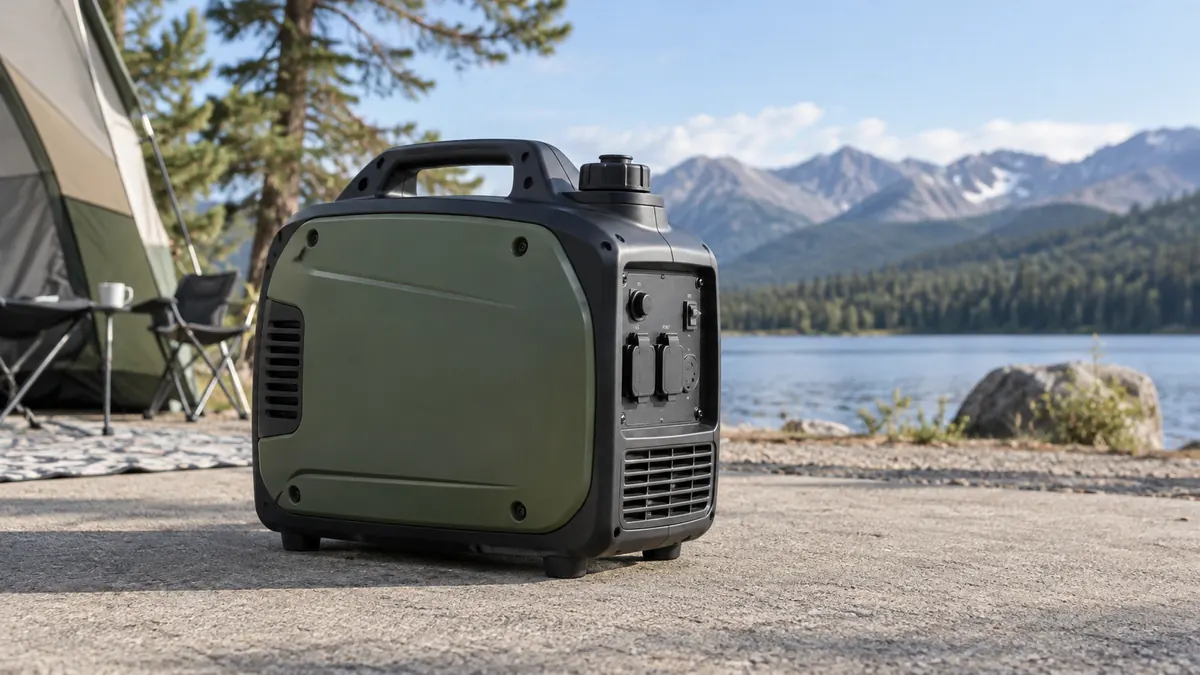
Verified MXR3500-EU specifications
The manufacturer's product table identifies the EU gasoline model separately from nearby variants. It lists a 145 cc, four-stroke OHV engine, manual recoil starting, a 4 L fuel tank and a net weight of 21 kg. The published dimensions are 48 × 29 × 44 cm. Its stated AC output is single-phase 230 V at 50 Hz, with two 230 V / 16 A sockets; the table also lists one 12 V DC outlet and two USB ports.
| Item | MXR3500-EU documentation | How to interpret it |
|---|---|---|
| Fuel and engine | Gasoline; 145 cc, four-stroke OHV | Do not apply these details to the DR dual-fuel version. |
| Output | 3,000 W continuous / 3,300 W maximum | Use continuous output for sustained loads. |
| AC standard | 230 V, 50 Hz, single phase | EU/UK-oriented specification; not a North American 120 V / 60 Hz model. |
| Outlets | 2 × 230 V / 16 A, 12 V DC, 2 USB | Each socket's label does not raise the generator's total output. |
| Fuel tank and stated runtime | 4 L; 8.3 h at 25% load, 4.5 h at 50% load | Runtime changes with load and conditions. |
| Size and weight | 48 × 29 × 44 cm; 21 kg net | Allow space for safe outdoor placement and ventilation. |
| Noise | 58 dB at 7 m, as published by the manufacturer | This is a stated figure, not an independent measurement or a guarantee at every load. |
The specifications above come from the manufacturer's EU model table and its UK product listing. They should be treated as published data, not independently measured results. The product page also lists an Eco mode and parallel capability; the parallel connection requires compatible equipment and must follow the current manual. Confirm what the seller includes in the package instead of assuming a parallel cable, oil, charging leads or other accessories are supplied.
What 3,000 W rated and 3,300 W maximum mean
For planning, the 3,000 W continuous rating is the important limit. The 3,300 W maximum figure is a short-duration ceiling; it does not mean the machine can sustain 3,300 W throughout a run. Add the loads that will operate at the same time and leave room for the temporary startup demand of motors, compressors and pumps. Check both the appliance nameplate and the generator manual when the startup current is material.
At the stated 230 V, 3,000 W corresponds to about 13 A in a simple resistive-load calculation. That helps explain why two 16 A outlets do not mean 32 A of continuous generator capacity: the total alternator output remains the limit, and outlet protection and load sharing must follow the manual. Do not use an adapter or splitter to bypass a socket's current rating.
A practical load sheet can make the decision clearer. Write down each device's running watts, startup requirement, voltage and whether it must run simultaneously with the others. A small refrigerator and lighting may fit while a high-draw heater or large compressor may not. If labels list only amps or give conflicting startup information, ask the appliance maker or an electrician rather than guessing.
Runtime, outlets and the EU electrical standard
The manufacturer's table gives up to 8.3 hours at 25% load and 4.5 hours at 50% load from the 4 L tank. These figures describe two different test conditions. They are not promises that one tank will last a full workday at any load, and they should not be compared with another generator unless the fuel, load percentage and measurement method match. Keep fuel storage, refuelling and maintenance within the manual's instructions.
The 230 V / 50 Hz specification is a regional compatibility check. It is intended for equipment designed for that electrical supply. Do not assume the generator can run a 120 V / 60 Hz appliance common in the United States or Canada. A plug adapter changes the physical connector only; it does not convert voltage or frequency. Check every appliance label and use a properly engineered transformer only when its manufacturer and a qualified professional confirm compatibility.
The listed 12 V and USB ports are useful for compatible low-voltage devices, but check their current and power limits in the manual. Do not treat a USB connector or 12 V socket as an alternative to the 230 V rating, and do not connect automotive or other batteries without the specified charging procedure.
Compare runtime figures on the same basis
Runtime comparisons are meaningful only when they use the same load percentage, fuel and test conditions. Here, the manufacturer gives both a quarter-load and half-load figure; it does not mean a tank lasts 8.3 hours at half load. In practice, a changing set of appliances changes fuel use as well. A useful plan is to identify which loads are essential, estimate how long each must run, and keep spare fuel only in an approved container stored and handled according to local rules. Do not refuel a hot or running generator.
Read the noise and parallel claims carefully
The manufacturer lists 58 dB at 7 m, but that distance is part of the claim. It is not an independent sound test, a guarantee at a neighbour's property or a statement that the generator can be used indoors. The location, reflective walls, load and surrounding ambient sound affect what people hear. Eco mode may adjust engine speed with demand, but this does not remove the published power limit or make exhaust safe near an occupied area.
The manufacturer also lists parallel capability. Treat that as a feature to confirm in the current manual, not permission to connect two generators with improvised wiring. If the manual permits parallel use, verify the compatible kit, the combined continuous rating and socket limits, and that the connected appliances remain within those limits. Parallel output still does not make an unsafe house connection acceptable.
MXR3500-EU versus MXR3500-DR-EU
MaXpeedingRods' product table lists the MXR3500-EU as gasoline-only. It separately lists the MXR3500-DR-EU for gasoline and LPG. The DR model has different output figures, a larger tank and a different starting package. A listing headline that only says “MXR3500” or “3,500 W” does not establish which version is being sold.
Before relying on any retailer listing, compare the complete model code on the product label, the manual cover, fuel connectors and the specification table. A photo of a generator body may be shared across marketplace listings and is not enough to identify the model. Do not infer LPG capability from a fuel hose in an unrelated image or from an abbreviated title.
We removed the Amazon.es ASIN B0B1QFL177 from the Spanish counterpart on 10 October 2026 because the listing details did not identify the model as MXR3500, even though some advertised output figures resembled the EU specification. Without exact model identity, it is not a verified offer for this guide. This page therefore contains no Amazon recommendation or purchase box.
Suitable loads and practical limits
A portable inverter in this output class can suit planned, intermittent loads such as lighting, device charging and selected small tools, if their total demand and starting surge remain within the documented limits. The word “inverter” alone does not prove that every sensitive appliance is compatible; follow the equipment makers' requirements and the generator manual.
It is not a whole-house solution by default. It cannot run loads whose combined continuous demand exceeds 3,000 W, and the maximum figure is not spare capacity for continuous use. High-starting loads can also trip protection or prevent startup even when their running watts seem modest. For a refrigerator, pump or power tool, check the actual startup requirement instead of relying on a broad product-category estimate.
At 21 kg net, the listed mass may make it easier to move than a large open-frame generator, but it is still a fuel-powered engine with hot parts, exhaust and lifting constraints. Plan where it will sit before moving it. Do not run it in a caravan, tent, shed, garage, basement or other partly enclosed place.
Outdoor placement and electrical safety
The CDC advises operating portable generators outdoors, more than 20 feet from doors, windows and vents, with exhaust directed away from buildings. Never run one indoors or in a garage, even with the door open. Carbon monoxide is colourless and odourless; keep working CO alarms in the home and follow the current generator manual for placement and emergency procedures.
Place the generator on a stable, dry surface and protect it from rain without enclosing it or restricting airflow. The manual should determine grounding, extension-cord capacity, load connection, refuelling and maintenance procedures. Switch off and cool the equipment before refuelling, and store gasoline in an approved container away from living spaces and ignition sources.
Never connect the generator to a wall socket to energize house wiring. That can send power back through the grid and endanger utility workers. A qualified electrician should select and install suitable transfer equipment and confirm earthing, circuit protection and the loads the generator can support.
A checklist for checking a listing
- Read the complete model code. Confirm that it says MXR3500-EU, rather than MXR3500-DR-EU or an unspecified MXR3500.
- Match fuel and output. Look for gasoline-only operation, 3,000 W continuous and 3,300 W maximum for this EU version.
- Check the supply standard. Confirm 230 V / 50 Hz and the receptacles needed by your equipment.
- Compare the manual and package list. Check starter type, tank, outlets, accessories, maintenance and warranty region.
- Plan the load. Sum simultaneous running demand and check motor startup requirements against the manual.
- Plan safe placement and connection. Use it outdoors and consult an electrician before connecting selected circuits at home.