

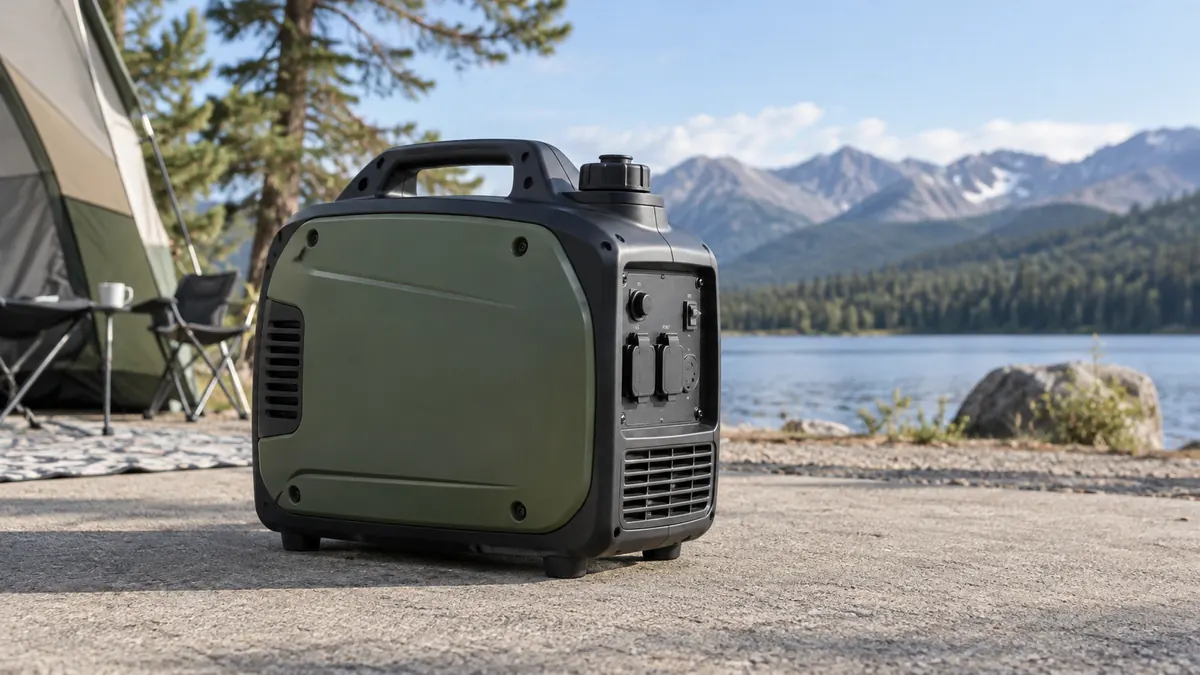
HY4500SEi specifications from Hyundai Power Products UK
The official product listing gives the following figures. They identify one marketed version of the HY4500SEi; check the plate and matching manual on the unit you are considering, especially if it is imported or sold under another regional package.
| Specification | UK product listing |
|---|---|
| Fuel and generator type | Petrol, portable inverter, single-phase |
| Continuous / maximum output | 3.8 kW / 4.0 kW |
| Voltage and frequency | 230 V, 50 Hz |
| AC outlets | Two 230 V sockets for UK 13 A mains plugs |
| DC outlet | 12 V battery-charging outlet |
| Engine and fuel tank | 223 cc, 4-stroke petrol engine; 9 L tank |
| Starting and control | Electric and recoil start; remote keys, LCD, ECO mode |
| Weight | 47 kg net and 49 kg gross in the specification table; the description rounds it to about 50 kg |
Hyundai's product description calls the engine a HY225E, while its specification table lists MT230. Both identify a 223 cc engine, but the labels differ on the same page. For parts, maintenance or a warranty claim, use the engine and serial information on the physical unit and its matching manual rather than choosing one label from a retailer title.
Match the 3.8 kW rating to the two UK outlets
Use 3.8 kW as the published continuous limit for a sustained load; 4.0 kW is the maximum figure, not a continuous allowance. The listing gives 16.52 A continuous and 17.4 A maximum. Its two 230 V AC sockets are for UK 13 A mains plugs, so the generator's total output is not available from a single socket. A load must stay within both the overall generator rating and the limit for the outlet and its protection.
The manufacturer describes digital inverter output and calls it a pure sine wave. The listing does not give a total harmonic distortion test value or its measurement conditions. For a sensitive appliance, check the appliance maker's requirements and request the exact output data for the unit's revision; the word “inverter” alone does not prove compatibility with every device.
Read the published runtime and noise conditions
The specification table states up to 6 hours at 50% load and 59 dB(A) at 7 m. Those are conditional manufacturer figures, not a promise for every load or installation. The same table gives fuel consumption of 1.46 L/hour at 50% load and 3.16 L/hour at 100% load; ambient conditions, fuel, maintenance and the actual equipment connected affect the result. Compare noise only when distance and load are similar, and do not treat a sound-pressure figure at 7 m as the level beside the generator.
The 9 L tank helps estimate refuelling frequency, but runtime changes with electrical demand and operating conditions. If an outage plan depends on overnight operation, calculate fuel needs from the intended load and confirm safe storage and refuelling requirements in the manual.
Confirm the regional version, engine label and kit
The listed 230 V / 50 Hz output and UK 13 A sockets are the central compatibility checks. They do not match the nominal 120/240 V, 60 Hz system commonly used in North America. A plug adapter cannot change voltage, frequency, circuit protection or certification. Before buying an imported unit, confirm the target market, approved uses, local service and replacement-part support with Hyundai or the seller.
Hyundai's UK product page lists a closed case, wheels, remote and recoil starting, two remote keys, two manual-start keys and a 12 V charging cable. It also states a three-year domestic and one-year commercial warranty subject to terms; this UK offer does not establish warranty coverage elsewhere. The page was marked sold out when checked on 10 October 2026, and no exact active Amazon.com offer for this configuration was verified. Price and availability are therefore omitted.
Where this leisure generator fits
Hyundai Power Products presents the HY4500SEi for caravans, motorhomes, camping and a garden workshop. It describes ECO mode as reducing engine speed to follow demand. The same distributor classifies leisure generators for holidays or standby use and says this model is not intended for continuous daily use or off-grid supply. That makes the advertised 3.8 kW figure only one part of the decision: consider duty cycle, refuelling access, ventilation, storage, local support and whether the listed UK sockets match your equipment.
The enclosure and inverter format do not make the generator weatherproof or suitable for use inside a vehicle, tent, shed or garage. Follow the exact manual's placement and ventilation instructions regardless of the intended leisure setting.
Check loads before connecting equipment
- List the appliances that must run at the same time and record their voltage and running demand.
- Check the startup requirement for motors, compressors and air-conditioning units; use the equipment manual or ask its manufacturer if the label is incomplete.
- Keep the combined sustained load within 3.8 kW and each device within its socket's rating.
- Check that plug type, voltage, frequency and protective devices match the particular HY4500SEi panel.
- For fixed wiring or home circuits, ask a qualified electrician to design a compliant transfer arrangement.
Do not infer that a 4.0 kW maximum rating can start any appliance with a large surge; the appliance's starting demand and the generator's exact conditions both matter. This guide does not establish that one unit can support a specific caravan, workshop or home without checking its individual loads.
Build a load plan for the UK outlet panel
The HY4500SEi's published 3.8 kW continuous figure describes the generator's overall output, while the listing identifies two 230 V sockets for UK 13 A plugs. Do not assume the full generator rating is available from one socket, or that the two sockets can be combined to serve a single appliance. Check the manual's circuit and outlet limits for the exact panel, then connect each device only through a suitable plug and protective arrangement.
A useful plan separates what must run continuously from equipment that can be used one item at a time. For a caravan, for example, list the appliances that may be on together and separately record any device with a motor or compressor. Read each nameplate and manual for voltage, operating demand and startup requirement. Compare those values against the generator's 3.8 kW continuous rating and the socket limits, then decide which non-essential load must be switched off before starting another appliance. This avoids treating the 4.0 kW maximum as normal running capacity.
- Confirm the full HY4500SEi model and UK panel from the rating plate and manual.
- List each appliance, its plug, voltage and running demand; note the separate startup demand for motors.
- Mark which appliances share a socket or circuit and keep within the manual's outlet and protection limits.
- Remove or sequence loads that would exceed the continuous rating or cause a startup demand the manufacturer has not confirmed.
- Ask Hyundai or a qualified electrician about a fixed or caravan connection if the neutral, earthing or transfer arrangement is not clear.
The listing's UK warranty and package details do not establish support for an imported generator. Before purchasing across borders, obtain confirmation of the manual revision, replacement-part supply, service route and warranty territory in writing. A plug adapter changes plug shape only; it does not convert the generator's voltage, frequency or electrical approval. This distinction matters even when an appliance appears to fit the socket.
Transport and placement are part of the fit check too. Hyundai's specification table lists 47 kg net and 49 kg gross; its product page includes wheels and describes a closed case. Confirm the shipping weight, accessories and handling instructions for the exact package, and decide where the unit can be stored and operated before it arrives. A closed housing does not establish that the generator is weatherproof or safe to use indoors, inside a vehicle, or in an enclosed leisure space.
Before departure or a planned outage, keep the correct manual with the unit, confirm the oil and fuel procedure, inspect the casing and outlets, and make sure the intended leads and loads fit the documented UK panel. If the listing does not show the model plate or the warranty terms for your country, ask the seller for those details. This is especially important for imports: the same model name does not prove that the supplied sockets, engine label, emissions documentation or service support match the UK guide.
Carbon-monoxide and electrical safety
CDC says to operate portable generators outdoors, more than 20 feet from windows, doors and vents, never inside a home or garage, and to use a battery-powered or battery-backup CO detector in the home. A caravan, shed, tent or partly open garage is not a safe operating location. Position the exhaust away from buildings and people.
Follow the manual for grounding, refuelling, oil, maintenance and weather exposure. Stop the engine and let it cool before refuelling. Never connect a generator to a wall socket or building circuit with an improvised cord; any connection to fixed circuits needs correctly installed transfer equipment and a qualified electrician.
For related guidance, see our inverter generator guide and the gasoline generator hub. Compare models using the voltage, frequency, outlet type, continuous rating and service market that match your actual use.